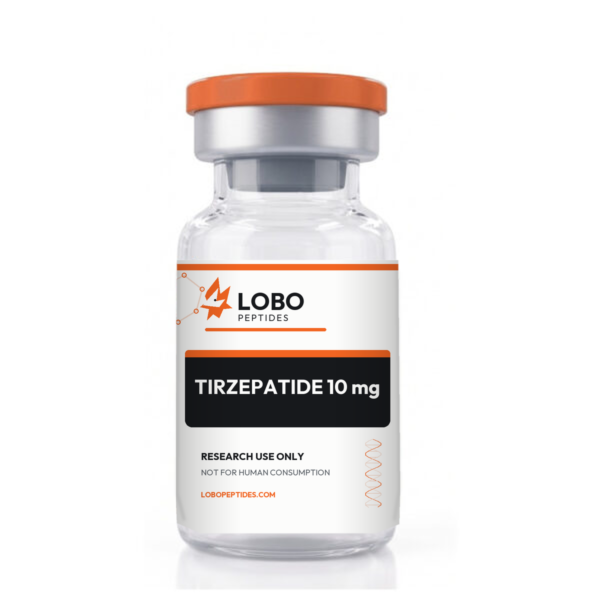
Tirzepatide 10mg*10vials
Tirzepatide, also identified in primary research as LY3298176, is supplied as ten vials labeled 10 mg each. It is a fatty-acid-modified peptide studied in GIP- and GLP-1-receptor systems. For research use only (RUO); not for human or veterinary use.
Out of stock
Tirzepatide Product Description
Tirzepatide, identified in discovery literature as LY3298176, is a fatty-acid-modified peptide studied at GIP and GLP-1 receptors. This listing preserves the supplied format of ten vials labeled 10 mg each. The resulting 100 mg nominal label total is not an assay result and does not establish actual content, modification state, counterion, excipients, or lot identity.
The dual-receptor description should remain assay-qualified. Activity at two receptor systems does not mean that every pathway is engaged equally, and later mechanistic work examined occupancy and pathway-dependent signaling differences. Tirzepatide is not semaglutide, native GIP, native GLP-1, or a blend of separate receptor ligands. Molecule-specific controls and exact nomenclature are needed for interpretable research.
Discovery work used recombinant and endogenous receptor cell systems, mouse models, and an early controlled human study with pharmacokinetic and biomarker observations. A later paper compared signaling at GIP and GLP-1 receptors with occupancy calculations and pathway assays. These sources support identity and model-qualified mechanism context; they do not verify this ten-vial pack or establish finished-product equivalence.
This RUO page is limited to receptor pharmacology, assay architecture, and evidence boundaries. Any new study would require independent confirmation of the test material and methods appropriate to the question. Identity, content, purity, sterility, endotoxin status, aggregation, and stability for these vials remain unresolved pending lot-specific documentation. The catalog identity and the literature identity are recorded as separate evidence layers so that future documentation can resolve open attributes without rewriting the scientific history or overstating what the current source set demonstrates within defined research boundaries.
Research Material Profile
Tirzepatide Research
Discovery across receptor systems
Discovery research characterized LY3298176 in recombinant and endogenous GIP- and GLP-1-receptor cell systems. Using more than one cellular context is informative because receptor abundance, coupling machinery, and assay readout can change apparent pharmacology. The work supports the description of tirzepatide as a dual-receptor research molecule while keeping each measurement tied to its system. It does not establish that all signaling pathways respond identically, and it does not verify the identity or activity of this commercial lot. The publication’s studied material and the Lobo ten-vial pack are separate evidentiary objects. For this RUO listing, the paper supports molecule-specific identity and examples of receptor-assay design. It provides no analytical result for the labeled 10 mg vials and no basis for treating them as a finished pharmaceutical product. (PubMed 30473097).
Mouse and controlled human research contexts
The discovery paper also reported mouse experiments and an early controlled human study that included pharmacokinetic and biomarker observations. These layers answer different questions: mouse models provide species-specific integrated observations, while controlled participant research characterizes the studied preparation under defined eligibility criteria, sampling, and analytical methods. Neither context can establish lot identity, formulation, content, or quality for this listing. The human study is described neutrally as a controlled research setting, not as a recommendation or commercial performance claim. Protocol amounts and operational details are intentionally omitted. Assay calibration, sampling intervals, and comparator selection would all need explicit reporting in any attempted replication. Read alongside the cell assays, the work illustrates a staged research program from receptor systems to whole-organism and participant measurements, with model boundaries retained at every step. (PubMed 32730231).
Pathway-resolved signaling study
A later mechanistic study compared tirzepatide signaling at GIP and GLP-1 receptors using receptor-occupancy calculations and cell-based pathway assays. The authors described imbalanced and pathway-biased agonism within those experimental systems. Such terms are assay-dependent: conclusions can vary with receptor expression, pathway readout, kinetic window, reference ligand, and analytical model. The paper therefore supports a nuanced research question about signaling architecture rather than a general outcome claim. It does not verify the modification state, content, purity, or performance of these ten vials. Together with the discovery paper, it reinforces the need to report receptor, pathway, cell background, and comparator explicitly. This RUO page keeps the evidence at that mechanistic level, requires model-specific interpretation, and offers no human or veterinary use guidance. (PubMed 30473097 · PubMed 32730231).
Evidence Boundaries
The cited literature supports only the identity and model-qualified research contexts summarized above for Tirzepatide. The label statement “10 mg per vial, 10 vials” is preserved as supplied and is not treated as an analytical measurement. Study findings remain bounded by the reported biochemical assay, cell system, animal species, or controlled participant protocol. Lot-specific identity, content, purity, sterility, endotoxin status, stability, and other unreported specifications remain unknown unless separately documented. No procedural, operational, or outcome guidance is provided.
Tirzepatide References
8 curated medical and scientific references used for identity, mechanism, model, and assay context.
- LY3298176, a novel dual GIP and GLP-1 receptor agonist for the treatment of type 2 diabetes mellitus: From discovery to clinical proof of concept.
Tamer Coskun, Kyle W Sloop, Corina Loghin et al.. Molecular metabolism. 2018.
exact identity · Recombinant/endogenous receptor cell systems, mouse models, and early controlled human research
View research source - Tirzepatide is an imbalanced and biased dual GIP and GLP-1 receptor agonist.
Francis S Willard, Jonathan D Douros, Maria Bn Gabe et al.. JCI insight. 2020.
exact identity · Cell-based receptor occupancy and pathway-resolved signaling assays
View research source - Tirzepatide Once Weekly for the Treatment of Obesity.
Ania M Jastreboff, Louis J Aronne, Nadia N Ahmad et al.. The New England journal of medicine. 2022.
exact identity · Randomized controlled phase 3 human trial in adults with obesity
View research source - Tirzepatide modulates the regulation of adipocyte nutrient metabolism through long-acting activation of the GIP receptor.
Ajit Regmi, Eitaro Aihara, Michael E Christe et al.. Cell metabolism. 2024.
exact identity · Adipocyte and metabolic mechanistic experiments
View research source - Tirzepatide for Heart Failure with Preserved Ejection Fraction and Obesity.
Milton Packer, Michael R Zile, Christopher M Kramer et al.. The New England journal of medicine. 2025.
exact identity · Randomized controlled human trial in obesity-related heart failure with preserved ejection fraction
View research source - Tirzepatide for Metabolic Dysfunction-Associated Steatohepatitis with Liver Fibrosis.
Rohit Loomba, Mark L Hartman, Eric J Lawitz et al.. The New England journal of medicine. 2024.
exact identity · Randomized phase 2 human trial with liver-biopsy endpoints
View research source - Tirzepatide for the Treatment of Obstructive Sleep Apnea and Obesity.
Atul Malhotra, Ronald R Grunstein, Ingo Fietze et al.. The New England journal of medicine. 2024.
exact identity · Two randomized controlled human trials in obstructive sleep apnea and obesity
View research source - Tirzepatide as Compared with Semaglutide for the Treatment of Obesity.
Louis J Aronne, Deborah Bade Horn, Carel W le Roux et al.. The New England journal of medicine. 2025.
exact identity · Randomized head-to-head human trial
View research source