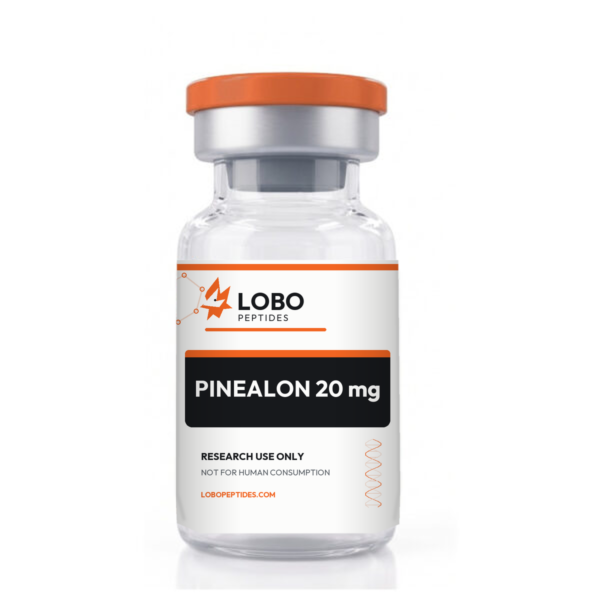
Pinealon 20mg
Pinealon 20mg is presented as Pinealon, Glu-Asp-Arg (EDR), with 20 mg nominal catalog strength. Distinct from tissue extracts, multi-peptide preparations, longer peptides, and other short peptide bioregulators. The amount is nominal pending lot-specific documentation. For research use only (RUO); not for human or veterinary use.
Out of stock
Pinealon 20mg Product Description
Pinealon 20mg is presented as Pinealon, Glu-Asp-Arg (EDR). The displayed inventory statement is 20 mg nominal catalog strength. This is a catalog description of intended identity and nominal quantity, not a report of independently measured composition. Terminal chemistry, counterion, physical form, purity, and assayed content remain unconfirmed. Until a lot-specific record is available, the listing should be read as an identification framework for qualified laboratory review rather than as an analytical certificate.
The principal boundary for this entry is straightforward: Distinct from tissue extracts, multi-peptide preparations, longer peptides, and other short peptide bioregulators. Close names can conceal meaningful differences in sequence, terminal groups, coordination state, labeling, oxidation state, or presentation. Those differences can affect assay design and interpretation, so adjacent compounds are not treated as substitutes. The product title is preserved exactly, and any ambiguity is made visible instead of being resolved through assumptions.
This material is offered for research use only (RUO) and is not for human or veterinary use. The page does not provide directions for preparation, administration, dosing, or consumer use. Appropriate experimental planning requires independent review of the selected model, controls, analytical methods, and the eventual lot documentation. Literature summarized below describes named study reagents under particular conditions; it is not evidence that this catalog unit reproduces those findings.
Its seller-specific statements about form, testing, composition, availability, or performance are not transferred to Lobo. This original text is organized around the Lobo specification, primary literature, and a conservative separation between published evidence and unverified product attributes.
Research Material Profile
Pinealon 20mg Research
Cultured-cell redox measurements
A cultured-cell study measured free-radical-related and viability-associated endpoints after exposure to EDR. Those observations belong to the selected cell system, assay methods, and exposure conditions. They do not establish organism-level performance and do not verify the composition of this 20 mg catalog unit. The paper supports a neutral description of Pinealon as a short peptide used in cell-based experiments that quantify redox and proliferation-associated variables. It does not support a broad claim about neural function or any human outcome. Because three-residue peptides can differ by sequence order and terminal chemistry, the source also reinforces the need to preserve the exact Glu-Asp-Arg identity. Interpretation therefore requires the source’s exact reagent definition, controls, comparators, reported endpoint, sampling framework, and analytical limitations before drawing narrow, model-bound conclusions from the reported experimental observations. (PubMed 21978084).
Localization and nucleic-acid assays
Fluorescence-labeled short-peptide experiments in HeLa cells examined intracellular localization, while separate in-vitro work evaluated interactions with deoxyribooligonucleotides and DNA. A labeled research probe may not behave identically to an unlabeled catalog material, and binding in a simplified assay does not establish a physiological result. The publication is relevant as mechanistic context for EDR and related short peptides, but its findings remain attached to the labeled constructs, cultured cells, and test conditions. It supplies no lot-specific evidence for sequence, terminal state, purity, or amount. This page therefore presents the study as an example of assay design rather than a product promise. Interpretation therefore requires the source’s exact reagent definition, controls, comparators, reported endpoint, sampling framework, and analytical limitations before drawing narrow, model-bound conclusions from the reported experimental observations. (PubMed 22117547).
Rat prenatal model and isolated neurons
A prenatal hyperhomocysteinemia rat study and associated isolated-neuron experiments evaluated EDR within an animal-model research program. Species, prenatal model construction, comparator groups, and laboratory endpoints bound any interpretation. These data do not establish an effect in people and cannot be used to characterize an untested catalog lot. The paper is included because it directly concerns Pinealon/EDR and adds animal and ex-vivo context distinct from the other cell studies. It does not justify statements about memory, intelligence, mental performance, or consumer use. The only product-level facts asserted here are the intended sequence designation and nominal catalog strength, both subject to analytical confirmation. Interpretation therefore requires the source’s exact reagent definition, controls, comparators, reported endpoint, sampling framework, and analytical limitations before drawing narrow, model-bound conclusions from the reported experimental observations. (PubMed 22567179).
Evidence Boundaries
The evidence set describes published experiments with defined study materials; it does not constitute analytical evidence for Pinealon 20mg. The product-level uncertainties remain: Terminal chemistry, counterion, physical form, purity, and assayed content remain unconfirmed. The listed quantity is nominal, and no unreported identity, purity, content, sterility, endotoxin, residual-solvent, or microbiological result should be inferred. Distinct from tissue extracts, multi-peptide preparations, longer peptides, and other short peptide bioregulators. Cell, biochemical, ex-vivo, animal, insect, or precursor studies are labeled as such and cannot be generalized across models. Source titles may describe the authors’ chosen endpoints, but this page does not convert them into commercial promises. No preparation, dosing, administration, or human-use conclusion is supplied.
Pinealon 20mg References
8 curated medical and scientific references used for identity, mechanism, model, and assay context.
- Pinealon increases cell viability by suppression of free radical levels and activating proliferative processes.
Khavinson V et al. Pinealon increases cell viability by suppression of free radical levels and activating proliferative processes. Rejuvenation Res (2011). PMID 21978084. DOI: 10.1089/rej.2011.1172.
Direct or closely adjacent Pinealon/EDR literature, bounded to the exact peptide, labeling state, and model reported. · Cultured-cell oxidative-stress, free-radical, viability, and proliferation readouts.
View research source - Penetration of short fluorescence-labeled peptides into the nucleus in HeLa cells and in vitro specific interaction of the peptides with deoxyribooligonucleotides and DNA.
Fedoreyeva LI et al. Penetration of short fluorescence-labeled peptides into the nucleus in HeLa cells and in vitro specific interaction of the peptides with deoxyribooligonucleotides and DNA. Biochemistry (Mosc) (2011). PMID 22117547. DOI: 10.1134/S0006297911110022.
Direct or closely adjacent Pinealon/EDR literature, bounded to the exact peptide, labeling state, and model reported. · Fluorescently labeled short peptides in HeLa cells plus in-vitro DNA/deoxyribooligonucleotide binding assays.
View research source - Pinealon protects the rat offspring from prenatal hyperhomocysteinemia.
Arutjunyan A et al. Pinealon protects the rat offspring from prenatal hyperhomocysteinemia. Int J Clin Exp Med (2012). PMID 22567179.
Direct or closely adjacent Pinealon/EDR literature, bounded to the exact peptide, labeling state, and model reported. · Prenatal hyperhomocysteinemia rat model and isolated-neuron readouts.
View research source - Role of Mono- and Divalent Ions in Peptide Glu-Asp-Arg-DNA Interaction.
Silanteva IA et al. Role of Mono- and Divalent Ions in Peptide Glu-Asp-Arg-DNA Interaction. J Phys Chem B (2019). PMID 30762356. DOI: 10.1021/acs.jpcb.8b10359.
Direct or closely adjacent Pinealon/EDR literature, bounded to the exact peptide, labeling state, and model reported. · In-vitro Glu-Asp-Arg–DNA interaction assays under mono- and divalent-ion conditions.
View research source - EDR Peptide: Possible Mechanism of Gene Expression and Protein Synthesis Regulation Involved in the Pathogenesis of Alzheimer's Disease.
Khavinson V et al. EDR Peptide: Possible Mechanism of Gene Expression and Protein Synthesis Regulation Involved in the Pathogenesis of Alzheimer's Disease. Molecules (2020). PMID 33396470. DOI: 10.3390/molecules26010159.
Direct or closely adjacent Pinealon/EDR literature, bounded to the exact peptide, labeling state, and model reported. · Cell-based EDR gene-expression and protein-synthesis assays relevant to Alzheimer-related pathways.
View research source - [Regulation of content of cytokines in blood serum and of caspase-3 activity in brains of old rats in model of sharp hypoxic hypoxia with Cortexin and Pinealon].
Mendzheritskiĭ AM et al. [Regulation of content of cytokines in blood serum and of caspase-3 activity in brains of old rats in model of sharp hypoxic hypoxia with Cortexin and Pinealon]. Adv Gerontol (2014). PMID 25051764.
Direct or closely adjacent Pinealon/EDR literature, bounded to the exact peptide, labeling state, and model reported. · Old rats under acute hypoxic hypoxia; serum cytokines and brain caspase-3 measured, with Cortexin also studied.
View research source - [Pinealon and Cortexin influence on behavior and neurochemical processes in 18-month aged rats within hypoxia and hypothermia].
Mendzheritsky AM et al. [Pinealon and Cortexin influence on behavior and neurochemical processes in 18-month aged rats within hypoxia and hypothermia]. Adv Gerontol (2015). PMID 28509493.
Direct or closely adjacent Pinealon/EDR literature, bounded to the exact peptide, labeling state, and model reported. · Eighteen-month-old rats under hypoxia/hypothermia with behavioral and neurochemical endpoints; Cortexin also studied.
View research source - Short Peptides Protect Fibroblast-Derived Induced Neurons from Age-Related Changes.
Kraskovskaya N et al. Short Peptides Protect Fibroblast-Derived Induced Neurons from Age-Related Changes. Int J Mol Sci (2024). PMID 39518916. DOI: 10.3390/ijms252111363.
Direct or closely adjacent Pinealon/EDR literature, bounded to the exact peptide, labeling state, and model reported. · Fibroblast-derived induced neurons assessed for age-related cellular changes.
View research source