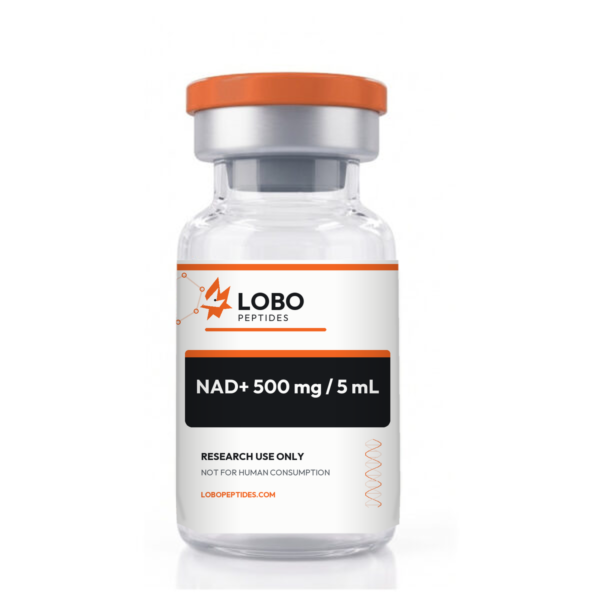
NAD+ 500mg / 5mL
NAD+ 500mg/5mL is presented as NAD+, oxidized nicotinamide adenine dinucleotide, with Nominal total amount 500 mg in 5 mL. A small-molecule coenzyme, not a peptide; distinct from NADH and precursors such as nicotinamide riboside or nicotinamide mononucleotide. The amount is nominal pending lot-specific documentation. For research use only (RUO); not for human or veterinary use.
Out of stock
NAD+ 500mg/5mL Product Description
NAD+ 500mg/5mL is presented as NAD+, oxidized nicotinamide adenine dinucleotide. The displayed inventory statement is Nominal total amount 500 mg in 5 mL. This is a catalog description of intended identity and nominal quantity, not a report of independently measured composition. Salt, counterion, solvent composition, measured concentration, redox composition, sterility, and assayed content are unconfirmed. Until a lot-specific record is available, the listing should be read as an identification framework for qualified laboratory review rather than as an analytical certificate.
The principal boundary for this entry is straightforward: A small-molecule coenzyme, not a peptide; distinct from NADH and precursors such as nicotinamide riboside or nicotinamide mononucleotide. Close names can conceal meaningful differences in sequence, terminal groups, coordination state, labeling, oxidation state, or presentation. Those differences can affect assay design and interpretation, so adjacent compounds are not treated as substitutes. The product title is preserved exactly, and any ambiguity is made visible instead of being resolved through assumptions.
This material is offered for research use only (RUO) and is not for human or veterinary use. The page does not provide directions for preparation, administration, dosing, or consumer use. Appropriate experimental planning requires independent review of the selected model, controls, analytical methods, and the eventual lot documentation. Literature summarized below describes named study reagents under particular conditions; it is not evidence that this catalog unit reproduces those findings.
Its seller-specific statements about form, testing, composition, availability, or performance are not transferred to Lobo. This original text is organized around the Lobo specification, primary literature, and a conservative separation between published evidence and unverified product attributes.
Research Material Profile
NAD+ 500mg/5mL Research
Subcellular NAD+ biosensing
A fluorescent-biosensor study measured free NAD+ in different subcellular compartments of cultured cells and investigated sources contributing to mitochondrial NAD+. This is direct NAD+-biology research in a cell system, not analysis of a commercial solution. Sensor calibration, compartment targeting, cell type, and metabolic conditions shape the measurements. The paper supports describing NAD+ as a redox coenzyme and substrate within cellular pathways, while leaving the 500 mg/5 mL presentation analytically unresolved. It does not establish solvent composition, concentration, redox ratio, or sterility for this product. It also does not turn a catalog NAD+ solution into an equivalent of interventions that alter endogenous biosynthesis. Interpretation therefore requires the source’s exact reagent definition, controls, comparators, reported endpoint, sampling framework, and analytical limitations before drawing narrow, model-bound conclusions from the reported experimental observations. (PubMed 27313049).
Aged-mouse CD38 context
Research in aged mice linked senescence-associated signaling, CD38-expressing macrophages, NADase activity, and declining tissue NAD+ measurements in adipose and liver, with associated cell experiments. This source concerns endogenous NAD+ regulation in an animal model rather than direct characterization of a catalog NAD+ solution. Species, age, tissue, immune-cell context, and assay design constrain interpretation. The paper supports pathway context for NAD+ turnover and compartmental biology. It does not establish that externally supplied NAD+ behaves in a particular way, and it provides no evidence for the identity, concentration, redox state, or microbiological status of this 500 mg/5 mL item. Interpretation therefore requires the source’s exact reagent definition, controls, comparators, reported endpoint, sampling framework, and analytical limitations before drawing narrow, model-bound conclusions from the reported experimental observations. (PubMed 33199924).
Precursor study kept separate
A frequently cited transgenic-mouse paper uses NAD+ language in its title, but the intervention described in the abstract was nicotinamide riboside, an NAD+ precursor. The work included APP/PS1 mice and microglial culture experiments involving cGAS-STING-related measurements. It is included solely to document precursor-pathway context and a common evidence-boundary problem. Nicotinamide riboside is not direct NAD+, so its model observations cannot be assigned to this product. The distinction is chemically and interpretively important: a precursor can alter cellular pools through metabolic conversion, whereas the listed item is intended to contain oxidized nicotinamide adenine dinucleotide in a stated liquid presentation. Interpretation therefore requires the source’s exact reagent definition, controls, comparators, reported endpoint, sampling framework, and analytical limitations before drawing narrow, model-bound conclusions from the reported experimental observations. (PubMed 34497121).
Evidence Boundaries
The evidence set describes published experiments with defined study materials; it does not constitute analytical evidence for NAD+ 500mg/5mL. The product-level uncertainties remain: Salt, counterion, solvent composition, measured concentration, redox composition, sterility, and assayed content are unconfirmed. The listed quantity is nominal, and no unreported identity, purity, content, sterility, endotoxin, residual-solvent, or microbiological result should be inferred. A small-molecule coenzyme, not a peptide; distinct from NADH and precursors such as nicotinamide riboside or nicotinamide mononucleotide. Cell, biochemical, ex-vivo, animal, insect, or precursor studies are labeled as such and cannot be generalized across models. Source titles may describe the authors’ chosen endpoints, but this page does not convert them into commercial promises. No preparation, dosing, administration, or human-use conclusion is supplied.
NAD+ 500mg/5mL References
8 curated medical and scientific references used for identity, mechanism, model, and assay context.
- Biosensor reveals multiple sources for mitochondrial NAD⁺.
Cambronne XA et al. Biosensor reveals multiple sources for mitochondrial NAD⁺. Science (2016). PMID 27313049. DOI: 10.1126/science.aad5168.
Direct intracellular NAD+ measurement evidence using compartment-resolved biosensors. · Cultured cells using fluorescent biosensors for free NAD+ in subcellular compartments.
View research source - Senescent cells promote tissue NAD+ decline during ageing via the activation of CD38+ macrophages.
Covarrubias AJ et al. Senescent cells promote tissue NAD+ decline during ageing via the activation of CD38+ macrophages. Nat Metab (2020). PMID 33199924. DOI: 10.1038/s42255-020-00305-3.
Endogenous/pathway evidence on tissue NAD+ decline; not direct supplementation evidence. · Aged-mouse adipose/liver work with macrophage and senescent-cell experiments.
View research source - NAD+ supplementation reduces neuroinflammation and cell senescence in a transgenic mouse model of Alzheimer's disease via cGAS-STING.
Hou Y et al. NAD+ supplementation reduces neuroinflammation and cell senescence in a transgenic mouse model of Alzheimer's disease via cGAS-STING. Proc Natl Acad Sci U S A (2021). PMID 34497121. DOI: 10.1073/pnas.2011226118.
Adjacent precursor evidence: the intervention was nicotinamide riboside, not direct NAD+. · APP/PS1 mice and microglial cultures; the experimental intervention was nicotinamide riboside.
View research source - SLC25A51 is a mammalian mitochondrial NAD+ transporter.
Luongo TS et al. SLC25A51 is a mammalian mitochondrial NAD+ transporter. Nature (2020). PMID 32906142. DOI: 10.1038/s41586-020-2741-7.
Endogenous/pathway evidence on mitochondrial NAD+ transport; not direct supplementation evidence. · Cellular, genetic, and subcellular mitochondrial-NAD+ transport assays.
View research source - NAD depletion mediates cytotoxicity in human neurons with autophagy deficiency.
Sun C et al. NAD depletion mediates cytotoxicity in human neurons with autophagy deficiency. Cell Rep (2023). PMID 37086404. DOI: 10.1016/j.celrep.2023.112372.
Endogenous/pathway evidence on NAD depletion in human neurons; not direct supplementation evidence. · Human neurons with autophagy deficiency and associated cellular assays.
View research source - Novel Approach to Skin Anti-Aging: Boosting Pharmacological Effects of Exogenous Nicotinamide Adenine Dinucleotide (NAD+) by Synergistic Inhibition of CD38 Expression.
Kang S et al. Novel Approach to Skin Anti-Aging: Boosting Pharmacological Effects of Exogenous Nicotinamide Adenine Dinucleotide (NAD+) by Synergistic Inhibition of CD38 Expression. Cells (2024). PMID 39513906. DOI: 10.3390/cells13211799.
Direct exogenous-NAD+ evidence in a combination cell strategy; not evidence for plain NAD+ alone. · Skin-related cell models combining exogenous NAD+ with CD38-expression inhibition.
View research source - Nicotinamide Adenine Dinucleotide-Loaded Lubricated Hydrogel Microspheres with a Three-Pronged Approach Alleviate Age-Related Osteoarthritis.
Lin Y et al. Nicotinamide Adenine Dinucleotide-Loaded Lubricated Hydrogel Microspheres with a Three-Pronged Approach Alleviate Age-Related Osteoarthritis. ACS Nano (2025). PMID 40315404. DOI: 10.1021/acsnano.5c01184.
Direct NAD+-containing hydrogel formulation evidence; delivery-system effects are not equivalent to free NAD+. · NAD+-loaded lubricated hydrogel microspheres in osteoarthritis cell and animal models.
View research source - Ultrasmall Polyphenol-NAD+ Nanoparticle-Mediated Renal Delivery for Mitochondrial Repair and Anti-Inflammatory Treatment of AKI-to-CKD Progression.
Kong Y et al. Ultrasmall Polyphenol-NAD+ Nanoparticle-Mediated Renal Delivery for Mitochondrial Repair and Anti-Inflammatory Treatment of AKI-to-CKD Progression. Adv Mater (2024). PMID 38805174. DOI: 10.1002/adma.202310731.
Direct NAD+-containing nanoparticle evidence; nanoparticle results are not equivalent to free NAD+. · Polyphenol-NAD+ nanoparticles in AKI-to-CKD progression models.
View research source