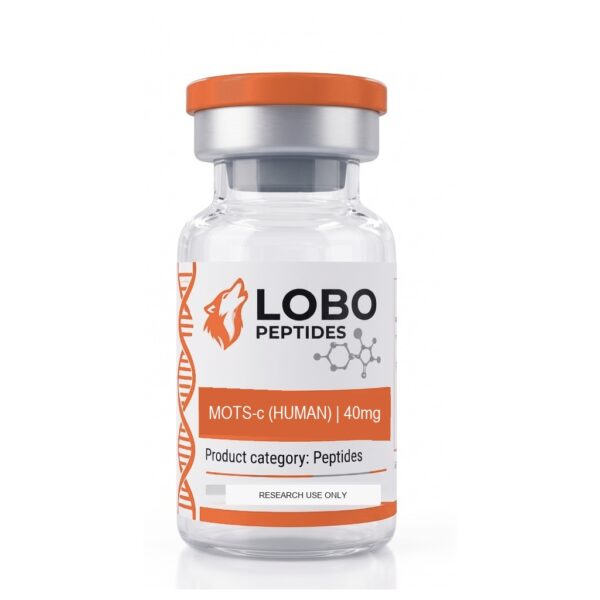
MOTS-c (Human) 40mg
Human-sequence MOTS-c research material supplied as one vial labeled at a nominal 40 mg. The listing is distinct from nonhuman sequences, labeled probes, fusion constructs, and modified analogues. For research use only (RUO); not for human or veterinary use.
Out of stock
button[data-lobo-tab=”coa”]{display:none!important}
(function(){var b=document.querySelector(‘button[data-lobo-tab=”catalog”]’);if(b){b.textContent=’References’;b.setAttribute(‘aria-label’,’References’);b.style.display=’block’;}})();
MOTS-c (Human) 40mg/vial Product Description
Canonical human MOTS-c is described as a 16-amino-acid mitochondrial-derived peptide encoded by a short open reading frame within mitochondrial 12S rRNA. Sequence origin and exact molecular form still require product-specific analytical confirmation. Each bottle contains one vial labeled at a nominal 40 mg. These figures are neither concentration nor assay results and do not verify sequence, terminal chemistry, counterion, purity, or measured content.
It is a related identity reference with a material strength mismatch, not an exact SKU comparison.
Research context includes cultured-cell metabolic-stress assays, nuclear-localization and transcription experiments, myoblast work, mouse models, and endogenous-expression measurements. Each line of evidence must remain tied to the exact sequence, model, and intervention actually studied. Source papers are summarized only at the level supported by their reported models, and the catalog language avoids translating experimental observations into promises.
The entry is structured for qualified laboratory review. Before publication or experimental comparison, product-specific records should resolve identity, physical form, component definition where applicable, and the relationship between the nominal label amount and any measured result. Until then, uncertainty is retained as part of the product record rather than replaced with assumptions. Each experiment should record the actual lot, reference standard, assay matrix, controls, instrument method, and acceptance criteria needed for reproducible interpretation.
Research Material Profile
MOTS-c (Human) 40mg/vial Research
Initial cell and mouse research
The initial primary report described MOTS-c as a 16-amino-acid mitochondrial-derived peptide encoded within mitochondrial 12S rRNA. Investigators used cultured-cell experiments and mouse metabolic models to characterize the peptide and associated pathways. This paper supports the canonical human identity framing and establishes that the molecule has been examined in those defined systems. It does not verify that a commercial vial contains the stated sequence or that its analytical profile matches the research material. Cell line, species, assay medium, comparator design, and test-article provenance constrain interpretation. Product-specific sequence and lot records remain necessary before any direct experimental comparison. Interpretation should remain linked to the reported methods, defined comparators, and confirmed test-article identity rather than the shared catalog name. (PubMed 25738459).
Nuclear translocation under metabolic stress
A later cell-based study investigated MOTS-c during metabolic stress and glucose restriction, measuring nuclear translocation and changes in nuclear gene expression. The evidence is mechanistic and model specific: it links observations to selected cells, defined stress conditions, imaging or localization methods, and transcriptional analyses. It does not establish a universal response, and it does not authenticate this catalog material. Labeled constructs, if used for visualization, must also be distinguished from the canonical unlabeled peptide because a probe result is not an identity certificate for another lot. For RUO presentation, the paper supports describing MOTS-c as a subject of cell-stress and localization research. It provides no basis for an expected result from the single-vial product and no support for treating a 10 mg comparator as strength-equivalent. Interpretation should remain linked to the reported methods, defined comparators, and confirmed test-article identity rather than the shared catalog name. (PubMed 29983246).
Myoblast, mouse, and endogenous-expression observations
Another study combined myoblast experiments, mouse models spanning age groups, and measurements of endogenous MOTS-c expression in exercised human participants. The human portion measured naturally present peptide-related signals; it did not test a Lobo catalog product as an intervention. That distinction prevents endogenous-expression observations from being recast as evidence for this supplied material. The cell and animal findings remain bounded by their own sequence definition, model, protocol, and analytical methods. The paper broadens the map of experimental contexts in which MOTS-c has been studied, but it does not establish product identity, quality, or equivalence. Any laboratory work with the current pack would need direct sequence confirmation, suitable controls, and independent endpoint selection. The nominal per-vial amount remains catalog information only. Interpretation should remain linked to the reported methods, defined comparators, and confirmed test-article identity rather than the shared catalog name. (PubMed 33473109).
Evidence Boundaries
The cited literature supports only the exact molecule or ingredient, model, and endpoint described in each source. It does not verify this Lobo lot, establish equivalence to another seller's material, or convert a nominal catalog amount into measured content. Cell, biochemical, microbial, ex vivo, animal, and controlled human research are not interchangeable evidence categories. Where a blend is involved, single-ingredient papers do not establish the fixed formulation, component ratio, interaction, compatibility, stability, combined performance, or combined safety. Where a fragment, probe, analogue, or related strength is involved, that distinction remains explicit. No unreported identity, sequence, termini, counterion, purity, sterility, endotoxin status, residual-solvent result, or other analytical attribute is inferred. The listing supplies research context only and includes no clinical guidance, procedural directions, or expected outcome.
MOTS-c (Human) 40mg/vial References
8 curated medical and scientific references used for identity, mechanism, model, and assay context.
- The mitochondrial-derived peptide MOTS-c promotes metabolic homeostasis and reduces obesity and insulin resistance.
Lee C, Zeng J, Drew BG, et al. The mitochondrial-derived peptide MOTS-c promotes metabolic homeostasis and reduces obesity and insulin resistance. Cell metabolism. 2015;21(3):443-54. doi:10.1016/j.cmet.2015.02.009.
Foundational MOTS-c identity study · Cultured cells and mouse metabolic models
View research source - The Mitochondrial-Encoded Peptide MOTS-c Translocates to the Nucleus to Regulate Nuclear Gene Expression in Response to Metabolic Stress.
Kim KH, Son JM, Benayoun BA, et al. The Mitochondrial-Encoded Peptide MOTS-c Translocates to the Nucleus to Regulate Nuclear Gene Expression in Response to Metabolic Stress. Cell metabolism. 2018;28(3):516-524.e7. doi:10.1016/j.cmet.2018.06.008.
Direct MOTS-c cell-mechanism study · Cellular glucose-restriction and metabolic-stress experiments
View research source - MOTS-c is an exercise-induced mitochondrial-encoded regulator of age-dependent physical decline and muscle homeostasis.
Reynolds JC, Lai RW, Woodhead JST, et al. MOTS-c is an exercise-induced mitochondrial-encoded regulator of age-dependent physical decline and muscle homeostasis. Nature communications. 2021;12(1):470. doi:10.1038/s41467-020-20790-0.
Direct MOTS-c aging/exercise study · Myoblasts, young-to-old mice, and endogenous measurements in exercised human participants
View research source - The mitochondrial-derived peptide MOTS-c is a regulator of plasma metabolites and enhances insulin sensitivity.
Kim SJ, Miller B, Mehta HH, et al. The mitochondrial-derived peptide MOTS-c is a regulator of plasma metabolites and enhances insulin sensitivity. Physiological reports. 2019;7(13):e14171. doi:10.14814/phy2.14171.
Direct MOTS-c animal metabolism study · Mouse metabolic phenotyping and plasma metabolomics
View research source - The mitochondrial-derived peptide MOTS-c promotes homeostasis in aged human placenta-derived mesenchymal stem cells in vitro.
Yu WD, Kim YJ, Cho MJ, et al. The mitochondrial-derived peptide MOTS-c promotes homeostasis in aged human placenta-derived mesenchymal stem cells in vitro. Mitochondrion. 2021;58:135-146. doi:10.1016/j.mito.2021.02.010.
Direct MOTS-c cell study · Aged human placenta-derived mesenchymal stem cells in vitro
View research source - MOTS-c modulates skeletal muscle function by directly binding and activating CK2.
Kumagai H, Kim SJ, Miller B, et al. MOTS-c modulates skeletal muscle function by directly binding and activating CK2. iScience. 2024;27(11):111212. doi:10.1016/j.isci.2024.111212.
Direct MOTS-c molecular and muscle study · Biochemical binding assays, cultured muscle cells, and mouse skeletal-muscle experiments
View research source - Mitochondrial-derived microprotein MOTS-c attenuates immobilization-induced skeletal muscle atrophy by suppressing lipid infiltration.
Kumagai H, Kim SJ, Miller B, et al. Mitochondrial-derived microprotein MOTS-c attenuates immobilization-induced skeletal muscle atrophy by suppressing lipid infiltration. American journal of physiology. Endocrinology and metabolism. 2024;326(3):E207-E214. doi:10.1152/ajpendo.00285.2023.
Direct MOTS-c animal muscle study · Mouse hindlimb-immobilization model with skeletal-muscle analysis
View research source - Novel function of MOTS-c in mitochondrial remodelling contributes to its antiviral role during HBV infection.
Lin C, Luo L, Xun Z, et al. Novel function of MOTS-c in mitochondrial remodelling contributes to its antiviral role during HBV infection. Gut. 2024;73(2):338-349. doi:10.1136/gutjnl-2023-330389.
Direct MOTS-c antiviral/mechanistic study · Cellular HBV systems and mouse liver experiments
View research source