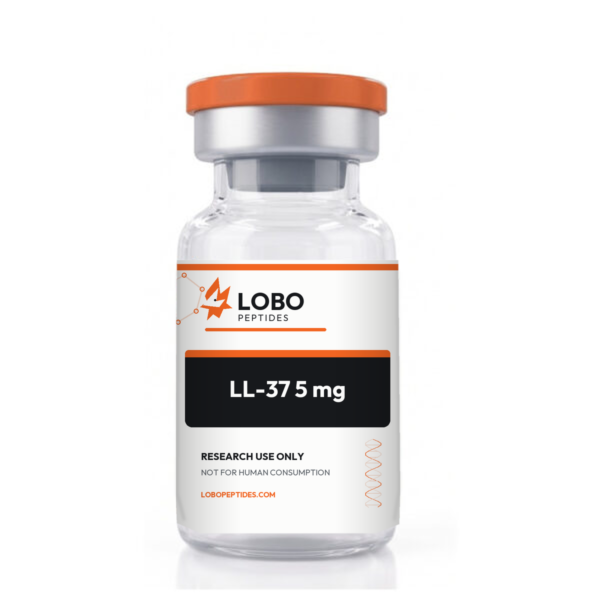
LL-37
LL-37, presented at a nominal 5 mg per vial, is a cationic cathelicidin research material for controlled microbial, biochemical, and cell-based assays. The displayed amount is a catalog statement rather than an analytical result. For research use only (RUO); not for human or veterinary use.
Out of stock
LL-37 5mg Product Description
In the literature, LL-37 is the conventional name for a cationic human cathelicidin peptide. The name on a catalog entry does not itself establish the exact sequence, termini, counterion, physical form, or composition of a particular vial. The 5 mg figure is a nominal per-vial amount, with no multipack represented. LL-37 experiments are highly dependent on concentration, medium, target organism or cell type, and assay timing, so results from one design should not be generalized to another.
Its seller claims, documentation language, and reported specifications are not evidence about the Lobo material and are intentionally excluded from this copy.
Appropriate catalog framing is limited to analytical identification work, controlled microbial assays, membrane-interaction experiments, receptor studies, and cell-signaling models designed by qualified investigators. The listing makes no claim that the supplied material will reproduce any cited observation. Source papers are summarized only at the level supported by their reported models, and the catalog language avoids translating experimental observations into promises.
The entry is structured for qualified laboratory review. Before publication or experimental comparison, product-specific records should resolve identity, physical form, component definition where applicable, and the relationship between the nominal label amount and any measured result. Until then, uncertainty is retained as part of the product record rather than replaced with assumptions. Each experiment should record the actual lot, reference standard, assay matrix, controls, instrument method, and acceptance criteria needed for reproducible interpretation.
Research Material Profile
LL-37 5mg Research
Single-cell microbial assay context
Investigators used time-lapse fluorescence microscopy to follow growing Bacillus subtilis cells exposed to defined LL-37 conditions. The study reported assay-dependent changes in growth, cell dimensions, and localized membrane permeability. This is direct evidence about a controlled bacterial model and the characterized peptide used by those investigators; it is not a general statement about all microorganisms or about an undocumented catalog lot. Medium composition, exposure conditions, imaging cadence, and analysis rules are part of the experimental result. A catalog researcher could use this paper to identify measurable endpoints and suitable controls when evaluating a cathelicidin reference material. The paper does not establish sequence, content, purity, or performance for this vial. Replication would require independently confirming the test article and documenting the exact assay design rather than relying on the product name alone. Interpretation should remain linked to the reported methods, defined comparators, and confirmed test-article identity rather than the shared catalog name. (PubMed 23454084).
Cell-signaling assay context
A separate in vitro study examined LL-37 in primary human peripheral-blood monocytes and a bronchial epithelial cell line. Investigators measured ERK1/2 and p38 pathway activation together with downstream transcriptional and cytokine readouts. Those observations are bounded by the selected cell systems, experimental concentrations, time points, and detection methods. They support describing LL-37 as a probe used in cell-signaling research, but they do not support an organism-level claim or confirm that a separate commercial material has comparable composition. For catalog interpretation, the useful point is methodological: several linked biochemical readouts were measured in defined cells under controlled conditions. Any new experiment should include identity controls, vehicle controls, baseline measurements, and prespecified endpoints. The cited work supplies research context only and is not a substitute for lot documentation or independent analytical characterization. Interpretation should remain linked to the reported methods, defined comparators, and confirmed test-article identity rather than the shared catalog name. (PubMed 15004180).
Receptor-dependent mast-cell systems
Researchers also studied LL-37 responses in LAD2 cells, CD34-positive-derived primary mast-cell systems, comparator cells, and engineered receptor-expression models. Calcium mobilization, degranulation, chemotaxis, knockdown, and receptor-expression experiments were used to examine the role of MrgX2. The strength of this paper for a product page is its explicit mechanistic and model context: the conclusions arose from converging laboratory assays, not from a broad claim about the peptide in every setting. Receptor abundance, cell provenance, culture conditions, and readout selection remain important variables. The study does not verify the identity or activity of this 5 mg listing. It instead illustrates how a qualified laboratory might separate receptor-associated observations from nonspecific assay effects while keeping conclusions tied to the tested systems and characterized study material. Interpretation should remain linked to the reported methods, defined comparators, and confirmed test-article identity rather than the shared catalog name. (PubMed 22069323).
Evidence Boundaries
The cited literature supports only the exact molecule or ingredient, model, and endpoint described in each source. It does not verify this Lobo lot, establish equivalence to another seller's material, or convert a nominal catalog amount into measured content. Cell, biochemical, microbial, ex vivo, animal, and controlled human research are not interchangeable evidence categories. Where a blend is involved, single-ingredient papers do not establish the fixed formulation, component ratio, interaction, compatibility, stability, combined performance, or combined safety. Where a fragment, probe, analogue, or related strength is involved, that distinction remains explicit. No unreported identity, sequence, termini, counterion, purity, sterility, endotoxin status, residual-solvent result, or other analytical attribute is inferred. The listing supplies research context only and includes no clinical guidance, procedural directions, or expected outcome.
LL-37 5mg References
8 curated medical and scientific references used for identity, mechanism, model, and assay context.
- The human cationic peptide LL-37 induces activation of the extracellular signal-regulated kinase and p38 kinase pathways in primary human monocytes.
Bowdish DM, Davidson DJ, Speert DP, et al. The human cationic peptide LL-37 induces activation of the extracellular signal-regulated kinase and p38 kinase pathways in primary human monocytes. Journal of immunology (Baltimore, Md. : 1950). 2004;172(6):3758-65. doi:10.4049/jimmunol.172.6.3758.
Direct LL-37 signaling study · Primary human monocytes and a human bronchial epithelial cell line in vitro
View research source - Mas-related gene X2 (MrgX2) is a novel G protein-coupled receptor for the antimicrobial peptide LL-37 in human mast cells: resistance to receptor phosphorylation, desensitization, and internalization.
Subramanian H, Gupta K, Guo Q, et al. Mas-related gene X2 (MrgX2) is a novel G protein-coupled receptor for the antimicrobial peptide LL-37 in human mast cells: resistance to receptor phosphorylation, desensitization, and internalization. The Journal of biological chemistry. 2011;286(52):44739-49. doi:10.1074/jbc.M111.277152.
Direct LL-37 receptor study · LAD2 mast cells, CD34+-derived primary human mast cells, knockdown, and engineered receptor-expression systems
View research source - Real-time attack of LL-37 on single Bacillus subtilis cells.
Barns KJ, Weisshaar JC. Real-time attack of LL-37 on single Bacillus subtilis cells. Biochimica et biophysica acta. 2013;1828(6):1511-20. doi:10.1016/j.bbamem.2013.02.011.
Direct LL-37 microbial-mechanism study · Single growing Bacillus subtilis cells observed by time-lapse fluorescence microscopy
View research source - Activities of LL-37, a cathelin-associated antimicrobial peptide of human neutrophils.
Turner J, Cho Y, Dinh NN, et al. Activities of LL-37, a cathelin-associated antimicrobial peptide of human neutrophils. Antimicrobial agents and chemotherapy. 1998;42(9):2206-14. doi:10.1128/AAC.42.9.2206.
Direct LL-37 antimicrobial assay study · Radial-diffusion and broth-microdilution assays across bacterial and fungal test organisms
View research source - Cationic antimicrobial peptide LL-37 is effective against both extra- and intracellular Staphylococcus aureus.
Noore J, Noore A, Li B. Cationic antimicrobial peptide LL-37 is effective against both extra- and intracellular Staphylococcus aureus. Antimicrobial agents and chemotherapy. 2013;57(3):1283-90. doi:10.1128/AAC.01650-12.
Direct LL-37 infection-model study · Extracellular bacterial assays and a human osteoblast–Staphylococcus aureus cell-culture model
View research source - Interaction of LL-37 human cathelicidin peptide with a model microbial-like lipid membrane.
Majewska M, Zamlynny V, Pieta IS, et al. Interaction of LL-37 human cathelicidin peptide with a model microbial-like lipid membrane. Bioelectrochemistry (Amsterdam, Netherlands). 2021;141:107842. doi:10.1016/j.bioelechem.2021.107842.
Direct LL-37 membrane-biophysics study · Model microbial-like lipid bilayer examined by impedance spectroscopy, AFM, and infrared spectroscopy
View research source - Molecular mechanisms of LL-37-induced receptor activation: An overview.
Verjans ET, Zels S, Luyten W, et al. Molecular mechanisms of LL-37-induced receptor activation: An overview. Peptides. 2016;85:16-26. doi:10.1016/j.peptides.2016.09.002.
Mechanistic review; not a lot-specific study · Review of receptor and intracellular-target studies involving LL-37
View research source - The chemistry and biology of LL-37.
Burton MF, Steel PG. The chemistry and biology of LL-37. Natural product reports. 2009;26(12):1572-84. doi:10.1039/b912533g.
Chemistry and biology review; not a lot-specific study · Review of structural, antimicrobial, and immunomodulatory literature
View research source