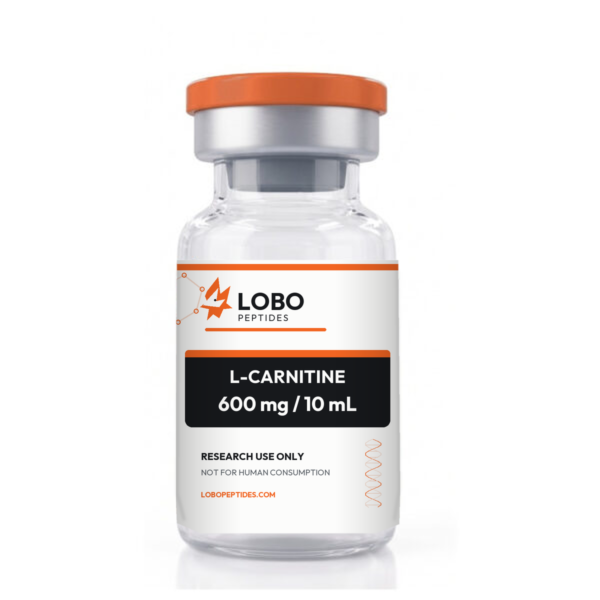
L-carnitine 600mg 10ml*10vials
L-Carnitine is listed as 600 mg/10 mL in a ten-vial pack, but the supplied notation does not resolve whether 600 mg is total content per vial or a concentration shorthand. No pack-total mass is inferred. For research use only (RUO); not for human or veterinary use.
Out of stock
L-Carnitine Product Description
L-Carnitine is the biologically active carnitine stereoisomer involved in cellular acyl-group transport. The product record is preserved exactly as 600 mg/10 mL, 10 vials. That notation is ambiguous: available information does not show whether 600 mg is the total content of each vial, a concentration shorthand, or another labeling convention. Calculating a pack-total mass would therefore create unsupported precision.
Molecular form also matters. L-Carnitine should not be conflated with D-carnitine, acetyl-L-carnitine, or an unspecified salt. The source record does not identify a counterion, excipients, solution composition, or lot characteristics.
The cited controlled physiology studies measured skeletal-muscle carnitine and related laboratory variables in healthy men under defined research protocols. They are relevant to analytical methods, tissue sampling, and experimental control, not to the identity of this ten-vial pack. Participant observations depend on protocol design, sampling, and assay methods and should not be transferred to another preparation or interpreted as a use recommendation.
This RUO listing is therefore documentation-forward. It records the label notation, flags the unresolved basis, and presents model-qualified literature context. Exact form, concentration, per-vial content, pack-total content, identity, purity, sterility, endotoxin status, and stability remain pending. None of those values is inferred from adjacent products or physiology papers. The catalog identity and the literature identity are recorded as separate evidence layers so that future documentation can resolve open attributes without rewriting the scientific history or overstating what the current source set demonstrates within defined research boundaries.
Research Material Profile
L-Carnitine Research
Controlled accumulation study
In a randomized crossover physiology study in healthy men, investigators measured skeletal-muscle carnitine accumulation under controlled L-carnitine exposure and differing insulin conditions. The paper demonstrates a protocol for combining participant controls, tissue sampling, and biochemical measurement to examine carnitine handling. Its observations are limited to the studied participants, material, analytical methods, and experimental conditions. They do not establish the concentration, salt form, or content of this Lobo pack, and the publication cannot resolve whether “600 mg/10 mL” describes total vial content or a concentration shorthand. For an RUO listing, the study supports only a neutral statement that skeletal-muscle carnitine accumulation has been measured in a controlled human physiology context. This summary omits protocol amounts and operational details and does not convert the research into guidance. (PubMed 16368715).
Acute tissue and fuel-marker study
A second controlled human physiology study examined acute changes in tissue carnitine together with resting fuel-metabolism markers. The experimental design is informative because a measured tissue concentration and a metabolic marker are distinct endpoints that may change on different timescales. Interpretation depends on participant selection, timing, sample handling, and analytical techniques. The paper concerns the defined study preparation and protocol, not this ambiguous ten-vial listing. It cannot verify stereochemical identity, counterion, excipients, concentration, or per-vial content. The source is cited here to show a research context in which L-carnitine and associated laboratory variables were measured together. Reporting the assay matrix and collection interval remains essential when comparing such measurements across protocols. It provides no basis for a commercial-lot performance claim or for human or veterinary use of this material. (PubMed 16984983).
Longer controlled physiology research
A longer controlled study tracked tissue carnitine and exercise-associated metabolic measurements over its specified research period. Such work adds longitudinal observations but remains bounded by the participant group, intervention protocol, assay methods, and endpoints reported. It does not establish that an uncharacterized catalog preparation is compositionally comparable to the studied material. Read with the two shorter physiology studies, it illustrates how acute, crossover, and longer-duration designs can address different questions about tissue measurement. The papers do not resolve the product’s ambiguous strength basis or justify calculating a nominal pack total. Accordingly, this page keeps the evidence at the level of controlled physiology methodology and model-qualified observations. Longitudinal findings require their own baseline, retention, and sampling considerations rather than direct comparison with acute experiments. Lot identity and all analytical attributes require separate documentation. (PubMed 21224234).
Evidence Boundaries
The cited literature supports only the identity and model-qualified research contexts summarized above for L-Carnitine. The label statement “600 mg/10 mL, 10 vials (strength basis ambiguous)” is preserved as supplied and is not treated as an analytical measurement. Study findings remain bounded by the reported biochemical assay, cell system, animal species, or controlled participant protocol. Lot-specific identity, content, purity, sterility, endotoxin status, stability, and other unreported specifications remain unknown unless separately documented. No procedural, operational, or outcome guidance is provided.
L-Carnitine References
8 curated medical and scientific references used for identity, mechanism, model, and assay context.
- Insulin stimulates L-carnitine accumulation in human skeletal muscle.
Francis B Stephens, Dumitru Constantin-Teodosiu, David Laithwaite et al.. FASEB journal : official publication of the Federation of American Societies for Experimental Biology. 2006.
exact identity · Randomized crossover human skeletal-muscle physiology study
View research source - An acute increase in skeletal muscle carnitine content alters fuel metabolism in resting human skeletal muscle.
Francis B Stephens, Dumitru Constantin-Teodosiu, David Laithwaite et al.. The Journal of clinical endocrinology and metabolism. 2006.
exact identity · Acute controlled human skeletal-muscle physiology study
View research source - Chronic oral ingestion of L-carnitine and carbohydrate increases muscle carnitine content and alters muscle fuel metabolism during exercise in humans.
Benjamin T Wall, Francis B Stephens, Dumitru Constantin-Teodosiu et al.. The Journal of physiology. 2011.
exact identity · Longer controlled human exercise/metabolism study
View research source - Pharmacokinetics of L-carnitine.
Allan M Evans, Gianfranco Fornasini. Clinical pharmacokinetics. 2003.
ingredient/parent context · Clinical pharmacokinetic review of L-carnitine studies
View research source - Intestinal microbiota metabolism of L-carnitine, a nutrient in red meat, promotes atherosclerosis.
Robert A Koeth, Zeneng Wang, Bruce S Levison et al.. Nature medicine. 2013.
exact identity · Human cohort observations plus microbiome, biochemical, and mouse experiments
View research source - l-Carnitine Supplementation in Recovery after Exercise.
Roger Fielding, Linda Riede, James P Lugo et al.. Nutrients. 2018.
ingredient/parent context · Scholarly review of exercise-recovery studies
View research source - L-carnitine–metabolic functions and meaning in humans life.
Jolanta Pekala, Bozena Patkowska-Sokoła, Robert Bodkowski et al.. Current drug metabolism. 2011.
ingredient/parent context · Scholarly review of human carnitine metabolism
View research source - L-Carnitine.
J H Walter. Archives of disease in childhood. 1996.
ingredient/parent context · Clinical review of carnitine biology and deficiency states
View research source