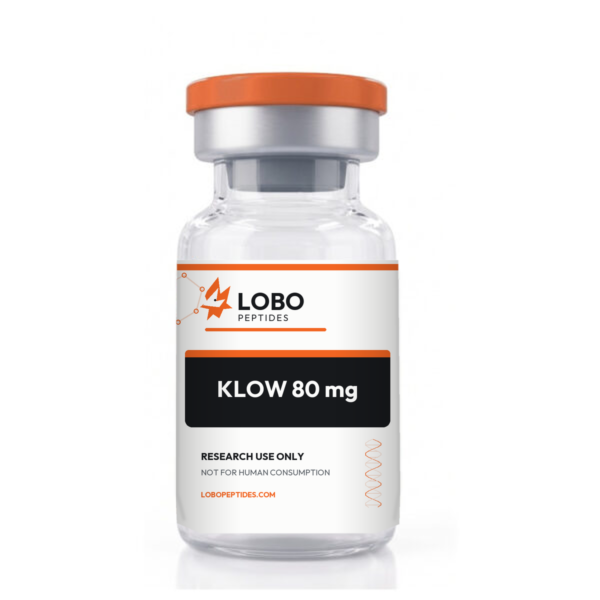
KLOW 80mg
One-vial research blend labeled KPV 10mg, BPC-157 10mg, GHK-Cu 50mg, and TB-500 10mg, for 80mg total nominal labeled content. For research use only (RUO). Not for human or veterinary use.
7 in stock
KLOW Product Description
KLOW 80mg is a catalog-defined, one-vial research blend labeled to contain KPV 10mg, BPC-157 10mg, GHK-Cu 50mg, and material designated TB-500 10mg, for a nominal total labeled content of 80mg.
The four names refer to materially different research substances. KPV is the tripeptide Lys-Pro-Val and is also described in the literature as the C-terminal alpha-MSH fragment alpha-MSH(11-13). BPC-157 is described in published research as a 15-amino-acid pentadecapeptide. GHK-Cu is a copper(II)-coordinated complex of glycyl-L-histidyl-L-lysine. “TB-500,” however, is a catalog designation that does not by itself establish a sequence, fragment length, terminal modification, or equivalence to full-length thymosin beta-4.
For research use only (RUO). Not for human or veterinary use. Not a drug, food, cosmetic, or dietary supplement.
Component Profile
- KPV — 10mg labeled content: Tripeptide studied in transporter, inflammatory-signaling, epithelial-cell, immune-cell, and chemically induced mouse models.
- BPC-157 — 10mg labeled content: Pentadecapeptide examined in tendon explants and cultured rat tendon fibroblasts.
- GHK-Cu — 50mg labeled content: Copper(II)-peptide complex examined in cultured-fibroblast extracellular-matrix assays.
- TB-500 — 10mg labeled material: Identity remains formulation-specific unless supported by analytical documentation for the supplied lot.
Research Scope
The research interest surrounding KLOW comes from ingredient-level studies that examine different but sometimes adjacent laboratory questions, including peptide transport, intracellular signaling, cell migration, cytoskeletal organization, and extracellular-matrix measurements. Those studies provide context for the individual labels; they do not demonstrate that the four materials remain stable together or produce additive, complementary, or synergistic activity in this formulation.
Product Details
- Research material: Catalog-defined one-vial blend labeled KPV 10mg + BPC-157 10mg + GHK-Cu 50mg + TB-500-labeled material 10mg.
- One-vial strength: 80mg total nominal labeled content. This is a label statement, not an independently assayed component ratio, concentration, or lot content.
KLOW Research
The available publications provide ingredient-level context for separately studied materials. They do not establish KLOW-specific activity, synergy, compatibility, safety, stability, concentration, or suitability for any human or veterinary application.
KPV: Transport and Signaling Models
In experiments using human intestinal epithelial cell lines and Jurkat T-cell systems, investigators studied KPV uptake through the PepT1 transporter and measured NF-kappaB, MAP-kinase, and cytokine readouts. The same publication also reported histologic and cytokine-expression endpoints in chemically induced mouse models. These results apply to isolated KPV under the study conditions—not to KLOW or any fixed combination (PubMed 18061177).
BPC-157: Explant and Fibroblast Assays
A study using rat Achilles-tendon explants and cultured tendon fibroblasts measured explant outgrowth, cell migration and spreading, survival under oxidative stress, F-actin formation, and FAK/paxillin-related signaling. The study did not test KPV, GHK-Cu, TB-500, or the KLOW blend, so its observations should remain limited to the defined BPC-157 material and experimental systems used (PubMed 21030672).
GHK-Cu: Extracellular-Matrix Measurements
In cultured fibroblasts, researchers examined collagen-synthesis measurements after exposure to a defined glycyl-L-histidyl-L-lysine-copper(II) complex. This cell-based work provides ingredient-level context for GHK-Cu; it does not establish the identity of an undocumented lot or a product-level repair outcome for the KLOW formulation (PubMed 3169264).
TB-500: Identity Must Be Established, Not Assumed
An analytical paper identified one tested TB-500 formulation as the N-terminally acetylated thymosin beta-4(17-23) fragment Ac-LKKTETQ using liquid chromatography and high-resolution mass spectrometry. Separate research on defined full-length thymosin beta-4 and its fragments shows why these identities cannot be treated as interchangeable. Neither paper proves the sequence or modification of the TB-500-labeled material in this product (PubMed 22962027; PubMed 14500546).
What the Literature Does—and Does Not—Establish
- It does establish: Model-specific measurements for separately studied, defined materials.
- It does not establish: KLOW-specific activity, synergy, compatibility, safety, stability, concentration, or suitability for any human or veterinary application.
- It does not replace testing: The displayed 80mg composition remains a label statement until confirmed by lot-specific analytical documentation.
KLOW References
12 curated medical and scientific references covering the four labeled components and relevant assay contexts.
- The promoting effect of pentadecapeptide BPC 157 on tendon healing involves tendon outgrowth, cell survival, and cell migration.
Chang CH, Tsai WC, Lin MS, Hsu YH, Pang JH The promoting effect of pentadecapeptide BPC 157 on tendon healing involves tendon outgrowth, cell survival, and cell migration. J Appl Physiol (1985). 2011;110(3):774-780. doi:10.1152/japplphysiol.00945.2010. PMID:21030672.
BPC 157 and tendon-cell/explant endpoints · Rat Achilles-tendon explants and cultured tendon fibroblasts.
View research source - Body protective compound-157 enhances alkali-burn wound healing in vivo and promotes proliferation, migration, and angiogenesis in vitro.
Huang T, Zhang K, Sun L, Xue X, Zhang C, Shu Z, Mu N, Gu J, Zhang W, Wang Y, Zhang Y, Zhang W Body protective compound-157 enhances alkali-burn wound healing in vivo and promotes proliferation, migration, and angiogenesis in vitro. Drug Des Devel Ther. 2015;9:2485-2499. doi:10.2147/dddt.s82030. PMID:25995620.
BPC 157 in endothelial assays and corneal injury model · Cultured HUVEC proliferation, migration, and tube-formation assays plus a rat alkali-burn model.
View research source - Therapeutic potential of pro-angiogenic BPC157 is associated with VEGFR2 activation and up-regulation.
Hsieh MJ, Liu HT, Wang CN, Huang HY, Lin Y, Ko YS, Wang JS, Chang VH, Pang JS Therapeutic potential of pro-angiogenic BPC157 is associated with VEGFR2 activation and up-regulation. J Mol Med (Berl). 2017;95(3):323-333. doi:10.1007/s00109-016-1488-y. PMID:27847966.
BPC 157 and VEGFR2-related signaling · Endothelial-cell assays, chick chorioallantoic membrane, and rat hind-limb ischemia model.
View research source - Thymosin beta 4 stimulates directional migration of human umbilical vein endothelial cells.
Malinda KM et al. Thymosin beta 4 stimulates directional migration of human umbilical vein endothelial cells. FASEB J (1997). PMID 9194528. DOI: 10.1096/fasebj.11.6.9194528.
Adjacent evidence on analytically defined thymosin beta-4; TB-500 remains an unresolved catalog designation. · Cultured human umbilical-vein endothelial cells, scratch-wounded monolayers, and a subcutaneous Matrigel migration assay.
View research source - The actin binding site on thymosin beta4 promotes angiogenesis.
Philp D et al. The actin binding site on thymosin beta4 promotes angiogenesis. FASEB J (2003). PMID 14500546. DOI: 10.1096/fj.03-0121fje.
Adjacent evidence on analytically defined thymosin beta-4; TB-500 remains an unresolved catalog designation. · Endothelial migration and chick aortic-arch sprouting assays comparing full-length thymosin beta-4, fragments, and synthetic peptides.
View research source - Thymosin beta 4 and a synthetic peptide containing its actin-binding domain promote dermal wound repair in db/db diabetic mice and in aged mice.
Philp D et al. Thymosin beta 4 and a synthetic peptide containing its actin-binding domain promote dermal wound repair in db/db diabetic mice and in aged mice. Wound Repair Regen (2003). PMID 12581423. DOI: 10.1046/j.1524-475x.2003.11105.x.
Adjacent evidence on analytically defined thymosin beta-4; TB-500 remains an unresolved catalog designation. · db/db diabetic and aged mouse wound models comparing thymosin beta-4 with a seven-residue actin-binding-domain peptide.
View research source - Stimulation of collagen synthesis in fibroblast cultures by the tripeptide-copper complex glycyl-L-histidyl-L-lysine-Cu2+.
Maquart FX et al. Stimulation of collagen synthesis in fibroblast cultures by the tripeptide-copper complex glycyl-L-histidyl-L-lysine-Cu2+. FEBS Lett (1988). PMID 3169264. DOI: 10.1016/0014-5793(88)80509-x.
Direct GHK-Cu literature; copper-complex evidence must not be assigned to uncomplexed GHK. · Cultured fibroblasts with collagen-synthesis measurements.
View research source - In vivo stimulation of connective tissue accumulation by the tripeptide-copper complex glycyl-L-histidyl-L-lysine-Cu2+ in rat experimental wounds.
Maquart FX et al. In vivo stimulation of connective tissue accumulation by the tripeptide-copper complex glycyl-L-histidyl-L-lysine-Cu2+ in rat experimental wounds. J Clin Invest (1993). PMID 8227353. DOI: 10.1172/JCI116842.
Direct GHK-Cu literature; copper-complex evidence must not be assigned to uncomplexed GHK. · Rat experimental-wound chambers with connective-tissue endpoints.
View research source - The tripeptide-copper complex glycyl-L-histidyl-L-lysine-Cu2+ stimulates matrix metalloproteinase-2 expression by fibroblast cultures.
Siméon A et al. The tripeptide-copper complex glycyl-L-histidyl-L-lysine-Cu2+ stimulates matrix metalloproteinase-2 expression by fibroblast cultures. Life Sci (2000). PMID 11045606. DOI: 10.1016/s0024-3205(00)00803-1.
Direct GHK-Cu literature; copper-complex evidence must not be assigned to uncomplexed GHK. · Cultured fibroblasts with MMP-2/TIMP-related measurements.
View research source - PepT1-mediated tripeptide KPV uptake reduces intestinal inflammation.
Dalmasso G et al. PepT1-mediated tripeptide KPV uptake reduces intestinal inflammation. Gastroenterology (2008). PMID 18061177. DOI: 10.1053/j.gastro.2007.10.026.
Direct KPV literature unless the study uses a carrier, co-assembly, or combination, in which case results are formulation-adjacent. · PepT1 uptake, intestinal-cell signaling, and chemically induced mouse intestinal-inflammation models.
View research source - Melanocortin-derived tripeptide KPV has anti-inflammatory potential in murine models of inflammatory bowel disease.
Kannengiesser K et al. Melanocortin-derived tripeptide KPV has anti-inflammatory potential in murine models of inflammatory bowel disease. Inflamm Bowel Dis (2008). PMID 18092346. DOI: 10.1002/ibd.20334.
Direct KPV literature unless the study uses a carrier, co-assembly, or combination, in which case results are formulation-adjacent. · Murine intestinal-inflammation models, including nonfunctional MC1R context.
View research source - Inhibition of cellular and systemic inflammation cues in human bronchial epithelial cells by melanocortin-related peptides: mechanism of KPV action and a role for MC3R agonists.
Land SC et al. Inhibition of cellular and systemic inflammation cues in human bronchial epithelial cells by melanocortin-related peptides: mechanism of KPV action and a role for MC3R agonists. Int J Physiol Pathophysiol Pharmacol (2012). PMID 22837805.
Direct KPV literature unless the study uses a carrier, co-assembly, or combination, in which case results are formulation-adjacent. · Immortalized human bronchial epithelial cells with NF-kB-related and epithelial-response readouts.
View research source