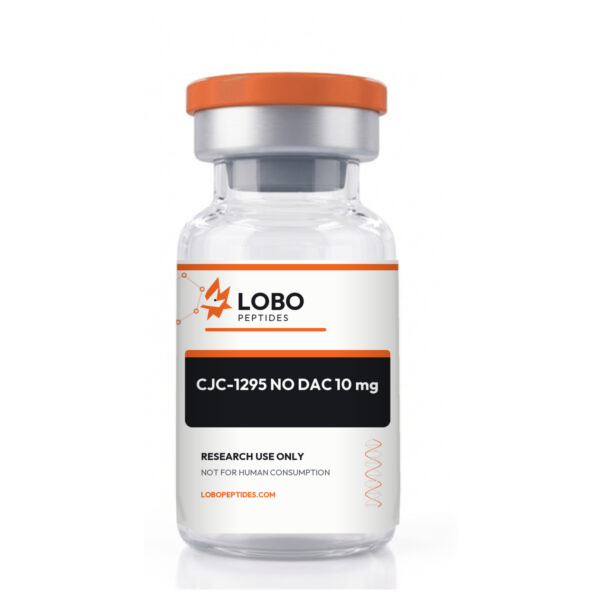
CJC-1295 (without DAC) 10mg
CJC-1295 without DAC at a 10mg display strength. For research use only (RUO); not for human or veterinary use.
Out of stock
CJC-1295 without DAC 10mg Product Description
The displayed identity is CJC-1295 without DAC at 10mg. In research catalogs, the no-DAC qualifier is essential because it separates this entry from the albumin-reactive CJC-1295 construct described in primary literature. The name is often associated with modified GRF(1-29), but the title alone does not prove a sequence or substitution pattern for the supplied material.
A 10mg display strength records nominal catalog content only. It does not reveal whether the selection represents one vial, several vials, a peptide salt, or another physical presentation. No physical unit or pack count has been supplied, so this draft does not infer either one. It also leaves counterion, water content, physical state, and fill tolerances unresolved.
For catalog use, this material should be positioned as an identity-sensitive laboratory reference rather than as interchangeable with DAC CJC-1295. Suitable neutral contexts include method development, reference comparison, receptor-pathway assay planning, and evaluation of documents supplied for a particular lot. Researchers should define the sequence required by their protocol and compare it with lot-specific documentation before drawing conclusions from an experiment. No certificate values are available in this draft, and no statement about purity, sterility, endotoxin, stability, or analytical performance is implied. The item is for research use only and is not for human or veterinary use. Qualified laboratories should base protocol decisions on their own requirements, the verified identity of the received material, and lot-specific records rather than on a retail family name. Catalog inclusion does not establish fitness for a particular method. Receiving records, chain of custody, reference standards, and acceptance criteria should be defined by the laboratory and documented independently for every lot and presentation.
Research Material Profile
CJC-1295 without DAC 10mg Research
What the DAC paper establishes
Primary research indexed at PMID 15817669 describes a tetrasubstituted hGRF(1-29) analog bearing a C-terminal maleimide-containing lysine derivative. Investigators examined albumin conjugation and related activity in cultured rat pituitary cells and rat experiments. That paper is useful here because it defines the DAC-bearing construct that this listing expressly excludes. It does not establish that a product called “without DAC” has any particular substitutions, salt form, content, or analytical profile. The study material and this catalog item therefore cannot be treated as the same reagent. Any comparison should preserve the distinction between a chemically defined albumin-reactive analog and an under-documented no-DAC listing. The source supports nomenclature boundaries and experimental context only; it does not support a quality statement, a duration claim, or a conclusion about the behavior of this 10mg item. Across interpretations, the publication supports only its reported material and measurements; it does not supply lot-level identity, composition, or quality evidence for this catalog presentation. (PubMed 15817669).
Adjacent GHRH fragment evidence
PMID 2061025 reports a human diagnostic experiment comparing GHRH fragments, including GHRH(1-29). It provides adjacent evidence for the shortened amino-terminal fragment used as a conceptual reference in this product family. The record does not establish the modified substitutions commonly associated with no-DAC catalog names, and it does not identify the sequence, counterion, or physical form of the present item. Because the experiment involved defined research materials in a controlled setting, its observations must remain attached to those materials and that study design. They cannot be converted into statements about an untested commercial lot. For an assay program, the paper may help explain why fragment length is an important identity variable, but sequence confirmation and lot-level characterization are still required before the catalog item can be linked confidently to a literature-defined reagent. Across interpretations, the publication supports only its reported material and measurements; it does not supply lot-level identity, composition, or quality evidence for this catalog presentation. (PubMed 2061025).
Interpretation for laboratory planning
The two cited papers define neighboring scientific entities rather than validating this SKU. One characterizes a DAC-bearing modified analog; the other examines GHRH fragments in a controlled human research setting. Together they show why a short retail name can conceal experimentally important structural differences. A laboratory considering this item should treat “without DAC” as a negative boundary—an excluded reactive group—not as complete positive identification. Sequence mapping, mass-based identity work, and content assessment would be product-specific tasks, and no result is supplied here. Experimental conclusions should name the exact reagent documentation used rather than relying on the family label alone. No cited study examines this 10mg presentation, and no source establishes equivalence between it and a particular modified GRF(1-29) standard. This conservative reading avoids importing properties from the excluded DAC construct. Across interpretations, the publication supports only its reported material and measurements; it does not supply lot-level identity, composition, or quality evidence for this catalog presentation. (PubMed 15817669 · PubMed 2061025).
Evidence Boundaries
The cited publications describe defined study materials in particular biochemical, cell, animal, or controlled human research settings. They do not authenticate this catalog item, transfer analytical specifications to it, or establish that a nominally similar retail product is equivalent. Model observations must remain attached to the reported species, preparation, protocol, and endpoints. Where the title leaves sequence, chemical form, processing state, physical unit, formulation, or pack details unresolved, this draft leaves them unresolved as well. No purity percentage, sterility status, endotoxin result, stability period, or content assay is inferred. Any stronger conclusion requires lot-specific documentation and, where relevant, direct testing of the exact formulation.
CJC-1295 without DAC 10mg References
6 curated medical and scientific references used for identity, mechanism, model, and assay context.
- Human growth hormone-releasing factor (hGRF)1-29-albumin bioconjugates activate the GRF receptor on the anterior pituitary in rats: identification of CJC-1295 as a long-lasting GRF analog.
Jetté L, Léger R, Thibaudeau K, Benquet C, Robitaille M, Pellerin I, Paradis V, van Wyk P, Pham K, Bridon DP Human growth hormone-releasing factor (hGRF)1-29-albumin bioconjugates activate the GRF receptor on the anterior pituitary in rats: identification of CJC-1295 as a long-lasting GRF analog. Endocrinology. 2005;146(7):3052-3058. doi:10.1210/en.2004-1286. PMID:15817669.
DAC-bearing CJC-1295 construct chemistry and pharmacology · Albumin conjugation assays, cultured rat anterior-pituitary cells, and male rat experiments.
View research source - Usefulness of the growth hormone-releasing hormone test regardless of which fragment is used (GHRH 1-44, 1-40 or 1-29).
Laron Z Usefulness of the growth hormone-releasing hormone test regardless of which fragment is used (GHRH 1-44, 1-40 or 1-29). Isr J Med Sci. 1991;27(6):343-345. PMID:2061025.
Comparison of human GHRH fragments · Controlled human diagnostic research comparing GHRH(1-44), GHRH(1-40), and GHRH(1-29).
View research source - Incorporation of D-Ala2 in growth hormone-releasing hormone-(1-29)-NH2 increases the half-life and decreases metabolic clearance in normal men.
Soule S, King JA, Millar RP Incorporation of D-Ala2 in growth hormone-releasing hormone-(1-29)-NH2 increases the half-life and decreases metabolic clearance in normal men. J Clin Endocrinol Metab. 1994;79(4):1208-1211. doi:10.1210/jcem.79.4.7962295. PMID:7962295.
Modified GHRH(1-29) pharmacokinetics · Controlled study in healthy men comparing a D-Ala2-modified GHRH(1-29) analogue with the referenced fragment.
View research source - Pharmacokinetics of growth hormone-releasing hormone(1-29)-NH2 and stimulation of growth hormone secretion in healthy subjects after intravenous or intranasal administration.
Wilton P, Chardet Y, Danielson K, Widlund L, Gunnarsson R Pharmacokinetics of growth hormone-releasing hormone(1-29)-NH2 and stimulation of growth hormone secretion in healthy subjects after intravenous or intranasal administration. Acta Paediatr Suppl. 1993;388:10-15. doi:10.1111/j.1651-2227.1993.tb12827.x. PMID:8329825.
GHRH(1-29)-NH2 pharmacokinetics and endocrine measurement · Controlled study in healthy participants with plasma pharmacokinetic and GH measurements.
View research source - Endocrine and metabolic effects of long-term administration of [Nle27]growth hormone-releasing hormone-(1-29)-NH2 in age-advanced men and women.
Khorram O, Laughlin GA, Yen SS Endocrine and metabolic effects of long-term administration of [Nle27]growth hormone-releasing hormone-(1-29)-NH2 in age-advanced men and women. J Clin Endocrinol Metab. 1997;82(5):1472-1479. doi:10.1210/jcem.82.5.3943. PMID:9141536.
Longer-term [Nle27]GHRH(1-29)-NH2 research · Controlled human endocrine and metabolic study in older adults.
View research source - New analogs of human growth hormone-releasing hormone (1-29) with high and prolonged antagonistic activity.
Toth K, Kovacs M, Zarandi M, Halmos G, Groot K, Nagy A, Kele Z, Schally AV New analogs of human growth hormone-releasing hormone (1-29) with high and prolonged antagonistic activity. J Pept Res. 1998;51(2):134-141. doi:10.1111/j.1399-3011.1998.tb00631.x. PMID:9516049.
Structure-activity work on GHRH(1-29) antagonists · Peptide synthesis and experimental characterization of modified human GHRH(1-29) antagonists.
View research source