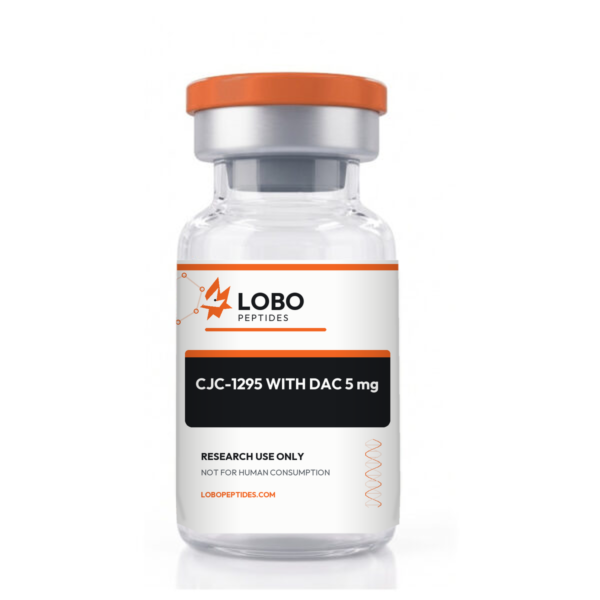
CJC-1295 with DAC 5mg
CJC-1295 with DAC 5 mg is a modified hGRF(1-29) analogue designed for albumin conjugation in experimental systems. The DAC designation is retained because it distinguishes this material from no-DAC modified GRF and related blends. For research use only (RUO); not for human or veterinary use.
Out of stock
CJC-1295 with DAC Product Description
CJC-1295 with DAC is described as a tetrasubstituted hGRF(1-29) analogue with a reactive maleimide-containing group designed to form a conjugate with serum albumin. That modification is central to its literature identity. The supplied listing states 5 mg, but the catalog amount does not establish chemical integrity, conjugation behavior, counterion, excipients, or any lot-specific analytical result.
The DAC qualifier must remain visible. No-DAC modified GRF(1-29) lacks the albumin-binding group and is not the same research material. CJC-1295/ipamorelin blends introduce another identity layer and cannot substantiate a single-component DAC product. A useful experimental record should name the exact analogue, define whether conjugation is being measured or assumed, and avoid transferring results between modified and unmodified forms.
The cited literature begins with biochemical, cultured rat anterior-pituitary-cell, and rat experiments that assessed maleimide-bearing hGRF analogues. Controlled studies in healthy adults later measured pharmacokinetics and serial GH- and IGF-I-related biomarkers, while a follow-up physiology study examined overnight secretion patterns. These studies create a model-qualified evidence chain; they do not verify the Lobo lot or authorize use outside research.
This RUO page therefore treats CJC-1295 with DAC as an identity-specific experimental reagent. Appropriate discussion includes conjugation chemistry, receptor-linked assays, pharmacokinetic modeling, and time-series biomarker methodology. Identity, content, purity, sterility, endotoxin status, stability, and actual albumin-conjugation performance remain pending until supported by lot-specific documentation. The catalog identity and the literature identity are recorded as separate evidence layers so that future documentation can resolve open attributes without rewriting the scientific history or overstating what the current source set demonstrates within defined research boundaries.
Research Material Profile
CJC-1295 with DAC Research
Analogue design and preclinical characterization
Researchers evaluated maleimide-bearing hGRF analogues in biochemical experiments, cultured rat anterior pituitary cells, and male rat models. They measured albumin conjugation, receptor-linked activity, and model-specific persistence, identifying CJC-1295 as the leading construct in that series. The work supports the design rationale for a DAC-containing analogue and distinguishes it from no-DAC modified GRF. Each result remains tied to its model: chemical conjugation measurements address reactivity, cultured-cell assays address responses in an isolated pituitary preparation, and rat observations add species-specific whole-organism context. The study does not establish how an untested commercial lot will behave, nor does the 5 mg label confirm the reactive group’s integrity. It is best used as a primary identity and mechanism source for the named construct. Any new experiment would still need independent material characterization and controls that preserve the exact DAC designation. (PubMed 15817669).
Controlled pharmacokinetic and biomarker study
Randomized research in healthy adults measured CJC-1295 concentrations and serial GH- and IGF-I-related biomarkers. The study provides a controlled setting for examining the relation between a DAC-modified analogue, observed exposure, and timed endocrine measurements. Those data belong to the specific study material, analytical methods, participant criteria, and protocol. They should not be converted into claims about this 5 mg catalog unit, and they do not apply to no-DAC CJC material or to combination products. Pharmacokinetic observations also do not verify receptor selectivity, lot purity, or formulation. On an RUO page, the publication supports only a neutral description of variables that have been measured in a controlled human research context. This summary omits protocol amounts and operational instructions and does not provide a basis for human or veterinary use. (PubMed 16352683).
Overnight secretion-pattern research
A follow-up physiology study evaluated overnight secretion patterns after CJC-1295 exposure in a defined human research setting. Time-series work of this kind can examine pulse organization and biomarker dynamics, but its interpretation depends on sampling frequency, analytical sensitivity, modeling choices, and participant selection. The observations are therefore protocol-specific and should not be generalized to another preparation or population. The study also does not independently establish the chemical identity, conjugation state, or analytical quality of this catalog material. Read with the preclinical design paper and pharmacokinetic study, it illustrates three distinct evidence layers: construct chemistry, controlled exposure analysis, and temporal biomarker assessment. Those layers can inform experimental questions without becoming commercial claims. Lot-specific identity and performance remain unresolved, and the evidence does not transfer to no-DAC material or blends. (PubMed 17018654).
Evidence Boundaries
The cited literature supports only the identity and model-qualified research contexts summarized above for CJC-1295 with DAC. The label statement “5 mg” is preserved as supplied and is not treated as an analytical measurement. Study findings remain bounded by the reported biochemical assay, cell system, animal species, or controlled participant protocol. Lot-specific identity, content, purity, sterility, endotoxin status, stability, and other unreported specifications remain unknown unless separately documented. No procedural, operational, or outcome guidance is provided.
CJC-1295 with DAC References
9 curated medical and scientific references used for identity, mechanism, model, and assay context.
- Human growth hormone-releasing factor (hGRF)1-29-albumin bioconjugates activate the GRF receptor on the anterior pituitary in rats: identification of CJC-1295 as a long-lasting GRF analog.
Lucie Jetté, Roger Léger, Karen Thibaudeau et al.. Endocrinology. 2005.
exact identity · Biochemical conjugation, cultured rat pituitary-cell, and rat studies
View research source - Prolonged stimulation of growth hormone (GH) and insulin-like growth factor I secretion by CJC-1295, a long-acting analog of GH-releasing hormone, in healthy adults.
Sam L Teichman, Ann Neale, Betty Lawrence et al.. The Journal of clinical endocrinology and metabolism. 2006.
exact identity · Randomized controlled human study in healthy adults
View research source - Pulsatile secretion of growth hormone (GH) persists during continuous stimulation by CJC-1295, a long-acting GH-releasing hormone analog.
Madalina Ionescu, Lawrence A Frohman. The Journal of clinical endocrinology and metabolism. 2006.
exact identity · Human overnight endocrine time-series study
View research source - Activation of the GH/IGF-1 axis by CJC-1295, a long-acting GHRH analog, results in serum protein profile changes in normal adult subjects.
Lucila Sackmann-Sala, Juan Ding, Lawrence A Frohman et al.. Growth hormone & IGF research : official journal of the Growth Hormone Research Society and the International IGF Research Society. 2009.
exact identity · Proteomic analysis of serum from healthy adults exposed to CJC-1295 in a research protocol
View research source - Once-daily administration of CJC-1295, a long-acting growth hormone-releasing hormone (GHRH) analog, normalizes growth in the GHRH knockout mouse.
Maria Alba, Danilo Fintini, Alessia Sagazio et al.. American journal of physiology. Endocrinology and metabolism. 2006.
exact identity · GHRH-knockout mouse model
View research source - Identification of CJC-1295, a growth-hormone-releasing peptide, in an unknown pharmaceutical preparation.
John Henninge, Milaim Pepaj, Ingunn Hullstein et al.. Drug testing and analysis. 2010.
method/assay context · Analytical identification of CJC-1295 in an unknown preparation
View research source - A method for confirming CJC-1295 abuse in equine plasma samples by LC-MS/MS.
Mark Timms, Katherine Ganio, Rohan Steel. Drug testing and analysis. 2019.
method/assay context · Equine-plasma LC-MS/MS method validation
View research source - An immuno polymerase chain reaction screen for the detection of CJC-1295 and other growth-hormone-releasing hormone analogs in equine plasma.
Mark Timms, Katherine Ganio, Grace Forbes et al.. Drug testing and analysis. 2019.
method/assay context · Equine-plasma immuno-PCR screening assay
View research source - Cationic exchange SPE combined with triple quadrupole UHPLC-MS/MS for detection of GHRHs in urine samples.
Cătălina-Diana Cristea, Mihai Radu, Ani Toboc et al.. Analytical biochemistry. 2023.
method/assay context · Urine sample preparation and triple-quadrupole UHPLC-MS/MS
View research source