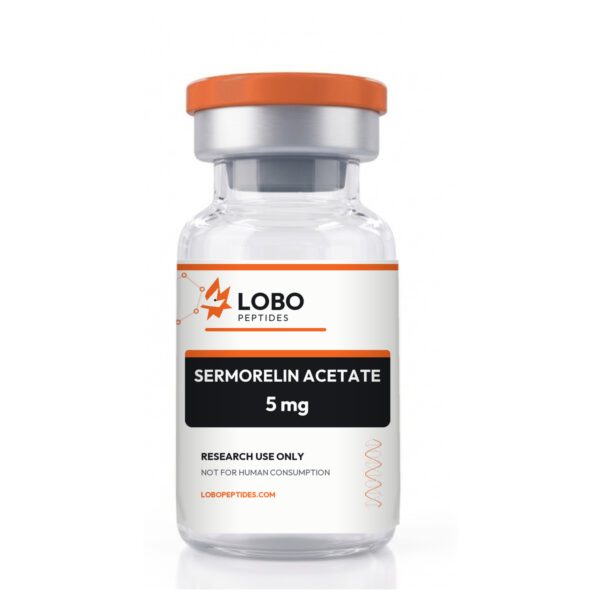
Sermorelin Acetate 5mg
Sermorelin acetate at a 5mg display strength. For research use only (RUO); not for human or veterinary use.
Out of stock
Sermorelin Acetate 5mg Product Description
Sermorelin acetate is displayed at a 5mg strength. In the literature, sermorelin is associated with the amino-terminal GHRH/GRF(1-29) fragment. The acetate designation is part of this catalog identity and should not be dropped, yet the title alone does not establish acetate stoichiometry, exact sequence, peptide content, or the physical unit represented by the selection.
This material must remain separate from modified GRF analogs, tesamorelin, and secretagogue-receptor agonists such as GHRP peptides. No pack count is specified, and this draft does not infer that the 5mg amount means one vial.
The listing may support neutral research catalog functions such as fragment identification, analytical-method planning, or controlled comparison with authenticated GHRH-family standards. Researchers should verify sequence and salt documentation for the specific lot before aligning it with literature methods. Observations from human diagnostic work or mass-spectrometric studies remain bound to their defined materials and protocols; they do not establish activity or quality for this catalog item. No certificate values are available in this draft, and no statement about purity, sterility, endotoxin, stability, or analytical performance is implied. The item is for research use only and is not for human or veterinary use. Qualified laboratories should base protocol decisions on their own requirements, the verified identity of the received material, and lot-specific records rather than on a retail family name. Catalog inclusion does not establish fitness for a particular method. Receiving records, chain of custody, reference standards, and acceptance criteria should be defined by the laboratory and documented independently for every lot and presentation.
Research Material Profile
Sermorelin Acetate 5mg Research
GHRH fragment comparison
PMID 2061025 reports a human diagnostic study comparing GHRH fragments, including GHRH(1-29). It supports the scientific relevance of fragment length and provides controlled context for the amino-terminal 1-29 entity associated with sermorelin. The paper does not establish that the present item has the expected sequence, and it does not identify acetate stoichiometry, physical form, or measured content. Findings from the characterized study materials cannot be transferred to a retail selection based only on a shared fragment name. The source is best used to explain why sequence boundaries matter when organizing GHRH-family reagents. It does not authenticate this 5mg presentation, provide lot-level specifications, or justify a claim about expected response. Any experimental comparison should use documented standards and preserve the distinction between an unmodified fragment and other GHRH analogs. Across interpretations, the publication supports only its reported material and measurements; it does not supply lot-level identity, composition, or quality evidence for this catalog presentation. (PubMed 2061025).
Name-specific analytical detection
PMID 26879649 describes an LC-HRMS/MS methods study that included Geref/Sermorelin among defined GHRH-related analytes in plasma. This provides name-specific analytical context and demonstrates that method development depends on a clearly identified analyte. It does not verify the acetate form, content, or sequence of this product and does not establish that the catalog material would behave identically in the reported method. Matrix, sample preparation, instrumentation, reference standards, and validation design are all part of the study context. The citation therefore supports analytical relevance rather than a quality or performance claim. A laboratory adapting the method would still need a documented standard and lot information for the material at hand. No conclusions about purity, stability, or suitability follow from inclusion of sermorelin in the paper. Across interpretations, the publication supports only its reported material and measurements; it does not supply lot-level identity, composition, or quality evidence for this catalog presentation. (PubMed 26879649).
Separating base peptide from salt presentation
Matching the base name and strength is not enough to prove chemical-form equivalence. Salt association, residual counterions, water content, and peptide content can affect how amounts are interpreted in analytical work, yet none is reported here. The two primary papers provide fragment and analytical contexts but do not characterize this 5mg item. No physical unit or pack count is recorded, so those details also remain open. The appropriate presentation is therefore a salt-designated, documentation-pending RUO material. Experimental reports should state the verified form actually used instead of assuming that every sermorelin-labeled product is interchangeable. Across interpretations, the publication supports only its reported material and measurements; it does not supply lot-level identity, composition, or quality evidence for this catalog presentation. (PubMed 2061025 · PubMed 26879649).
Evidence Boundaries
The cited publications describe defined study materials in particular biochemical, cell, animal, or controlled human research settings. They do not authenticate this catalog item, transfer analytical specifications to it, or establish that a nominally similar retail product is equivalent. Model observations must remain attached to the reported species, preparation, protocol, and endpoints. Where the title leaves sequence, chemical form, processing state, physical unit, formulation, or pack details unresolved, this draft leaves them unresolved as well. No purity percentage, sterility status, endotoxin result, stability period, or content assay is inferred. Any stronger conclusion requires lot-specific documentation and, where relevant, direct testing of the exact formulation.
Sermorelin Acetate 5mg References
8 curated medical and scientific references used for identity, mechanism, model, and assay context.
- Qualitative identification of growth hormone-releasing hormones in human plasma by means of immunoaffinity purification and LC-HRMS/MS.
Knoop A, Thomas A, Fichant E, Delahaut P, Schänzer W, Thevis M Qualitative identification of growth hormone-releasing hormones in human plasma by means of immunoaffinity purification and LC-HRMS/MS. Anal Bioanal Chem. 2016;408(12):3145-3153. doi:10.1007/s00216-016-9377-3. PMID:26879649.
Mass-spectrometric identification of Geref/sermorelin and other GHRHs · Immunoaffinity LC-HRMS/MS method validation with in-vitro work, rat samples, and one human sample.
View research source - Usefulness of the growth hormone-releasing hormone test regardless of which fragment is used (GHRH 1-44, 1-40 or 1-29).
Laron Z Usefulness of the growth hormone-releasing hormone test regardless of which fragment is used (GHRH 1-44, 1-40 or 1-29). Isr J Med Sci. 1991;27(6):343-345. PMID:2061025.
Comparison of human GHRH fragments · Controlled human diagnostic research comparing GHRH(1-44), GHRH(1-40), and GHRH(1-29).
View research source - Pharmacokinetics of growth hormone-releasing hormone(1-29)-NH2 and stimulation of growth hormone secretion in healthy subjects after intravenous or intranasal administration.
Wilton P, Chardet Y, Danielson K, Widlund L, Gunnarsson R Pharmacokinetics of growth hormone-releasing hormone(1-29)-NH2 and stimulation of growth hormone secretion in healthy subjects after intravenous or intranasal administration. Acta Paediatr Suppl. 1993;388:10-15. doi:10.1111/j.1651-2227.1993.tb12827.x. PMID:8329825.
GHRH(1-29)-NH2 pharmacokinetics and endocrine measurement · Controlled study in healthy participants with plasma pharmacokinetic and GH measurements.
View research source - Incorporation of D-Ala2 in growth hormone-releasing hormone-(1-29)-NH2 increases the half-life and decreases metabolic clearance in normal men.
Soule S, King JA, Millar RP Incorporation of D-Ala2 in growth hormone-releasing hormone-(1-29)-NH2 increases the half-life and decreases metabolic clearance in normal men. J Clin Endocrinol Metab. 1994;79(4):1208-1211. doi:10.1210/jcem.79.4.7962295. PMID:7962295.
Modified GHRH(1-29) pharmacokinetics · Controlled study in healthy men comparing a D-Ala2-modified GHRH(1-29) analogue with the referenced fragment.
View research source - Cationic exchange SPE combined with triple quadrupole UHPLC-MS/MS for detection of GHRHs in urine samples.
Cristea CD, Radu M, Toboc A, Stan C, David V Cationic exchange SPE combined with triple quadrupole UHPLC-MS/MS for detection of GHRHs in urine samples. Anal Biochem. 2023;682:115336. doi:10.1016/j.ab.2023.115336. PMID:37806509.
Targeted UHPLC-MS/MS detection of GHRHs · Analytical method development using cation-exchange solid-phase extraction and triple-quadrupole mass spectrometry.
View research source - In-house standards derived from doping peptides: Enzymatic and serum stability and degradation profile of GHRP and GHRH-related peptides.
González-López NM, Guerra-Acero-Turizo LM, Blanco-Medina I, Barragán-Cárdenas AC, Ramírez-Celis DA, Martínez-Ramírez JA, Fierro-Medina R, García-Castañeda JE, Rivera-Monroy ZJ In-house standards derived from doping peptides: Enzymatic and serum stability and degradation profile of GHRP and GHRH-related peptides. Biomed Chromatogr. 2023;37(12):e5741. doi:10.1002/bmc.5741. PMID:37688464.
Stability and degradation of GHRH/GHRP peptide standards · In-vitro enzymatic and serum stability experiments with defined analytical standards.
View research source - Advances in the detection of growth hormone releasing hormone synthetic analogs.
Memdouh S, Gavrilović I, Ng K, Cowan D, Abbate V Advances in the detection of growth hormone releasing hormone synthetic analogs. Drug Test Anal. 2021;13(11-12):1871-1887. doi:10.1002/dta.3183. PMID:34665524.
Detection methods for synthetic GHRH analogues · Academic review of mass-spectrometric and related analytical approaches.
View research source - Sermorelin: a review of its use in the diagnosis and treatment of children with idiopathic growth hormone deficiency.
Prakash A, Goa KL Sermorelin: a review of its use in the diagnosis and treatment of children with idiopathic growth hormone deficiency. BioDrugs. 1999;12(2):139-157. doi:10.2165/00063030-199912020-00007. PMID:18031173.
Sermorelin identity and historical research overview · Peer-reviewed review of sermorelin in pediatric diagnostic and clinical studies.
View research source