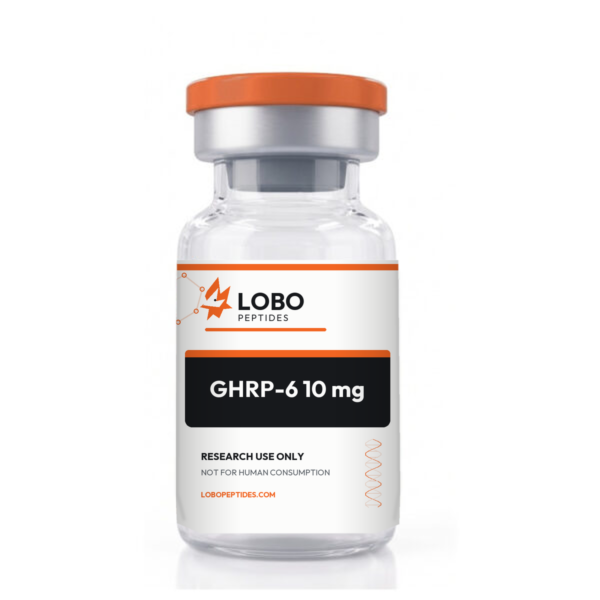
GHRP-6 10mg*10vials
GHRP-6 at 10mg per vial in a 10-vial pack. For research use only (RUO); not for human or veterinary use.
Out of stock
GHRP-6 10mg, 10 vials Product Description
GHRP-6 is listed at 10mg per vial in a pack of ten vials. Primary literature treats it as a defined synthetic hexapeptide studied in secretagogue-receptor and pituitary signaling contexts. Despite a related family name, it is not interchangeable with GHRP-2, ipamorelin, or peptides derived from growth-hormone-releasing hormone.
The displayed amount and pack count are catalog specifications rather than analytical results. The title does not verify sequence, counterion, physical form, water content, measured content, or identity of a particular lot.
A compliant research description should focus on exact naming, identity separation, and the kinds of laboratory models found in peer-reviewed work. Cell-signaling assays and analytical method development are examples of neutral contexts once the reagent is appropriately characterized. The copy should not convert controlled research observations into expected outcomes. Experimental reports should identify the specific lot and documentation used so that findings are not attributed to the family name alone. No certificate values are available in this draft, and no statement about purity, sterility, endotoxin, stability, or analytical performance is implied. The item is for research use only and is not for human or veterinary use. Qualified laboratories should base protocol decisions on their own requirements, the verified identity of the received material, and lot-specific records rather than on a retail family name. Catalog inclusion does not establish fitness for a particular method. Receiving records, chain of custody, reference standards, and acceptance criteria should be defined by the laboratory and documented independently for every lot and presentation.
Research Material Profile
GHRP-6 10mg, 10 vials Research
Cultured pituitary-cell signaling
PMID 7772238 describes experiments in cultured human pituitary somatotroph preparations. Investigators measured phosphatidylinositol turnover and a parallel laboratory-marker response after exposure to defined GHRP-6. The work supports a cell-culture signaling context for the named peptide, but the result is specific to the preparation, experimental conditions, and study reagent. It does not authenticate these vials, establish their sequence or counterion, or show that the supplied lot has a particular activity. A cultured-cell observation also should not be reframed as a whole-organism or clinical result. For research planning, the paper may help identify measurable pathways or controls, provided the laboratory confirms reagent identity and uses a model appropriate to its question. No inference about purity, stability, or expected response is justified from the citation alone. Across interpretations, the publication supports only its reported material and measurements; it does not supply lot-level identity, composition, or quality evidence for this catalog presentation. (PubMed 7772238).
Analytical and pharmacokinetic context
PMID 23099431 reports an LC-MS-based study involving a specified GHRP-6 sequence in nine healthy adult men. The record provides useful analytical context and shows how a defined study material was measured in a controlled research design. It does not verify this catalog lot, and its results cannot establish the content, physical form, or analytical performance of a separate commercial item. The small, selected study population and protocol-bound measurements also prevent broad claims. In a product research panel, the value of this source is methodological: exact sequence and validated measurement matter when linking a named peptide to data. The citation does not support human-use directions, outcome promises, or substitution of a retail material for the characterized research reagent. Across interpretations, the publication supports only its reported material and measurements; it does not supply lot-level identity, composition, or quality evidence for this catalog presentation. (PubMed 23099431).
Keeping adjacent secretagogues separate
GHRP-6, GHRP-2, and ipamorelin appear in related scientific discussions, but evidence for one cannot be assigned to another. The two cited GHRP-6 papers use defined materials and distinct models—a cultured pituitary preparation and a controlled analytical study. Neither describes a 10mg-by-10-vial pack. A retail title that matches the common name is only the start of identity work; sequence, counterion, measured content, and lot traceability remain necessary for reproducibility. Accordingly, this catalog entry is limited to an identity-aware RUO presentation, with no claim about activity, sterility, stability, or suitability for any particular protocol. Across interpretations, the publication supports only its reported material and measurements; it does not supply lot-level identity, composition, or quality evidence for this catalog presentation. (PubMed 7772238 · PubMed 23099431).
Evidence Boundaries
The cited publications describe defined study materials in particular biochemical, cell, animal, or controlled human research settings. They do not authenticate this catalog item, transfer analytical specifications to it, or establish that a nominally similar retail product is equivalent. Model observations must remain attached to the reported species, preparation, protocol, and endpoints. Where the title leaves sequence, chemical form, processing state, physical unit, formulation, or pack details unresolved, this draft leaves them unresolved as well. No purity percentage, sterility status, endotoxin result, stability period, or content assay is inferred. Any stronger conclusion requires lot-specific documentation and, where relevant, direct testing of the exact formulation.
GHRP-6 10mg, 10 vials References
8 curated medical and scientific references used for identity, mechanism, model, and assay context.
- Growth hormone releasing peptide (GHRP-6) stimulates phosphatidylinositol (PI) turnover in human pituitary somatotroph cells.
Lei T, Buchfelder M, Fahlbusch R, Adams EF Growth hormone releasing peptide (GHRP-6) stimulates phosphatidylinositol (PI) turnover in human pituitary somatotroph cells. J Mol Endocrinol. 1995;14(1):135-138. doi:10.1677/jme.0.0140135. PMID:7772238.
GHRP-6 signaling in human pituitary cells · Cultured human pituitary somatotroph-cell phosphatidylinositol-turnover assays.
View research source - Pharmacokinetic study of Growth Hormone-Releasing Peptide 6 (GHRP-6) in nine male healthy volunteers.
Cabrales A, Gil J, Fernández E, Valenzuela C, Hernández F, García I, Hernández A, Besada V, Reyes O, Padrón G, Berlanga J, Guillén G, González LJ Pharmacokinetic study of Growth Hormone-Releasing Peptide 6 (GHRP-6) in nine male healthy volunteers. Eur J Pharm Sci. 2013;48(1-2):40-46. doi:10.1016/j.ejps.2012.10.006. PMID:23099431.
GHRP-6 pharmacokinetics · Controlled pharmacokinetic study in nine healthy male volunteers.
View research source - The effects of GH-releasing peptide-6 (GHRP-6) and GHRP-2 on intracellular adenosine 3',5'-monophosphate (cAMP) levels and GH secretion in ovine and rat somatotrophs.
Wu D, Chen C, Zhang J, Bowers CY, Clarke IJ The effects of GH-releasing peptide-6 (GHRP-6) and GHRP-2 on intracellular adenosine 3',5'-monophosphate (cAMP) levels and GH secretion in ovine and rat somatotrophs. J Endocrinol. 1996;148(2):197-205. doi:10.1677/joe.0.1480197. PMID:8699133.
Direct comparison of GHRP-6 and GHRP-2 · Ovine and rat somatotroph cAMP and GH-secretion assays.
View research source - Regulation of growth hormone secretion by the growth hormone releasing hexapeptide (GHRP-6).
Micic D, Mallo F, Mallo F, Peino R, Cordido F, Leal-Cerro A, Garcia-Mayor RV, Casanueva FF Regulation of growth hormone secretion by the growth hormone releasing hexapeptide (GHRP-6). J Pediatr Endocrinol. 1993;6(3-4):283-289. doi:10.1515/jpem.1993.6.3-4.283. PMID:7920995.
Regulation of GH secretion by GHRP-6 · Human endocrine research and mechanistic interpretation of a defined GHRP-6 preparation.
View research source - Growth hormone secretion after the administration of GHRP-6 or GHRH combined with GHRP-6 does not decline in late adulthood.
Micic D, Popovic V, Kendereski A, Macut D, Casanueva FF, Dieguez C Growth hormone secretion after the administration of GHRP-6 or GHRH combined with GHRP-6 does not decline in late adulthood. Clin Endocrinol (Oxf). 1995;42(2):191-194. doi:10.1111/j.1365-2265.1995.tb01861.x. PMID:7734029.
GHRP-6 alone and with GHRH in older adults · Controlled human endocrine study comparing GHRP-6 and a GHRH/GHRP-6 combination.
View research source - Growth hormone (GH) responses to the combined administration of GH-releasing hormone plus GH-releasing peptide 6 in adults with GH deficiency.
Leal-Cerro A, Garcia E, Astorga R, Casanueva FF, Dieguez C Growth hormone (GH) responses to the combined administration of GH-releasing hormone plus GH-releasing peptide 6 in adults with GH deficiency. Eur J Endocrinol. 1995;132(6):712-715. doi:10.1530/eje.0.1320712. PMID:7788011.
GHRH plus GHRP-6 in adults with GH deficiency · Controlled human endocrine challenge study.
View research source - Determination of growth hormone releasing peptides metabolites in human urine after nasal administration of GHRP-1, GHRP-2, GHRP-6, Hexarelin, and Ipamorelin.
Semenistaya E, Zvereva I, Thomas A, Thevis M, Krotov G, Rodchenkov G Determination of growth hormone releasing peptides metabolites in human urine after nasal administration of GHRP-1, GHRP-2, GHRP-6, Hexarelin, and Ipamorelin. Drug Test Anal. 2015;7(10):919-925. doi:10.1002/dta.1787. PMID:25869809.
Mass-spectrometric differentiation of GHRP metabolites · Human urine LC-MS analytical study after administration of several defined GHRPs.
View research source - Growth hormone response to GHRH, GHRP-6 and GHRH + GHRP-6 in patients with polycystic ovary syndrome.
Micić D, Kendereski A, Popović V, Sumarac M, Zorić S, Macut D, Dieguez C, Casanueva F Growth hormone response to GHRH, GHRP-6 and GHRH + GHRP-6 in patients with polycystic ovary syndrome. Clin Endocrinol (Oxf). 1996;45(4):385-390. doi:10.1046/j.1365-2265.1996.8380848.x. PMID:8959075.
GHRP-6 and GHRH combination research · Controlled endocrine study in participants with polycystic ovary syndrome.
View research source