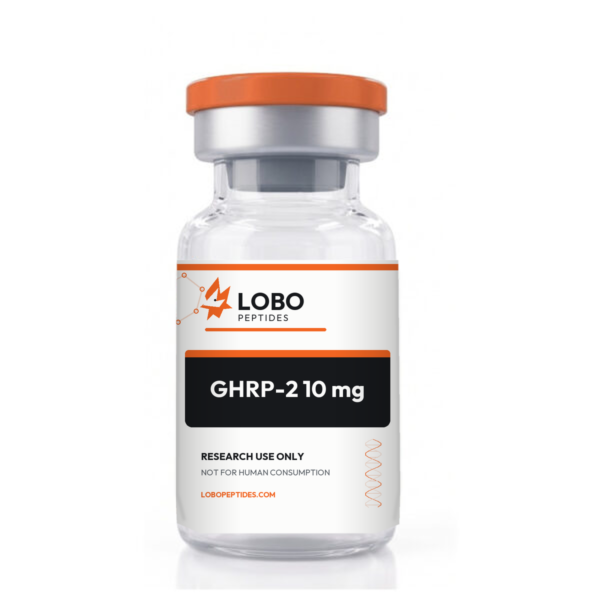
GHRP-2 10mg*10vials
GHRP-2 at 10mg per vial in a 10-vial pack. For research use only (RUO); not for human or veterinary use.
Out of stock
GHRP-2 10mg, 10 vials Product Description
GHRP-2 is presented at 10mg per vial in a 10-vial pack. The compound is also called pralmorelin or KP-102 in primary literature and is studied as a synthetic secretagogue peptide. It is a separate identity from GHRP-6, ipamorelin, sermorelin, and modified GHRH fragments, even when those materials appear in the same research category.
The catalog title and pack notation record the intended identity and nominal amount, not analytical confirmation. They do not provide sequence, counterion, physical form, water content, measured peptide content, or lot identity.
This listing is suitable for neutral catalog description as a named research peptide intended for controlled laboratory investigation. Possible contexts include receptor-pharmacology assay planning, pituitary-cell method comparisons, and analytical confirmation against an authenticated standard. Literature observations should remain tied to the exact study material and model. They should not be presented as guarantees about a catalog lot, and no human-use, administration, or performance message belongs in the product copy. No certificate values are available in this draft, and no statement about purity, sterility, endotoxin, stability, or analytical performance is implied. The item is for research use only and is not for human or veterinary use. Qualified laboratories should base protocol decisions on their own requirements, the verified identity of the received material, and lot-specific records rather than on a retail family name. Catalog inclusion does not establish fitness for a particular method. Receiving records, chain of custody, reference standards, and acceptance criteria should be defined by the laboratory and documented independently for every lot and presentation.
Research Material Profile
GHRP-2 10mg, 10 vials Research
Preclinical KP-102 pharmacology
PMID 15646370 examines KP-102/GHRP-2 in conscious rats, dogs, and isolated pituitary preparations. The study provides primary support for the alias connection and places the defined compound in animal and ex-vivo secretagogue research. Each observation is limited to the species, preparations, endpoints, and characterized study material reported by the investigators. The record does not authenticate this 10mg-by-10-vial product and does not establish its sequence, salt, content, or analytical profile. It also does not permit substitution of findings from GHRP-6 or ipamorelin, which are distinct compounds. For laboratory planning, the source may inform the selection of model-appropriate controls or endpoints, but product-specific identity must be established independently. No statement about the behavior of an untested commercial lot follows from the paper. Across interpretations, the publication supports only its reported material and measurements; it does not supply lot-level identity, composition, or quality evidence for this catalog presentation. (PubMed 15646370).
Controlled human experiment as bounded evidence
PMID 15699539 reports a small controlled experiment in healthy adult men in which researchers measured food intake and circulating laboratory markers during acute exposure to defined GHRP-2. The paper is evidence that this named compound has been used in a controlled human research setting, but it is not a product endorsement and does not validate the catalog item. The selected population, acute design, study material, and measured endpoints limit interpretation. The findings should not be generalized into therapeutic, wellness, body-composition, or performance claims. They also provide no information about the composition or quality of these vials. In RUO copy, this source is best used to show the type of tightly controlled experimental context found in the literature while preserving a strict separation between publication evidence and lot documentation. Across interpretations, the publication supports only its reported material and measurements; it does not supply lot-level identity, composition, or quality evidence for this catalog presentation. (PubMed 15699539).
Identity and reproducibility requirements
The cited animal, ex-vivo, and human research depends on defined GHRP-2 study material. Reproducibility with a catalog reagent requires more than matching the common name and nominal strength. Sequence confirmation, relevant chemical-form information, content assessment, and traceable lot documentation would be needed to compare materials responsibly. Researchers should also keep GHRP-2 distinct from other secretagogue peptides and from GHRH analogs when organizing controls or reporting results. This panel summarizes research context only; it makes no assertion about purity, activity, sterility, stability, or expected experimental outcome for the supplied product. Across interpretations, the publication supports only its reported material and measurements; it does not supply lot-level identity, composition, or quality evidence for this catalog presentation. (PubMed 15646370 · PubMed 15699539).
Evidence Boundaries
The cited publications describe defined study materials in particular biochemical, cell, animal, or controlled human research settings. They do not authenticate this catalog item, transfer analytical specifications to it, or establish that a nominally similar retail product is equivalent. Model observations must remain attached to the reported species, preparation, protocol, and endpoints. Where the title leaves sequence, chemical form, processing state, physical unit, formulation, or pack details unresolved, this draft leaves them unresolved as well. No purity percentage, sterility status, endotoxin result, stability period, or content assay is inferred. Any stronger conclusion requires lot-specific documentation and, where relevant, direct testing of the exact formulation.
GHRP-2 10mg, 10 vials References
8 curated medical and scientific references used for identity, mechanism, model, and assay context.
- Pharmacological characteristics of KP-102 (GHRP-2), a potent growth hormone-releasing peptide.
Doi N, Hirotani C, Ukai K, Shimada O, Okuno T, Kurasaki S, Kiyofuji T, Ikegami R, Futamata M, Nakagawa T, Ase K, Chihara K Pharmacological characteristics of KP-102 (GHRP-2), a potent growth hormone-releasing peptide. Arzneimittelforschung. 2004;54(12):857-867. doi:10.1055/s-0031-1297041. PMID:15646370.
GHRP-2/KP-102 pharmacological characterization · Rat pituitary-cell assays and animal pharmacology experiments.
View research source - Growth hormone releasing peptide-2 (GHRP-2), like ghrelin, increases food intake in healthy men.
Laferrère B, Abraham C, Russell CD, Bowers CY Growth hormone releasing peptide-2 (GHRP-2), like ghrelin, increases food intake in healthy men. J Clin Endocrinol Metab. 2005;90(2):611-614. doi:10.1210/jc.2004-1719. PMID:15699539.
Controlled GHRP-2 study in healthy men · Controlled human study measuring food-intake and endocrine responses.
View research source - Effects of GHRP-2 and hexarelin, two synthetic GH-releasing peptides, on GH, prolactin, ACTH and cortisol levels in man. Comparison with the effects of GHRH, TRH and hCRH.
Arvat E, di Vito L, Maccagno B, Broglio F, Boghen MF, Deghenghi R, Camanni F, Ghigo E Effects of GHRP-2 and hexarelin, two synthetic GH-releasing peptides, on GH, prolactin, ACTH and cortisol levels in man. Comparison with the effects of GHRH, TRH and hCRH. Peptides. 1997;18(6):885-891. doi:10.1016/s0196-9781(97)00016-8. PMID:9285939.
Comparison of GHRP-2 and hexarelin · Controlled human endocrine study comparing defined secretagogues and releasing hormones.
View research source - The effect of GH-releasing peptide-2 (GHRP-2 or KP 102) on GH secretion from primary cultured ovine pituitary cells can be abolished by a specific GH-releasing factor (GRF) receptor antagonist.
Wu D, Chen C, Katoh K, Zhang J, Clarke IJ The effect of GH-releasing peptide-2 (GHRP-2 or KP 102) on GH secretion from primary cultured ovine pituitary cells can be abolished by a specific GH-releasing factor (GRF) receptor antagonist. J Endocrinol. 1994;140(2):R9-13. doi:10.1677/joe.0.140r009. PMID:8169551.
GHRP-2 in cultured ovine pituitary cells · Primary cultured ovine pituitary-cell secretion assays with a GRF-receptor antagonist.
View research source - General pharmacology of KP-102 (GHRP-2), a potent growth hormone-releasing peptide.
Furuta S, Shimada O, Doi N, Ukai K, Nakagawa T, Watanabe J, Imaizumi M General pharmacology of KP-102 (GHRP-2), a potent growth hormone-releasing peptide. Arzneimittelforschung. 2004;54(12):868-880. doi:10.1055/s-0031-1297042. PMID:15646371.
General pharmacology of KP-102/GHRP-2 · Multi-system animal pharmacology testing.
View research source - Physiologically based pharmacokinetic model for pralmorelin hydrochloride in rats.
Nasu R, Kumagai Y, Kogetsu H, Tsujimoto M, Ohtani H, Sawada Y Physiologically based pharmacokinetic model for pralmorelin hydrochloride in rats. Drug Metab Dispos. 2005;33(10):1488-1494. doi:10.1124/dmd.104.001040. PMID:16033952.
Pralmorelin hydrochloride pharmacokinetic model · Rat tissue-distribution and physiologically based pharmacokinetic modeling.
View research source - Determination of growth hormone secretagogue pralmorelin (GHRP-2) and its metabolite in human urine by liquid chromatography/electrospray ionization tandem mass spectrometry.
Okano M, Sato M, Ikekita A, Kageyama S Determination of growth hormone secretagogue pralmorelin (GHRP-2) and its metabolite in human urine by liquid chromatography/electrospray ionization tandem mass spectrometry. Rapid Commun Mass Spectrom. 2010;24(14):2046-2056. doi:10.1002/rcm.4619. PMID:20552695.
Analytical detection of pralmorelin and metabolite · Human urine LC-ESI-MS/MS method development and validation.
View research source - Growth hormone/insulin-like growth factor-1 response to acute and chronic growth hormone-releasing peptide-2, growth hormone-releasing hormone 1-44NH2 and in combination in older men and women with decreased growth hormone secretion.
Bowers CY, Granda-Ayala R Growth hormone/insulin-like growth factor-1 response to acute and chronic growth hormone-releasing peptide-2, growth hormone-releasing hormone 1-44NH2 and in combination in older men and women with decreased growth hormone secretion. Endocrine. 2001;14(1):79-86. doi:10.1385/endo:14:1:079. PMID:11322505.
GHRP-2 and GHRH research in older adults · Controlled human endocrine study of GHRP-2, GHRH(1-44), and their combination.
View research source