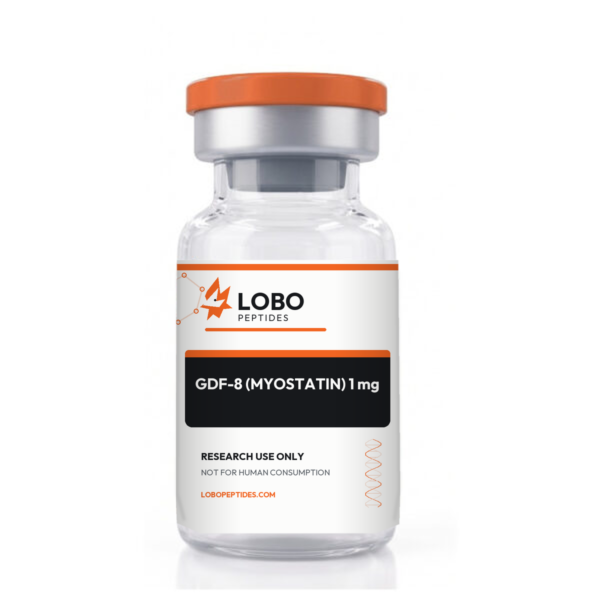
GDF-8 1mg*10vials
GDF-8 labeled 1mg per vial in a 10-vial pack. For research use only (RUO); not for human or veterinary use.
Out of stock
GDF-8 1mg, 10 vials Product Description
The item is labeled GDF-8 at 1mg per vial and ten vials. In primary literature, GDF-8 is the protein also called myostatin, a member of the TGF-beta superfamily. The short title does not state whether the vial contains mature ligand, full precursor, latent complex, isolated propeptide, or another recombinant construction.
Those forms are experimentally non-interchangeable. Processing changes domain composition and can alter what a biochemical or cell-based assay detects. The listing supplies no expression host, sequence boundary, processing state, oligomeric state, carrier, or molecular-mass information. Accordingly, the exact pack count is known while the molecular identity remains unresolved.
The material should be presented as an identity-pending research reagent. Potential neutral contexts include analytical characterization, ligand-processing comparisons, or receptor-binding assay development after the molecular form is confirmed. The catalog must not describe GDF-8 itself as an inhibitor merely because propeptide constructs or pathway inhibitors appear in nearby markets. Any experimental interpretation should identify the form actually tested and avoid transferring observations among precursor, mature ligand, and latent complex. No certificate values are available in this draft, and no statement about purity, sterility, endotoxin, stability, or analytical performance is implied. The item is for research use only and is not for human or veterinary use. Qualified laboratories should base protocol decisions on their own requirements, the verified identity of the received material, and lot-specific records rather than on a retail family name. Catalog inclusion does not establish fitness for a particular method. Receiving records, chain of custody, reference standards, and acceptance criteria should be defined by the laboratory and documented independently for every lot and presentation.
Research Material Profile
GDF-8 1mg, 10 vials Research
Original GDF-8 identification
PMID 9139826 reports the identification of murine GDF-8, its expression pattern, and a gene-disruption experiment in mice. The work established the GDF-8/myostatin naming relationship and investigated biological function through genetics in that animal model. It did not characterize a packaged recombinant reagent and does not indicate which molecular form is present in this listing. A knockout model concerns absence of gene function, which is not equivalent to adding a purified ligand, precursor, propeptide, or latent complex to an assay. The paper is therefore appropriate for identity history and model context only. It cannot support a claim that this vial is an inhibitor, has a specified activity, or will reproduce a genetic phenotype. Product-level conclusions require sequence, processing, and analytical records tied to the supplied lot. Across interpretations, the publication supports only its reported material and measurements; it does not supply lot-level identity, composition, or quality evidence for this catalog presentation. (PubMed 9139826).
Processing and receptor-binding context
PMID 11459935 describes mammalian-cell-derived myostatin as a complex involving an N-terminal propeptide and a disulfide-linked C-terminal mature dimer. In the reported biochemical work, the mature dimer bound activin type II receptors. This paper explains why a bare GDF-8 label is inadequate: precursor, propeptide, latent association, and mature dimer represent distinct molecular states. The article does not authenticate the 1mg vials or establish their expression system, processing state, oligomeric condition, or content. Even if a catalog title uses the same common name, equivalence cannot be assumed without molecular documentation. The source supports a structural and assay distinction, not a product performance statement. Any receptor-binding experiment using this item would need to identify the actual species present and employ controls suited to that form. Across interpretations, the publication supports only its reported material and measurements; it does not supply lot-level identity, composition, or quality evidence for this catalog presentation. (PubMed 11459935).
Catalog interpretation under uncertainty
Taken together, the genetics and biochemical studies define GDF-8 as myostatin while also demonstrating that biological context and molecular processing matter. Neither source resolves whether this product contains mature active ligand, a precursor, a latent complex, a propeptide, or another construct. Those possibilities should not be collapsed into one identity, and literature about a propeptide cannot be used as direct evidence for a mature ligand product. The 1mg-per-vial and 10-vial statements are catalog facts, not analytical measurements. Until lot documentation is available, claims should be confined throughout to the displayed name, pack, and the uncertainty itself. Across interpretations, the publication supports only its reported material and measurements; it does not supply lot-level identity, composition, or quality evidence for this catalog presentation. (PubMed 9139826 · PubMed 11459935).
Evidence Boundaries
The cited publications describe defined study materials in particular biochemical, cell, animal, or controlled human research settings. They do not authenticate this catalog item, transfer analytical specifications to it, or establish that a nominally similar retail product is equivalent. Model observations must remain attached to the reported species, preparation, protocol, and endpoints. Where the title leaves sequence, chemical form, processing state, physical unit, formulation, or pack details unresolved, this draft leaves them unresolved as well. No purity percentage, sterility status, endotoxin result, stability period, or content assay is inferred. Any stronger conclusion requires lot-specific documentation and, where relevant, direct testing of the exact formulation.
GDF-8 1mg, 10 vials References
8 curated medical and scientific references used for identity, mechanism, model, and assay context.
- Regulation of skeletal muscle mass in mice by a new TGF-beta superfamily member.
McPherron AC, Lawler AM, Lee SJ Regulation of skeletal muscle mass in mice by a new TGF-beta superfamily member. Nature. 1997;387(6628):83-90. doi:10.1038/387083a0. PMID:9139826.
Discovery of GDF-8/myostatin and knockout phenotype · Gene-expression work and Gdf8 knockout experiments in mice.
View research source - Regulation of myostatin activity and muscle growth.
Lee SJ, McPherron AC Regulation of myostatin activity and muscle growth. Proc Natl Acad Sci U S A. 2001;98(16):9306-9311. doi:10.1073/pnas.151270098. PMID:11459935.
Myostatin precursor processing and receptor binding · Mammalian-cell protein production, biochemical complex analysis, receptor-binding assays, and mouse experiments.
View research source - Induction of cachexia in mice by systemically administered myostatin.
Zimmers TA, Davies MV, Koniaris LG, Haynes P, Esquela AF, Tomkinson KN, McPherron AC, Wolfman NM, Lee SJ Induction of cachexia in mice by systemically administered myostatin. Science. 2002;296(5572):1486-1488. doi:10.1126/science.1069525. PMID:12029139.
Circulating/overexpressed myostatin in mice · Systemic myostatin administration and overexpression experiments in adult mice.
View research source - Regulation of muscle growth by multiple ligands signaling through activin type II receptors.
Lee SJ, Reed LA, Davies MV, Girgenrath S, Goad ME, Tomkinson KN, Wright JF, Barker C, Ehrmantraut G, Holmstrom J, Trowell B, Gertz B, Jiang MS, Sebald SM, Matzuk M, Li E, Liang LF, Quattlebaum E, Stotish RL, Wolfman NM Regulation of muscle growth by multiple ligands signaling through activin type II receptors. Proc Natl Acad Sci U S A. 2005;102(50):18117-18122. doi:10.1073/pnas.0505996102. PMID:16330774.
Activin type II receptor signaling by multiple ligands · Genetic and soluble-receptor experiments in mice.
View research source - Myostatin is an inhibitor of myogenic differentiation.
Ríos R, Carneiro I, Arce VM, Devesa J Myostatin is an inhibitor of myogenic differentiation. Am J Physiol Cell Physiol. 2002;282(5):C993-9. doi:10.1152/ajpcell.00372.2001. PMID:11940514.
Myostatin effects on myogenic differentiation · Cultured myoblast differentiation assays.
View research source - Characterization of the ligand binding functionality of the extracellular domain of activin receptor type IIb.
Sako D, Grinberg AV, Liu J, Davies MV, Castonguay R, Maniatis S, Andreucci AJ, Pobre EG, Tomkinson KN, Monnell TE, Ucran JA, Martinez-Hackert E, Pearsall RS, Underwood KW, Seehra J, Kumar R Characterization of the ligand binding functionality of the extracellular domain of activin receptor type IIb. J Biol Chem. 2010;285(27):21037-21048. doi:10.1074/jbc.m110.114959. PMID:20385559.
ActRIIB extracellular-domain ligand binding · Biochemical binding-kinetics and structural/functional assays with defined ligands.
View research source - Myostatin precursor protein is increased and associates with amyloid-beta precursor protein in inclusion-body myositis culture model.
Wojcik S, Nogalska A, McFerrin J, Engel WK, Oledzka G, Askanas V Myostatin precursor protein is increased and associates with amyloid-beta precursor protein in inclusion-body myositis culture model. Neuropathol Appl Neurobiol. 2007;33(2):238-242. doi:10.1111/j.1365-2990.2006.00821.x. PMID:17359364.
Myostatin precursor in an inclusion-body-myositis culture model · Cultured human muscle-fiber disease model with protein-expression and association measurements.
View research source - Follistatin induces muscle hypertrophy through satellite cell proliferation and inhibition of both myostatin and activin.
Gilson H, Schakman O, Kalista S, Lause P, Tsuchida K, Thissen JP Follistatin induces muscle hypertrophy through satellite cell proliferation and inhibition of both myostatin and activin. Am J Physiol Endocrinol Metab. 2009;297(1):E157-64. doi:10.1152/ajpendo.00193.2009. PMID:19435857.
Follistatin, myostatin, and activin pathway study · Cellular and mouse muscle experiments.
View research source