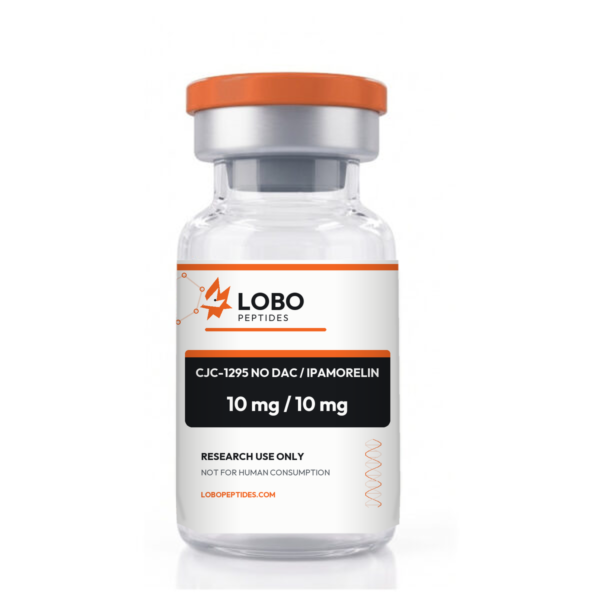
CJC-1295 without DAC 10mg + Ipamorelin 10mg
A 20mg total blend labeled CJC-1295 without DAC 10mg plus Ipamorelin 10mg. For research use only (RUO); not for human or veterinary use.
Out of stock
CJC-1295 without DAC 10mg + Ipamorelin 10mg Product Description
This entry records two named components separately: CJC-1295 without DAC at 10mg and ipamorelin at 10mg, for 20mg total stated content. The 1:1 mass presentation must remain visible because a different ratio is a different experimental formulation. The no-DAC designation also prevents substitution of evidence for albumin-reactive CJC-1295.
The title does not establish the sequence, salt, physical state, or measured content of either component. It also does not establish mixture homogeneity, compatibility, stability, or whether the displayed amount corresponds to one vial. Those questions require formulation- and lot-specific records. A related retail page using 5mg plus 5mg is not an exact strength match and supplies no evidence for this item.
The blend may be cataloged as a dual-component research material for controlled laboratory inquiry, provided every protocol keeps ingredient identity and formulation identity separate. Ingredient papers can guide selection of analytical endpoints or controls, but they cannot demonstrate a combined mechanism or predictable mixture behavior. Appropriate planning would include component-resolved identity assessment and controls that distinguish observations associated with each named reagent from observations unique to the mixture. No certificate values are available in this draft, and no statement about purity, sterility, endotoxin, stability, or analytical performance is implied. The item is for research use only and is not for human or veterinary use. Qualified laboratories should base protocol decisions on their own requirements, the verified identity of the received material, and lot-specific records rather than on a retail family name. Catalog inclusion does not establish fitness for a particular method. Receiving records, chain of custody, reference standards, and acceptance criteria should be defined by the laboratory and documented independently for every lot and presentation.
Research Material Profile
CJC-1295 without DAC 10mg + Ipamorelin 10mg Research
Ipamorelin as a defined ingredient
PMID 9849822 describes ipamorelin as a defined pentapeptide and examines its pharmacology in cultured rat pituitary cells and animal models. The investigators’ observations belong to ipamorelin as studied, not to a co-formulation with a GHRH-family analog. This source can support the ingredient name, peptide class, and model-specific receptor-pharmacology context. It cannot support mixture stability, compatibility, combined signaling, or the content of the 10mg ipamorelin portion in this item. The fixed blend also changes experimental interpretation because two independently active research entities are present together. A laboratory would need controls for the separate ingredients and suitable analytical confirmation before attributing an observation to one component, both components, or a formulation effect. Nothing in the paper authenticates this catalog material or evaluates a 1:1 mass blend. Across interpretations, the publication supports only its reported material and measurements; it does not supply lot-level identity, composition, or quality evidence for this catalog presentation. (PubMed 9849822).
Why the no-DAC boundary matters
PMID 15817669 characterizes a CJC-1295 construct that includes a maleimide-bearing group intended for albumin conjugation. The experiments used cultured rat pituitary cells and rats, and they define the DAC-bearing entity. This listing states without DAC, so the paper functions chiefly as exclusion evidence: the characterized reactive construct is not the identity claimed in the title. The source does not establish the positive sequence of the no-DAC component and does not validate a blend containing ipamorelin. Transferring persistence or conjugation findings would erase the central identity boundary. For rigorous work, the CJC component should be documented independently, including sequence and relevant chemical form, while the mixture itself should be evaluated as a separate formulation. No cited source supplies those records for this 20mg presentation. Across interpretations, the publication supports only its reported material and measurements; it does not supply lot-level identity, composition, or quality evidence for this catalog presentation. (PubMed 15817669).
Fixed-blend evidence limit
No cited primary study directly evaluates CJC-1295 without DAC 10mg plus ipamorelin 10mg as the exact fixed formulation displayed here. Ingredient-level literature can establish that researchers have investigated each named family member in specific models, but it cannot establish synergy, antagonism, compatibility, stability, combined safety, or a reproducible response for the mixture. In an experimental design, the blend should have its own identity and content records, and conclusions should be limited to the verified material and measured endpoints. The displayed total is arithmetic from the title, not an analytical result. This distinction is especially important when comparing data across formulations with different ratios or undocumented physical presentations. Across interpretations, the publication supports only its reported material and measurements; it does not supply lot-level identity, composition, or quality evidence for this catalog presentation. (PubMed 9849822 · PubMed 15817669).
Evidence Boundaries
The cited publications describe defined study materials in particular biochemical, cell, animal, or controlled human research settings. They do not authenticate this catalog item, transfer analytical specifications to it, or establish that a nominally similar retail product is equivalent. Model observations must remain attached to the reported species, preparation, protocol, and endpoints. Where the title leaves sequence, chemical form, processing state, physical unit, formulation, or pack details unresolved, this draft leaves them unresolved as well. No purity percentage, sterility status, endotoxin result, stability period, or content assay is inferred. Any stronger conclusion requires lot-specific documentation and, where relevant, direct testing of the exact formulation.
CJC-1295 without DAC 10mg + Ipamorelin 10mg References
8 curated medical and scientific references used for identity, mechanism, model, and assay context.
- Ipamorelin, the first selective growth hormone secretagogue.
Raun K, Hansen BS, Johansen NL, Thøgersen H, Madsen K, Ankersen M, Andersen PH Ipamorelin, the first selective growth hormone secretagogue. Eur J Endocrinol. 1998;139(5):552-561. doi:10.1530/eje.0.1390552. PMID:9849822.
Ipamorelin identity and secretagogue pharmacology · Isolated rat pituitary-cell assays and rat experiments.
View research source - Pharmacokinetic-pharmacodynamic modeling of ipamorelin, a growth hormone releasing peptide, in human volunteers.
Gobburu JV, Agersø H, Jusko WJ, Ynddal L Pharmacokinetic-pharmacodynamic modeling of ipamorelin, a growth hormone releasing peptide, in human volunteers. Pharm Res. 1999;16(9):1412-1416. doi:10.1023/a:1018955126402. PMID:10496658.
Ipamorelin PK/PD modeling · Controlled human volunteer study with plasma concentration and timed GH measurements.
View research source - Pharmacokinetic evaluation of ipamorelin and other peptidyl growth hormone secretagogues with emphasis on nasal absorption.
Johansen PB, Hansen KT, Andersen JV, Johansen NL Pharmacokinetic evaluation of ipamorelin and other peptidyl growth hormone secretagogues with emphasis on nasal absorption. Xenobiotica. 1998;28(11):1083-1092. doi:10.1080/004982598238976. PMID:9879640.
Comparative disposition of peptidyl GH secretagogues · Animal pharmacokinetic experiments comparing ipamorelin and other defined secretagogues.
View research source - A new series of highly potent growth hormone-releasing peptides derived from ipamorelin.
Ankersen M, Johansen NL, Madsen K, Hansen BS, Raun K, Nielsen KK, Thogersen H, Hansen TK, Peschke B, Lau J, Lundt BF, Andersen PH A new series of highly potent growth hormone-releasing peptides derived from ipamorelin. J Med Chem. 1998;41(19):3699-3704. doi:10.1021/jm9801962. PMID:9733495.
Ipamorelin-derived peptide structure-activity series · Medicinal-chemistry synthesis and pharmacological assays of defined peptide analogues.
View research source - Usefulness of the growth hormone-releasing hormone test regardless of which fragment is used (GHRH 1-44, 1-40 or 1-29).
Laron Z Usefulness of the growth hormone-releasing hormone test regardless of which fragment is used (GHRH 1-44, 1-40 or 1-29). Isr J Med Sci. 1991;27(6):343-345. PMID:2061025.
Comparison of human GHRH fragments · Controlled human diagnostic research comparing GHRH(1-44), GHRH(1-40), and GHRH(1-29).
View research source - Incorporation of D-Ala2 in growth hormone-releasing hormone-(1-29)-NH2 increases the half-life and decreases metabolic clearance in normal men.
Soule S, King JA, Millar RP Incorporation of D-Ala2 in growth hormone-releasing hormone-(1-29)-NH2 increases the half-life and decreases metabolic clearance in normal men. J Clin Endocrinol Metab. 1994;79(4):1208-1211. doi:10.1210/jcem.79.4.7962295. PMID:7962295.
Modified GHRH(1-29) pharmacokinetics · Controlled study in healthy men comparing a D-Ala2-modified GHRH(1-29) analogue with the referenced fragment.
View research source - Human growth hormone-releasing factor (hGRF)1-29-albumin bioconjugates activate the GRF receptor on the anterior pituitary in rats: identification of CJC-1295 as a long-lasting GRF analog.
Jetté L, Léger R, Thibaudeau K, Benquet C, Robitaille M, Pellerin I, Paradis V, van Wyk P, Pham K, Bridon DP Human growth hormone-releasing factor (hGRF)1-29-albumin bioconjugates activate the GRF receptor on the anterior pituitary in rats: identification of CJC-1295 as a long-lasting GRF analog. Endocrinology. 2005;146(7):3052-3058. doi:10.1210/en.2004-1286. PMID:15817669.
DAC-bearing CJC-1295 construct chemistry and pharmacology · Albumin conjugation assays, cultured rat anterior-pituitary cells, and male rat experiments.
View research source - Expression of growth hormone secretagogue-receptors by growth hormone-releasing hormone neurons in the mediobasal hypothalamus.
Tannenbaum GS, Lapointe M, Beaudet A, Howard AD Expression of growth hormone secretagogue-receptors by growth hormone-releasing hormone neurons in the mediobasal hypothalamus. Endocrinology. 1998;139(10):4420-4423. doi:10.1210/endo.139.10.6330. PMID:9751527.
GHS receptor expression on GHRH neurons · Rat hypothalamic neuroanatomy and receptor-expression experiments.
View research source