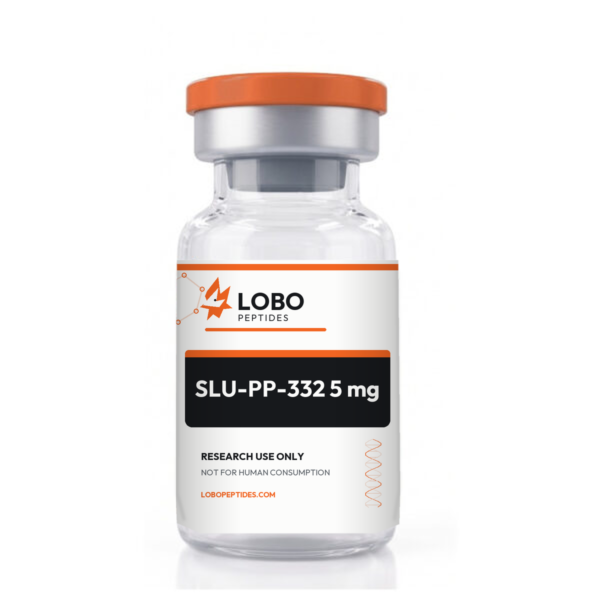
SLU332 5mg
SLU332 5 mg is an identity-pending small-molecule research listing. Published studies in the adjacent field name SLU-PP-332; punctuation and name similarity do not prove that it is the same chemical entity as SLU332. For research use only (RUO); not for human or veterinary use.
Out of stock
SLU332 Product Description
The supplied display name is SLU332, and that name is preserved exactly. Primary studies located for the adjacent research area identify a punctuated compound name, SLU-PP-332. Similar spelling is not chemical proof. Until supplier or lot records provide a chemical name, structure, and molecular form, the Lobo item remains identity-pending and cannot inherit the literature identity of SLU-PP-332.
The 5 mg label records only a nominal amount. It does not establish structure, counterion, solvation state, excipients, container format, or content.
Adjacent primary literature describes SLU-PP-332 as a small-molecule agonist across ERR alpha, beta, and gamma in biochemical and cell-based work, followed by mouse exercise-physiology and diet-challenge models. Separate research studied pan-ERR agonists in cellular and pressure-overload cardiac systems. These sources define a nearby research field but are not evidence about SLU332 without identity confirmation.
This RUO profile is intentionally conservative. It can guide documentation requests and show why exact nomenclature matters, but it cannot present SLU-PP-332 observations as product characteristics. Chemical identity, molecular form, content, purity, sterility where relevant, endotoxin status where relevant, and stability all remain unresolved pending direct lot documentation. The catalog identity and the literature identity are recorded as separate evidence layers so that future documentation can resolve open attributes without rewriting the scientific history or overstating what the current source set demonstrates within defined research boundaries.
Research Material Profile
SLU332 Research
Adjacent biochemical and cell evidence
A primary study characterized the explicitly named compound SLU-PP-332 in biochemical and cell-based systems as an agonist across ERR alpha, beta, and gamma. Those findings apply to the chemical entity used by the investigators, not automatically to the differently written catalog name SLU332. Biochemical receptor assays and cellular response measurements provide distinct evidence layers, each dependent on method, concentration range, controls, and material identity. Because no supplier documentation currently maps SLU332 to SLU-PP-332, the paper is cited only as adjacent nomenclature and field context. It cannot support a claim about this 5 mg item’s target activity, identity, or analytical quality. The appropriate research conclusion is procedural: confirm structure and molecular form before selecting SLU-PP-332 literature as a basis for experimental design. Until then, even a matching nominal amount would not create an exact identity match. (PubMed 36988910).
Adjacent mouse research
The SLU-PP-332 study extended its biochemical and cell work to acute exercise-physiology measurements in mice, and a later paper examined the named compound in diet-challenged mouse models. These observations remain specific to mice, the reported protocols, and the verified study compound. They should not be transformed into claims about a catalog item whose identity has not been resolved. Whole-animal endpoints also cannot substitute for chemical characterization; a label name and nominal 5 mg amount do not establish that the vial contains the compound described in the publications. On this page, the mouse papers demonstrate how the adjacent ERR-agonist research program progressed across models. They provide no evidence for human or veterinary use and no lot-specific conclusion for the supplied SLU332 material. (PubMed 37739806).
Adjacent cardiac-system research
Separate primary work evaluated pan-ERR agonists in cellular systems and a pressure-overload animal model related to cardiac research. That study broadens the adjacent mechanism landscape but does not independently prove that SLU332 is SLU-PP-332 or that this listing contains any particular pan-ERR agonist. Cell and animal observations must remain attached to the exact compounds, models, and methods reported. The source can inform a literature search after identity is confirmed; before confirmation, it is only contextual. This distinction prevents a common catalog error in which similar names are treated as synonyms and downstream biology is assigned to an unverified item. No chemical structure, molecular form, content, purity, or stability statement is made for this product. Direct supplier and lot evidence is the necessary next evidentiary layer. (PubMed 37961903).
Evidence Boundaries
The cited literature supports only the identity and model-qualified research contexts summarized above for SLU332. The label statement “5 mg” is preserved as supplied and is not treated as an analytical measurement. Study findings remain bounded by the reported biochemical assay, cell system, animal species, or controlled participant protocol. Lot-specific identity, content, purity, sterility, endotoxin status, stability, and other unreported specifications remain unknown unless separately documented. No procedural, operational, or outcome guidance is provided.
SLU332 References
7 curated medical and scientific references used for identity, mechanism, model, and assay context.
- Synthetic ERRα/β/γ Agonist Induces an ERRα-Dependent Acute Aerobic Exercise Response and Enhances Exercise Capacity.
Cyrielle Billon, Sadichha Sitaula, Subhashis Banerjee et al.. ACS chemical biology. 2023.
adjacent identity · Biochemical, cellular, and mouse exercise-physiology experiments with SLU-PP-332
View research source - A Synthetic ERR Agonist Alleviates Metabolic Syndrome.
Cyrielle Billon, Emmalie Schoepke, Amer Avdagic et al.. The Journal of pharmacology and experimental therapeutics. 2024.
adjacent identity · Diet-challenged mouse metabolic-disease models using SLU-PP-332
View research source - Novel Pan-ERR Agonists Ameliorate Heart Failure Through Enhancing Cardiac Fatty Acid Metabolism and Mitochondrial Function.
Weiyi Xu, Cyrielle Billon, Hui Li et al.. Circulation. 2024.
adjacent identity · Cellular and pressure-overload cardiac models using pan-ERR agonists
View research source - Estrogen-Related Receptor Agonism Reverses Mitochondrial Dysfunction and Inflammation in the Aging Kidney.
Xiaoxin X Wang, Komuraiah Myakala, Andrew E Libby et al.. The American journal of pathology. 2023.
adjacent identity · Aging-kidney cell and animal research with ERR agonism
View research source - In Vitro Metabolism and Analytical Characterization of SLU-PP-332 and SLU-PP-915: Novel Pan-ERR Agonists With Doping Potential.
Tristan Möller, Oliver Krug, Mario Thevis. Rapid communications in mass spectrometry : RCM. 2026.
method/assay context · In-vitro metabolism and analytical characterization of SLU-PP-332 and SLU-PP-915
View research source - Chemical optimization of the exercise mimetic SLU-PP-332 enables insight into estrogen-related receptor signaling.
Hazem Essam Okda, Puhan Zhao, Matt Hayes et al.. International journal of biological macromolecules. 2026.
adjacent identity · Medicinal-chemistry optimization and ERR signaling assays based on SLU-PP-332
View research source - Analysis and Identification of In Vitro Metabolites of Exercise Mimetic SLU-PP-332 ERRα/β/γ Agonist for Doping-Control Purposes.
Nuraly K Avliyakulov, Tim Sobolevsky, Elizabeth Ahrens. Drug testing and analysis. 2026.
method/assay context · In-vitro metabolite identification for doping-control analysis of SLU-PP-332
View research source