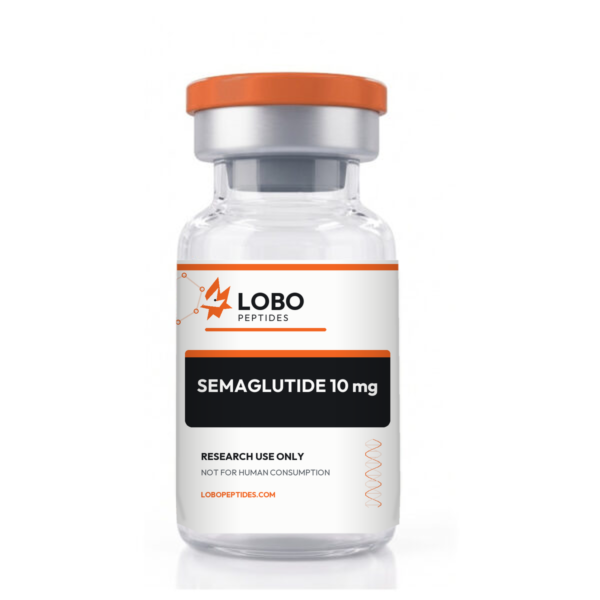
Semaglutide 10mg*10vials
Semaglutide is supplied as ten vials labeled 10 mg each, a nominal labeled pack total of 100 mg that is not a lot-specific analytical result. The molecule is an acylated GLP-1 analogue described in medicinal-chemistry literature. For research use only (RUO); not for human or veterinary use.
Out of stock
Semaglutide Product Description
Semaglutide, also identified in discovery literature as NN9535, is an acylated GLP-1 analogue with reported amino-acid substitutions and a lysine-linked fatty-diacid design. Those structural features define the research identity used in the cited medicinal-chemistry paper. This pack contains ten vials labeled 10 mg each; the 100 mg nominal label total is arithmetic on the supplied format, not proof of measured content.
The RUO pack must remain distinct from any branded or regulator-reviewed finished product. A shared active-molecule name does not establish matching formulation, excipients, manufacturing controls, delivery system, or analytical profile.
The primary source reports a medicinal-chemistry program that compared GLP-1 analogues through receptor assays, albumin-binding experiments, stability work, and nonclinical pharmacokinetic models. Semaglutide was selected within that program. Each experimental layer addresses a distinct question, and none verifies this catalog lot. In particular, receptor activity does not establish formulation quality, while animal exposure measurements remain model-specific.
This page limits discussion to identity, structure-activity research, and assay design. The cited paper supports the analogue’s reported modification pattern and model-qualified characterization. Counterion, excipients, physical state, identity, content, purity, sterility, endotoxin status, and stability for these ten vials remain unresolved pending lot-specific documentation. The catalog identity and the literature identity are recorded as separate evidence layers so that future documentation can resolve open attributes without rewriting the scientific history or overstating what the current source set demonstrates within defined research boundaries.
Research Material Profile
Semaglutide Research
Medicinal-chemistry identity program
A primary medicinal-chemistry study compared GLP-1 analogues and described the substitutions and acylation strategy associated with semaglutide. This work supports the literature identity of the named analogue and shows that analogue selection emerged from a structured design program rather than from the native peptide sequence alone. Structural description is important for catalog interpretation because a general GLP-1 label would not capture the same molecular entity. The publication characterizes study material prepared for its experiments; it does not verify the sequence, modification state, or content of these Lobo vials. The ten-vial format and 10 mg labels come from the catalog record, not from the paper. For this RUO page, the source supports identity-level discussion and research questions about how sequence and acylation changes relate to measured assay behavior. It does not support a finished-product equivalence claim or any human-use guidance. (PubMed 26308095).
Receptor, binding, and stability assays
The same discovery program used cell-based GLP-1 receptor measurements, albumin-binding experiments, and stability studies to compare analogue candidates. These endpoints should remain distinct. Receptor assays describe responses in a specified cellular system; albumin-binding experiments examine interaction under defined conditions; stability methods measure persistence or degradation within the tested matrix and time window. A result in one assay does not automatically predict another, and none proves the analytical quality of an untested commercial lot. The paper provides a useful framework for selecting orthogonal methods when studying an acylated peptide analogue, but any new experiment would require independent material characterization and appropriate controls. This catalog entry therefore presents the assays as examples of published research context, not as specifications that these ten vials are claimed to meet. (PubMed 26308095).
Nonclinical pharmacokinetic context
The medicinal-chemistry paper also reported nonclinical pharmacokinetic work, including minipig studies, for the selected analogue. Those observations are species- and protocol-specific and depend on the precise study preparation, sampling design, and analytical method. They do not establish behavior in another model and do not verify identity, content, or formulation of this RUO pack. Read with the receptor, binding, and stability experiments, the nonclinical data illustrate a staged research program moving from molecular design to assays and then to whole-animal exposure measurement. The evidence remains bounded at every stage. This page does not import conclusions from later clinical literature and does not present the pack as equivalent to a finished pharmaceutical product. Lot-specific testing is required before attaching any analytical statement to the supplied vials. (PubMed 26308095).
Evidence Boundaries
The cited literature supports only the identity and model-qualified research contexts summarized above for Semaglutide. The label statement “10 mg per vial, 10 vials” is preserved as supplied and is not treated as an analytical measurement. Study findings remain bounded by the reported biochemical assay, cell system, animal species, or controlled participant protocol. Lot-specific identity, content, purity, sterility, endotoxin status, stability, and other unreported specifications remain unknown unless separately documented. No procedural, operational, or outcome guidance is provided.
Semaglutide References
8 curated medical and scientific references used for identity, mechanism, model, and assay context.
- Discovery of the Once-Weekly Glucagon-Like Peptide-1 (GLP-1) Analogue Semaglutide.
Jesper Lau, Paw Bloch, Lauge Schäffer et al.. Journal of medicinal chemistry. 2015.
exact identity · Medicinal chemistry, receptor assays, albumin binding, stability, and nonclinical pharmacokinetics
View research source - Once-Weekly Semaglutide in Adults with Overweight or Obesity.
John P H Wilding, Rachel L Batterham, Salvatore Calanna et al.. The New England journal of medicine. 2021.
exact identity · Randomized placebo-controlled phase 3 human trial
View research source - Effect of Continued Weekly Subcutaneous Semaglutide vs Placebo on Weight Loss Maintenance in Adults With Overweight or Obesity: The STEP 4 Randomized Clinical Trial.
Domenica Rubino, Niclas Abrahamsson, Melanie Davies et al.. JAMA. 2021.
exact identity · Randomized withdrawal human trial
View research source - Semaglutide lowers body weight in rodents via distributed neural pathways.
Sanaz Gabery, Casper G Salinas, Sarah J Paulsen et al.. JCI insight. 2020.
exact identity · Rodent studies with neuroanatomical and molecular analyses
View research source - The Discovery and Development of Liraglutide and Semaglutide.
Lotte Bjerre Knudsen, Jesper Lau. Frontiers in endocrinology. 2019.
ingredient/parent context · Discovery-history review by semaglutide developers
View research source - A Placebo-Controlled Trial of Subcutaneous Semaglutide in Nonalcoholic Steatohepatitis.
Philip N Newsome, Kristine Buchholtz, Kenneth Cusi et al.. The New England journal of medicine. 2021.
exact identity · Randomized placebo-controlled phase 2 human trial with histologic endpoints
View research source - Efficacy and safety of once-weekly semaglutide monotherapy versus placebo in patients with type 2 diabetes (SUSTAIN 1): a double-blind, randomised, placebo-controlled, parallel-group, multinational, multicentre phase 3a trial.
Christopher Sorli, Shin-Ichi Harashima, George M Tsoukas et al.. The lancet. Diabetes & endocrinology. 2017.
exact identity · Randomized placebo-controlled phase 3a human trial in type 2 diabetes
View research source - Semaglutide: First Global Approval.
Sohita Dhillon. Drugs. 2018.
ingredient/parent context · Regulatory and clinical-development review
View research source