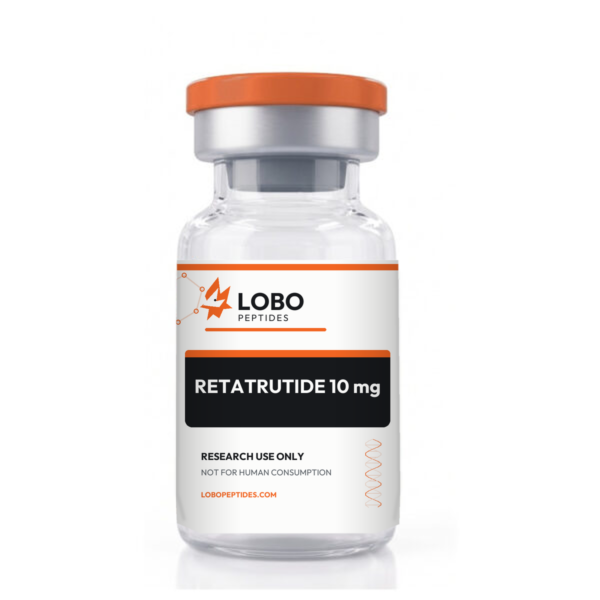
Retatrutide
Retatrutide (LY3437943) research material in nominally labeled 10mg, 15mg, and 20mg one-vial selections. A single GCGR/GIPR/GLP-1R triagonist peptide; not a three-peptide blend. Research use only; not for human or veterinary use.
Retatrutide Product Description
Retatrutide research material is offered in one-vial selections nominally labeled 10mg, 15mg, or 20mg. The literature identifies retatrutide as LY3437943, a single acylated peptide engineered to activate the glucagon receptor (GCGR), glucose-dependent insulinotropic polypeptide receptor (GIPR), and glucagon-like peptide-1 receptor (GLP-1R).
Retatrutide is a single molecular design, not a blend of three peptides. It is distinct from native glucagon, GIP, and GLP-1, and it is not interchangeable with semaglutide, tirzepatide, or other adjacent agonists. Reported receptor activity is not equal across all three receptors and depends on assay conditions.
The selected strength is a nominal catalog amount. It does not establish identity, sequence, modified-residue pattern, acylation state, content, purity, sterility, stability, or equivalence to investigational material used in published studies. No lot-specific certificate of analysis is currently published on this page.
For research use only. Not for human or veterinary use. No preparation, dosing, administration, weight-management, diagnostic, or therapeutic guidance is provided.
Research Material Profile
Retatrutide Research
Receptor and cell-based characterization
In engineered HEK293 systems, LY3437943 produced agonist responses at human GCGR, GIPR, and GLP-1R. The same research program examined glucose-output signaling in human iPSC-derived hepatocytes and lipolysis-related readouts in differentiated human adipocytes. These are receptor and cell-model observations, not organism-level outcomes. (PubMed 35985340).
Animal mechanism studies
Obese-mouse experiments used receptor-blockade designs to separate changes associated with GCGR activation from those linked to GIPR/GLP-1R activity. The reported food-intake, energy-expenditure, body-mass, and glycemic measurements are specific to the animal models and experimental conditions. They do not establish the magnitude or mechanism of any effect in people. (PubMed 35985340).
Early controlled human research
A 12-week phase 1b trial examined safety, tolerability, pharmacokinetics, and pharmacodynamics in 72 adults with type 2 diabetes. It was a small, controlled investigational study, not evidence about this catalog product. (PubMed 36354040).
Phase 2 and imaging substudies
Separate phase 2 trials evaluated prespecified metabolic endpoints and adverse events under controlled protocols. Smaller MRI and DXA substudies examined liver-fat and body-composition measurements in defined participant groups. These investigations used controlled clinical material and cannot validate the identity, quality, or performance of an RUO vial. (PubMed 37366315; PubMed 37385280; PubMed 38858523).
Evidence Boundaries
The literature defines LY3437943 and reports receptor assays, animal experiments, and controlled human investigations. It does not establish that each catalog strength is compositionally identical to study material, nor does it substantiate lot identity, content, purity, sterility, stability, safety, or suitability for administration. Published clinical findings must not be converted into consumer benefit claims or use directions.
References
6 curated scientific sources used for identity, mechanism, model, and assay context.
- LY3437943, a novel triple glucagon, GIP, and GLP-1 receptor agonist for glycemic control and weight loss: From discovery to clinical proof of concept.
Coskun T et al. Cell Metab (2022). PMID 35985340. DOI: 10.1016/j.cmet.2022.07.013.
Discovery, human-receptor assays, cell models, animal studies, and early clinical proof-of-concept research.
View research source - LY3437943, a novel triple GIP, GLP-1, and glucagon receptor agonist in people with type 2 diabetes: a phase 1b, multicentre, double-blind, placebo-controlled, randomised, multiple-ascending dose trial.
Urva S et al. Lancet (2022). PMID 36354040. DOI: 10.1016/S0140-6736(22)02033-5.
Small controlled phase 1b study focused on safety, tolerability, pharmacokinetics, and pharmacodynamics.
View research source - Triple-Hormone-Receptor Agonist Retatrutide for Obesity — A Phase 2 Trial.
Jastreboff AM et al. N Engl J Med (2023). PMID 37366315. DOI: 10.1056/NEJMoa2301972.
Controlled phase 2 human research; it does not validate a commercial RUO vial.
View research source - Retatrutide, a GIP, GLP-1 and glucagon receptor agonist, for people with type 2 diabetes: a randomised, double-blind, placebo and active-controlled, parallel-group, phase 2 trial conducted in the USA.
Rosenstock J et al. Lancet (2023). PMID 37385280. DOI: 10.1016/S0140-6736(23)01053-X.
Controlled phase 2 glycemic and safety research.
View research source - Triple hormone receptor agonist retatrutide for metabolic dysfunction-associated steatotic liver disease: a randomized phase 2a trial.
Sanyal AJ et al. Nat Med (2024). PMID 38858523. DOI: 10.1038/s41591-024-03018-2.
MRI-based liver-fat substudy in a defined participant group.
View research source - Effects of retatrutide on body composition in people with type 2 diabetes: a substudy of a phase 2, double-blind, parallel-group, placebo-controlled, randomised trial.
Coskun T et al. Lancet Diabetes Endocrinol (2025). PMID 40609566. DOI: 10.1016/S2213-8587(25)00092-0.
DXA body-composition substudy within controlled phase 2 research.
View research source