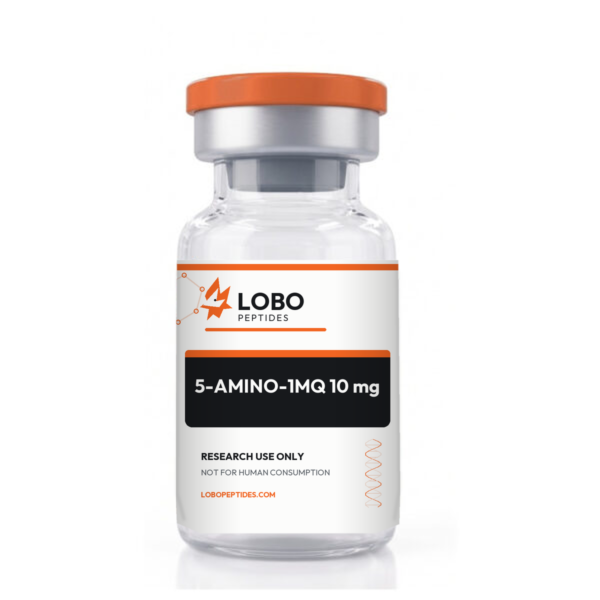
5-Amino-1MQ 10mg
5-Amino-1MQ 10 mg is a small-molecule research item associated in primary literature with nicotinamide N-methyltransferase inhibition. It is not a peptide, and target evidence from genetic NNMT knockdown is kept clearly separate from compound-specific studies. For research use only (RUO); not for human or veterinary use.
Out of stock
5-Amino-1MQ Product Description
5-Amino-1MQ is a small molecule investigated as an inhibitor of nicotinamide N-methyltransferase, an enzyme involved in nicotinamide and methyl-donor metabolism. It should not be categorized as a peptide. The supplied listing states 10 mg but does not establish the exact molecular form, counterion, excipients, physical presentation, or analytical status of a lot.
Two evidence types must remain separate. One cited paper directly characterized a series of NNMT inhibitors that included 5-amino-1-methylquinolinium compounds through enzyme, permeability, cell, and mouse experiments. Another used genetic Nnmt knockdown in mouse adipose tissue. Genetic target manipulation can illuminate pathway biology, but it is not direct evidence that a particular inhibitor or catalog material reproduces the same perturbation.
The relevant research questions are therefore mechanistic and model-specific: how an inhibitor interacts with NNMT in a defined assay, whether it reaches the intended cellular compartment in a cell system, and how pathway markers change in a particular animal model. Results should be attributed to the exact compound and method used. High-fat-diet mouse observations cannot be generalized to other models or treated as evidence about this 10 mg unit.
This RUO profile records identity context without implying a catalog-lot result. Before experimental interpretation, the exact molecular form and lot composition would need independent confirmation. Identity, content, purity, sterility where relevant, endotoxin status where relevant, and stability are not supplied by the label amount or the papers and remain unresolved. The catalog identity and the literature identity are recorded as separate evidence layers so that future documentation can resolve open attributes without rewriting the scientific history or overstating what the current source set demonstrates within defined research boundaries.
Research Material Profile
5-Amino-1MQ Research
Direct inhibitor characterization
Researchers characterized a series of NNMT inhibitors that included 5-amino-1-methylquinolinium compounds using enzyme assays, membrane-permeability work, and cellular experiments. These methods address different gates in compound research: biochemical inhibition asks whether a molecule affects the isolated target under assay conditions, permeability studies examine access across a model barrier, and cell assays place the compound in a more complex system. The paper therefore provides compound-class and mechanism context for 5-Amino-1MQ. Its results remain specific to the reported chemical material and experimental conditions; they do not confirm that this catalog item has the same molecular form, content, or analytical quality. An RUO listing can accurately point to NNMT-inhibitor research while avoiding a promise that an untested lot will match published potency or cell behavior. Independent identity and content testing would be required for that connection. (PubMed 29155147).
High-fat-diet mouse model
The inhibitor study also measured metabolic variables in high-fat-diet mouse models. Those observations are whole-animal and mouse-specific, with interpretation constrained by the diet challenge, strain, experimental controls, compound preparation, and endpoints selected by the investigators. They do not establish a general biological effect and should not be converted into a consumer outcome claim. The mouse work is useful as an example of how NNMT inhibitor hypotheses were extended from biochemical and cell systems into an integrated model. It does not verify this 10 mg listing or resolve its molecular form. For research planning, biochemical target activity, cellular access, and animal-model measurements should remain separate evidence layers, each with its own controls. This page cites the study only to describe that model-qualified research progression. (PubMed 24717514).
Genetic target-context study
A separate study used adipose-tissue Nnmt knockdown in mice to investigate relationships among NNMT, NAD-related metabolism, methyl-donor balance, and energy handling. Because the intervention was genetic rather than 5-Amino-1MQ, the paper supports target rationale only. A genetic reduction can differ from chemical inhibition in timing, tissue distribution, degree of perturbation, and off-target context. It would be methodologically incorrect to present the knockdown observations as direct evidence for this compound, much less for this untested lot. Read alongside the inhibitor paper, the source helps define pathway questions that might be examined with orthogonal tools. It does not establish molecular identity, content, purity, or performance for the Lobo item. The distinction between target biology and compound evidence is retained throughout this listing. (PubMed 29155147 · PubMed 24717514).
Evidence Boundaries
The cited literature supports only the identity and model-qualified research contexts summarized above for 5-Amino-1MQ. The label statement “10 mg” is preserved as supplied and is not treated as an analytical measurement. Study findings remain bounded by the reported biochemical assay, cell system, animal species, or controlled participant protocol. Lot-specific identity, content, purity, sterility, endotoxin status, stability, and other unreported specifications remain unknown unless separately documented. No procedural, operational, or outcome guidance is provided.
5-Amino-1MQ References
7 curated medical and scientific references used for identity, mechanism, model, and assay context.
- Selective and membrane-permeable small molecule inhibitors of nicotinamide N-methyltransferase reverse high fat diet-induced obesity in mice.
Harshini Neelakantan, Virginia Vance, Michael D Wetzel et al.. Biochemical pharmacology. 2018.
exact identity · Enzyme, permeability, cell, and high-fat-diet mouse experiments
View research source - Nicotinamide N-methyltransferase knockdown protects against diet-induced obesity.
Daniel Kraus, Qin Yang, Dong Kong et al.. Nature. 2014.
ingredient/parent context · Adipose Nnmt knockdown and diet-induced-obesity experiments in mice
View research source - Structure-Activity Relationship for Small Molecule Inhibitors of Nicotinamide N-Methyltransferase.
Harshini Neelakantan, Hua-Yu Wang, Virginia Vance et al.. Journal of medicinal chemistry. 2017.
exact identity · Medicinal-chemistry structure-activity and biochemical inhibition assays
View research source - Combined nicotinamide N-methyltransferase inhibition and reduced-calorie diet normalizes body composition and enhances metabolic benefits in obese mice.
Catherine M Sampson, Andrea L Dimet, Harshini Neelakantan et al.. Scientific reports. 2021.
ingredient/parent context · Diet-induced-obesity mouse study combining pharmacologic NNMT inhibition with calorie reduction
View research source - Reduced calorie diet combined with NNMT inhibition establishes a distinct microbiome in DIO mice.
Andrea Dimet-Wiley, Qinglong Wu, Jerrin T Wiley et al.. Scientific reports. 2022.
ingredient/parent context · Diet-induced-obesity mouse microbiome study with NNMT inhibition
View research source - Nicotinamide N-methyltransferase inhibition mitigates obesity-related metabolic dysfunction.
JoAnne J Babula, Dinh Bui, Heather L Stevenson et al.. Diabetes, obesity & metabolism. 2024.
ingredient/parent context · Preclinical obesity-related metabolic dysfunction models
View research source - Mechanisms and inhibitors of nicotinamide N-methyltransferase.
Iredia D Iyamu, Rong Huang. RSC medicinal chemistry. 2021.
ingredient/parent context · Scholarly review of NNMT enzyme mechanisms and inhibitor classes
View research source