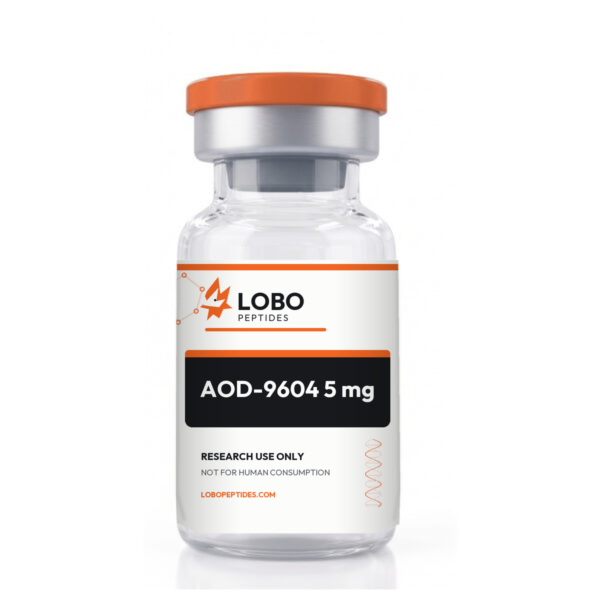
AOD-9604 5mg
AOD-9604, shown at a nominal 5 mg per vial, is the tyrosine-extended human growth hormone 177–191 fragment described in analytical literature. It is distinct from intact growth hormone and other fragments. For research use only (RUO); not for human or veterinary use.
Out of stock
AOD-9604 5mg Product Description
AOD-9604 is described analytically as Tyr-hGH 177–191: the C-terminal 177–191 region of human growth hormone with an additional N-terminal tyrosine. This exact reference should be preserved rather than shortened to an ambiguous parent-hormone description. The product is presented as one vial with a nominal 5 mg amount and no stated pack count. The name and amount do not independently verify sequence, termini, counterion, purity, degradation profile, or lot content.
Its product claims, reported testing, and seller documentation remain separate and are not evidence for Lobo's material.
Neutral contexts include peptide identification, in vitro stability or transformation analysis, receptor-comparison designs, and carefully qualified animal-model studies. The literature does not remove the need to characterize the actual lot or justify an expected result in another system. Source papers are summarized only at the level supported by their reported models, and the catalog language avoids translating experimental observations into promises.
The entry is structured for qualified laboratory review. Before publication or experimental comparison, product-specific records should resolve identity, physical form, component definition where applicable, and the relationship between the nominal label amount and any measured result. Until then, uncertainty is retained as part of the product record rather than replaced with assumptions. Each experiment should record the actual lot, reference standard, assay matrix, controls, instrument method, and acceptance criteria needed for reproducible interpretation.
Research Material Profile
AOD-9604 5mg Research
Obese Zucker rat model
A primary investigation examined AOD-9604 in obese Zucker rats and measured metabolic and adipose-tissue-related endpoints under a defined animal protocol. The paper provides model-specific evidence about the characterized peptide used by the investigators. It does not establish a general outcome, and it does not verify that the Lobo vial has the same sequence, composition, or analytical profile. Rat strain, experimental conditions, test-article provenance, assay selection, and analysis methods are essential qualifiers. On an RUO page, the source is properly used to show that Tyr-hGH 177–191 has been studied in this animal context. It cannot support an outcome promise or replace direct identity testing for the current lot. The nominal 5 mg catalog amount has no analytical link to the publication's material. Interpretation should remain linked to the reported methods, defined comparators, and confirmed test-article identity rather than the shared catalog name. (PubMed 11146367).
Mouse and receptor-knockout comparisons
Another study investigated AOD-9604 in obese mouse models and beta-3-adrenergic-receptor knockout animals, using metabolic and adipose-tissue measurements to examine model-dependent responses. The knockout comparison is useful experimental context because it addresses a specific mechanistic question through genotype-defined groups. Conclusions nevertheless remain bounded by the mouse strains, protocol, endpoint choices, and exact study material. They cannot be generalized to other systems or used to authenticate a retail vial. This paper also does not make intact human growth hormone and AOD-9604 interchangeable; the fragment identity remains Tyr-hGH 177–191. A new laboratory study should preserve that molecular distinction and independently document the supplied test article before comparing observations with the published data. Interpretation should remain linked to the reported methods, defined comparators, and confirmed test-article identity rather than the shared catalog name. (PubMed 11713213).
Analytical identity and in vitro transformation
An analytical study characterized AOD-9604 and products formed during in vitro incubation in serum and urine. This source directly supports the exact Tyr-hGH 177–191 reference and illustrates how analytical methods can distinguish the parent peptide from resulting products over the studied conditions. The experiment was performed in vitro and does not establish behavior in an intact organism or verify the composition of the Lobo vial. Matrix, incubation conditions, sampling schedule, instrument method, reference standards, and assignment criteria all matter to interpretation. For catalog copy, the paper offers a strong identity anchor and a neutral analytical research context. Lot-specific sequence, terminal chemistry, content, and purity still require direct records; the same name and 5 mg display amount on another seller's page do not provide those records. Interpretation should remain linked to the reported methods, defined comparators, and confirmed test-article identity rather than the shared catalog name. (PubMed 25208511).
Evidence Boundaries
The cited literature supports only the exact molecule or ingredient, model, and endpoint described in each source. It does not verify this Lobo lot, establish equivalence to another seller's material, or convert a nominal catalog amount into measured content. Cell, biochemical, microbial, ex vivo, animal, and controlled human research are not interchangeable evidence categories. Where a blend is involved, single-ingredient papers do not establish the fixed formulation, component ratio, interaction, compatibility, stability, combined performance, or combined safety. Where a fragment, probe, analogue, or related strength is involved, that distinction remains explicit. No unreported identity, sequence, termini, counterion, purity, sterility, endotoxin status, residual-solvent result, or other analytical attribute is inferred. The listing supplies research context only and includes no clinical guidance, procedural directions, or expected outcome.
AOD-9604 5mg References
8 curated medical and scientific references used for identity, mechanism, model, and assay context.
- Metabolic studies of a synthetic lipolytic domain (AOD9604) of human growth hormone.
Ng FM, Sun J, Sharma L, et al. Metabolic studies of a synthetic lipolytic domain (AOD9604) of human growth hormone. Hormone research. 2000;53(6):274-8. doi:10.1159/000053183.
Direct AOD9604 animal metabolic study · Obese Zucker rats
View research source - The effects of human GH and its lipolytic fragment (AOD9604) on lipid metabolism following chronic treatment in obese mice and beta(3)-AR knock-out mice.
Heffernan M, Summers RJ, Thorburn A, et al. The effects of human GH and its lipolytic fragment (AOD9604) on lipid metabolism following chronic treatment in obese mice and beta(3)-AR knock-out mice. Endocrinology. 2001;142(12):5182-9. doi:10.1210/endo.142.12.8522.
Direct AOD9604 animal mechanism study · Obese mice and beta3-adrenergic-receptor knockout mice
View research source - Detection and in vitro metabolism of AOD9604.
Cox HD, Smeal SJ, Hughes CM, et al. Detection and in vitro metabolism of AOD9604. Drug testing and analysis. 2015;7(1):31-8. doi:10.1002/dta.1715.
Exact AOD9604 identity and analytical study · Synthetic reference, human serum/urine incubations, and LC–MS detection
View research source - Effect of Intra-articular Injection of AOD9604 with or without Hyaluronic Acid in Rabbit Osteoarthritis Model.
Kwon DR, Park GY. Effect of Intra-articular Injection of AOD9604 with or without Hyaluronic Acid in Rabbit Osteoarthritis Model. Annals of clinical and laboratory science. 2015;45(4):426-32.
Direct AOD9604 animal joint study · Collagenase-induced knee osteoarthritis model in New Zealand White rabbits
View research source - AOD-9604 does not influence the WADA hGH isoform immunoassay.
Orlovius AK, Thomas A, Schänzer W, et al. AOD-9604 does not influence the WADA hGH isoform immunoassay. Drug testing and analysis. 2013;5(11-12):850-2. doi:10.1002/dta.1557.
AOD9604 analytical interference study · WADA hGH isoform immunoassay evaluation
View research source - Increase of fat oxidation and weight loss in obese mice caused by chronic treatment with human growth hormone or a modified C-terminal fragment.
Heffernan MA, Thorburn AW, Fam B, et al. Increase of fat oxidation and weight loss in obese mice caused by chronic treatment with human growth hormone or a modified C-terminal fragment. International journal of obesity and related metabolic disorders : journal of the International Association for the Study of Obesity. 2001;25(10):1442-9. doi:10.1038/sj.ijo.0801740.
Direct modified hGH C-terminal-fragment study · Obese and lean mice plus hGH-receptor binding/proliferation cell assays
View research source - Identification and characterization of peptide drugs in unknown pharmaceutical preparations seized by the Belgian authorities: case report on AOD9604.
Vanhee C, Moens G, Deconinck E, et al. Identification and characterization of peptide drugs in unknown pharmaceutical preparations seized by the Belgian authorities: case report on AOD9604. Drug testing and analysis. 2014;6(9):964-8. doi:10.1002/dta.1687.
Exact-material forensic analytical report · Unknown/seized pharmaceutical preparations analyzed by mass spectrometry
View research source - AOD-9604 Metabolic.
Wilding J. AOD-9604 Metabolic. Current opinion in investigational drugs (London, England : 2000). 2004;5(4):436-40.
Sparse clinical-development record · Drug-development summary of early AOD-9604 studies
View research source