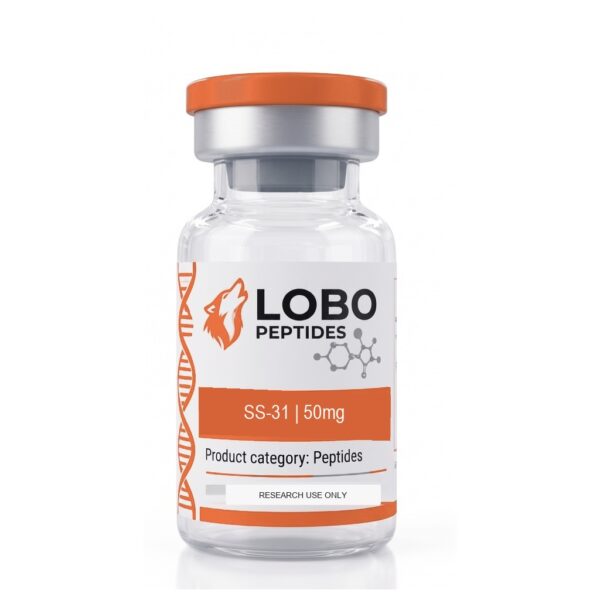
SS-31 50mg
SS-31 research material supplied as one vial labeled at a nominal 50 mg. The canonical unlabeled peptide is distinct from fluorescent probes and related analogues used in some studies. For research use only (RUO); not for human or veterinary use.
Out of stock
button[data-lobo-tab=”coa”]{display:none!important}
(function(){var b=document.querySelector(‘button[data-lobo-tab=”catalog”]’);if(b){b.textContent=’References’;b.setAttribute(‘aria-label’,’References’);b.style.display=’block’;}})();
SS-31 50mg/vial Product Description
SS-31 is a mitochondria-targeted tetrapeptide studied in biochemical, cellular, isolated-organelle, ex vivo, and animal systems. It must remain distinct from other Szeto–Schiller peptides, fluorescent SS-31 probes, and modified comparator analogues. Each bottle contains one vial with a nominal 50 mg amount. The figures are label arithmetic and do not establish concentration, sequence, salt form, purity, or independently measured content.
Neutral framing includes mitochondrial membrane assays, isolated-organelle experiments, fluorescent-probe binding studies, cultured-cell analysis, ex vivo preparations, and defined animal models. Probe findings and analogue comparisons are not identity evidence for the unlabeled Lobo material. Source papers are summarized only at the level supported by their reported models, and the catalog language avoids translating experimental observations into promises.
The entry is structured for qualified laboratory review. Before publication or experimental comparison, product-specific records should resolve identity, physical form, component definition where applicable, and the relationship between the nominal label amount and any measured result. Until then, uncertainty is retained as part of the product record rather than replaced with assumptions. Each experiment should record the actual lot, reference standard, assay matrix, controls, instrument method, and acceptance criteria needed for reproducible interpretation.
Research Material Profile
SS-31 50mg/vial Research
Cells, isolated mitochondria, and ex vivo tissue
A foundational study examined SS-31 in N2A cells, isolated mitochondria, and an ex vivo ischemic-heart preparation while also testing comparator analogues. Investigators measured mitochondrial swelling, oxidative cell-death-associated readouts, and tissue-level endpoints within those controlled systems. The publication supports the statement that SS-31 has been used across cell, organelle, and ex vivo experimental formats. It does not show that this catalog lot is chemically or analytically equivalent to the study material. Analogue results also cannot be reassigned to canonical SS-31 without respecting each sequence difference. For a new RUO experiment, test-article identity, preparation-specific controls, assay calibration, and model provenance would need independent documentation. The nominal vial amount has no evidentiary relationship to the paper and should not be read as an analytical specification. Interpretation should remain linked to the reported methods, defined comparators, and confirmed test-article identity rather than the shared catalog name. (PubMed 15178689).
Cardiolipin-associated biochemical work
Another primary study investigated SS-31 through biochemical assays, a polarity-sensitive fluorescent SS-31 analogue, and a rat renal-ischemia model. The fluorescent construct was useful for the measured interaction work, but adding a label creates a distinct probe whose behavior cannot by itself establish equivalence to an unlabeled commercial vial. The animal observations likewise remain specific to the stated species, model, protocol, and characterized test article. This paper supports cardiolipin-associated research context and illustrates how orthogonal assays can address a mechanistic question. It does not verify sequence, content, purity, or performance for the Lobo product. Any experiment using the current pack should distinguish direct measurements on unlabeled SS-31 from inferences based on a labeled probe and should document all comparator identities. Interpretation should remain linked to the reported methods, defined comparators, and confirmed test-article identity rather than the shared catalog name. (PubMed 23813215).
Rat renal mitochondrial endpoints
A separate rat study measured mitochondrial and renal endpoints following an ischemia–reperfusion protocol with a defined mitochondria-targeted peptide. The report provides an animal-model record associated with SS-31, but its conclusions are inseparable from the species, procedural design, test-article provenance, timing, and endpoint methods. It cannot establish an outcome in another model and cannot authenticate this 50 mg-per-vial listing. The catalog's single-vial configuration is unrelated to the publication's experimental design. For research planning, the source may help identify assay families and model-specific controls, while direct lot documentation remains necessary for any material-level comparison. Interpretation should remain linked to the reported methods, defined comparators, and confirmed test-article identity rather than the shared catalog name. (PubMed 21546574).
Evidence Boundaries
The cited literature supports only the exact molecule or ingredient, model, and endpoint described in each source. It does not verify this Lobo lot, establish equivalence to another seller's material, or convert a nominal catalog amount into measured content. Cell, biochemical, microbial, ex vivo, animal, and controlled human research are not interchangeable evidence categories. Where a blend is involved, single-ingredient papers do not establish the fixed formulation, component ratio, interaction, compatibility, stability, combined performance, or combined safety. Where a fragment, probe, analogue, or related strength is involved, that distinction remains explicit. No unreported identity, sequence, termini, counterion, purity, sterility, endotoxin status, residual-solvent result, or other analytical attribute is inferred. The listing supplies research context only and includes no clinical guidance, procedural directions, or expected outcome.
SS-31 50mg/vial References
8 curated medical and scientific references used for identity, mechanism, model, and assay context.
- Cell-permeable peptide antioxidants targeted to inner mitochondrial membrane inhibit mitochondrial swelling, oxidative cell death, and reperfusion injury.
Zhao K, Zhao GM, Wu D, et al. Cell-permeable peptide antioxidants targeted to inner mitochondrial membrane inhibit mitochondrial swelling, oxidative cell death, and reperfusion injury. The Journal of biological chemistry. 2004;279(33):34682-90. doi:10.1074/jbc.M402999200.
Direct SS-31 preclinical mechanism study · N2A cells, isolated mitochondria, and ex-vivo ischemic-heart model
View research source - Mitochondria-targeted peptide accelerates ATP recovery and reduces ischemic kidney injury.
Szeto HH, Liu S, Soong Y, et al. Mitochondria-targeted peptide accelerates ATP recovery and reduces ischemic kidney injury. Journal of the American Society of Nephrology : JASN. 2011;22(6):1041-52. doi:10.1681/ASN.2010080808.
Direct SS-31 animal study · Rat renal ischemia–reperfusion model
View research source - The mitochondrial-targeted compound SS-31 re-energizes ischemic mitochondria by interacting with cardiolipin.
Birk AV, Liu S, Soong Y, et al. The mitochondrial-targeted compound SS-31 re-energizes ischemic mitochondria by interacting with cardiolipin. Journal of the American Society of Nephrology : JASN. 2013;24(8):1250-61. doi:10.1681/ASN.2012121216.
Direct SS-31 cardiolipin mechanism study · Biochemical assays, fluorescent SS-31 analogue, and rat renal-ischemia model
View research source - Targeting mitochondrial cardiolipin and the cytochrome c/cardiolipin complex to promote electron transport and optimize mitochondrial ATP synthesis.
Birk AV, Chao WM, Bracken C, et al. Targeting mitochondrial cardiolipin and the cytochrome c/cardiolipin complex to promote electron transport and optimize mitochondrial ATP synthesis. British journal of pharmacology. 2014;171(8):2017-28. doi:10.1111/bph.12468.
SS-31 mechanism review/experimental synthesis · Cardiolipin and cytochrome-c biochemical literature with mitochondrial respiration context
View research source - First-in-class cardiolipin-protective compound as a therapeutic agent to restore mitochondrial bioenergetics.
Szeto HH. First-in-class cardiolipin-protective compound as a therapeutic agent to restore mitochondrial bioenergetics. British journal of pharmacology. 2014;171(8):2029-50. doi:10.1111/bph.12461.
SS-31 cardiolipin-focused review · Review of mitochondrial bioenergetics and preclinical SS-31 findings
View research source - Mitochondrial protein interaction landscape of SS-31.
Chavez JD, Tang X, Campbell MD, et al. Mitochondrial protein interaction landscape of SS-31. Proceedings of the National Academy of Sciences of the United States of America. 2020;117(26):15363-15373. doi:10.1073/pnas.2002250117.
Direct SS-31 protein-interaction study · Mitochondrial proteomics and biochemical interaction analyses
View research source - The mitochondria-targeted peptide SS-31 binds lipid bilayers and modulates surface electrostatics as a key component of its mechanism of action.
Mitchell W, Ng EA, Tamucci JD, et al. The mitochondria-targeted peptide SS-31 binds lipid bilayers and modulates surface electrostatics as a key component of its mechanism of action. The Journal of biological chemistry. 2020;295(21):7452-7469. doi:10.1074/jbc.RA119.012094.
Direct SS-31 membrane-biophysics study · Model lipid bilayers and membrane electrostatics assays
View research source - Elamipretide Improves Mitochondrial Function in the Failing Human Heart.
Chatfield KC, Sparagna GC, Chau S, et al. Elamipretide Improves Mitochondrial Function in the Failing Human Heart. JACC. Basic to translational science. 2019;4(2):147-157. doi:10.1016/j.jacbts.2018.12.005.
Direct elamipretide human-tissue study · Failing and nonfailing human heart tissue/mitochondrial preparations ex vivo
View research source