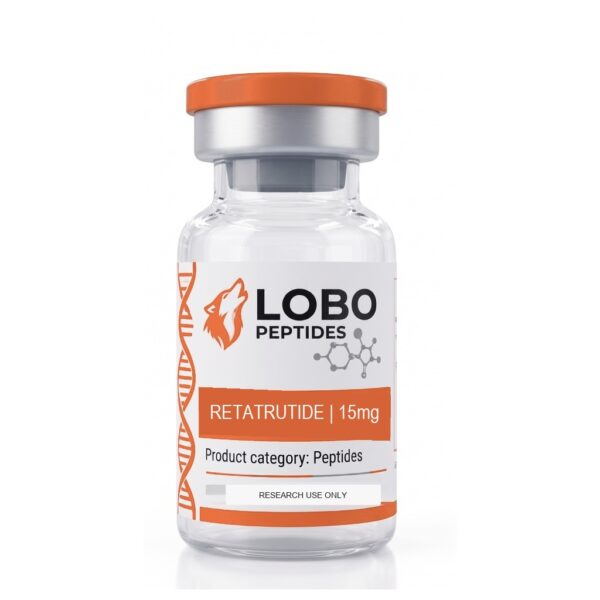
Retatrutide 15mg
Retatrutide, also designated LY3437943 in the scientific literature, supplied as one vial labeled at a nominal 15 mg. It is a single multi-receptor peptide, not a three-ingredient blend. For research use only (RUO); not for human or veterinary use.
Out of stock
button[data-lobo-tab=”coa”]{display:none!important}
(function(){var b=document.querySelector(‘button[data-lobo-tab=”catalog”]’);if(b){b.textContent=’References’;b.setAttribute(‘aria-label’,’References’);b.style.display=’block’;}})();
Retatrutide 15mg/vial Product Description
Retatrutide is the literature name for LY3437943, a single peptide studied as an agonist at glucagon, GIP, and GLP-1 receptors. The three receptor targets do not mean the material is a mixture of three compounds. Each bottle contains one vial labeled at a nominal 15 mg. These label quantities do not establish concentration, sequence, molecular form, counterion, purity, or measured lot content.
A missing comparator is preserved as a substantive result rather than replaced with a nearby molecule, editorial article, or different seller's listing.
Appropriate research framing includes receptor pharmacology, cell-signaling comparisons, nonclinical model analysis, and review of controlled investigational studies. Published findings concern characterized study materials and cannot authenticate or predict the behavior of this RUO pack. Source papers are summarized only at the level supported by their reported models, and the catalog language avoids translating experimental observations into promises.
The entry is structured for qualified laboratory review. Before publication or experimental comparison, product-specific records should resolve identity, physical form, component definition where applicable, and the relationship between the nominal label amount and any measured result. Until then, uncertainty is retained as part of the product record rather than replaced with assumptions. Each experiment should record the actual lot, reference standard, assay matrix, controls, instrument method, and acceptance criteria needed for reproducible interpretation.
Research Material Profile
Retatrutide 15mg/vial Research
Discovery and receptor characterization
Discovery researchers characterized LY3437943 through receptor assays, cultured-cell systems, nonclinical models, and an early controlled human investigation. The paper supports the description of retatrutide as one peptide with activity studied at glucagon, GIP, and GLP-1 receptors. It does not support describing the material as a blend, and it does not establish that a catalog vial has the same sequence, conformation, formulation, or analytical profile as the study compound. Assay platform, receptor expression, comparator selection, species, and test-article provenance are central to interpretation. For RUO catalog purposes, the source supplies identity and pharmacology context only. The nominal 15 mg per-vial amount is a seller-displayed quantity that remain separate from the paper's data and require lot-specific confirmation. Interpretation should remain linked to the reported methods, defined comparators, and confirmed test-article identity rather than the shared catalog name. (PubMed 35985340).
Phase 2 controlled study context
A phase 2 controlled study evaluated characterized retatrutide in a specifically enrolled population and reported prespecified metabolic outcomes. That evidence is bound to the protocol, participant criteria, investigational supply, comparator structure, and statistical analysis described by the authors. It cannot validate Lobo's sequence, nominal content, purity, or equivalence, and it is not a source of catalog-use instructions. On this page, the study is included only to map the molecule's research history and to distinguish controlled investigational evidence from claims about an RUO product. No expected result is assigned to the single-vial product. A laboratory comparison would need direct analytical information for the actual lot as well as methods and controls appropriate to the selected experimental system. Interpretation should remain linked to the reported methods, defined comparators, and confirmed test-article identity rather than the shared catalog name. (PubMed 37366315).
Independent controlled research record
Another phase 2 report studied retatrutide under a separate controlled protocol in a defined population. Its inclusion provides a second primary record associated with the exact literature identity, not a commercial endorsement or a bridge to this product's quality. Clinical protocol findings cannot be generalized to uncharacterized research material, and the report does not establish the physical or chemical attributes of any Lobo vial. Researchers should keep source categories separate: PubMed records support literature context, the Lobo title supplies nominal catalog configuration, and future lot records would be needed for product-specific analytical statements. None of those layers should be substituted for another. Interpretation should remain linked to the reported methods, defined comparators, and confirmed test-article identity rather than the shared catalog name. (PubMed 37385280).
Evidence Boundaries
The cited literature supports only the exact molecule or ingredient, model, and endpoint described in each source. It does not verify this Lobo lot, establish equivalence to another seller's material, or convert a nominal catalog amount into measured content. Cell, biochemical, microbial, ex vivo, animal, and controlled human research are not interchangeable evidence categories. Where a blend is involved, single-ingredient papers do not establish the fixed formulation, component ratio, interaction, compatibility, stability, combined performance, or combined safety. Where a fragment, probe, analogue, or related strength is involved, that distinction remains explicit. No unreported identity, sequence, termini, counterion, purity, sterility, endotoxin status, residual-solvent result, or other analytical attribute is inferred. The listing supplies research context only and includes no clinical guidance, procedural directions, or expected outcome.
Retatrutide 15mg/vial References
8 curated medical and scientific references used for identity, mechanism, model, and assay context.
- LY3437943, a novel triple glucagon, GIP, and GLP-1 receptor agonist for glycemic control and weight loss: From discovery to clinical proof of concept.
Coskun T, Urva S, Roell WC, et al. LY3437943, a novel triple glucagon, GIP, and GLP-1 receptor agonist for glycemic control and weight loss: From discovery to clinical proof of concept. Cell metabolism. 2022;34(9):1234-1247.e9. doi:10.1016/j.cmet.2022.07.013.
Retatrutide discovery and translational study · Receptor assays, nonclinical models, and early controlled human research
View research source - Triple-Hormone-Receptor Agonist Retatrutide for Obesity – A Phase 2 Trial.
Jastreboff AM, Kaplan LM, Frías JP, et al. Triple-Hormone-Receptor Agonist Retatrutide for Obesity – A Phase 2 Trial. The New England journal of medicine. 2023;389(6):514-526. doi:10.1056/NEJMoa2301972.
Retatrutide phase 2 randomized trial · Adults with obesity in a controlled participant study
View research source - Retatrutide, a GIP, GLP-1 and glucagon receptor agonist, for people with type 2 diabetes: a randomised, double-blind, placebo and active-controlled, parallel-group, phase 2 trial conducted in the USA.
Rosenstock J, Frias J, Jastreboff AM, et al. Retatrutide, a GIP, GLP-1 and glucagon receptor agonist, for people with type 2 diabetes: a randomised, double-blind, placebo and active-controlled, parallel-group, phase 2 trial conducted in the USA. Lancet (London, England). 2023;402(10401):529-544. doi:10.1016/S0140-6736(23)01053-X.
Retatrutide phase 2 randomized trial · Adults with type 2 diabetes in placebo- and active-controlled research
View research source - Structural insights into the triple agonism at GLP-1R, GIPR and GCGR manifested by retatrutide.
Li W, Zhou Q, Cong Z, et al. Structural insights into the triple agonism at GLP-1R, GIPR and GCGR manifested by retatrutide. Cell discovery. 2024;10(1):77. doi:10.1038/s41421-024-00700-0.
Retatrutide structural pharmacology study · Cryo-EM/receptor structural analysis and receptor-signaling assays
View research source - Triple hormone receptor agonist retatrutide for metabolic dysfunction-associated steatotic liver disease: a randomized phase 2a trial.
Sanyal AJ, Kaplan LM, Frias JP, et al. Triple hormone receptor agonist retatrutide for metabolic dysfunction-associated steatotic liver disease: a randomized phase 2a trial. Nature medicine. 2024;30(7):2037-2048. doi:10.1038/s41591-024-03018-2.
Retatrutide phase 2a imaging substudy · Adults with metabolic dysfunction-associated steatotic liver disease
View research source - LY3437943, a novel triple GIP, GLP-1, and glucagon receptor agonist in people with type 2 diabetes: a phase 1b, multicentre, double-blind, placebo-controlled, randomised, multiple-ascending dose trial.
Urva S, Coskun T, Loh MT, et al. LY3437943, a novel triple GIP, GLP-1, and glucagon receptor agonist in people with type 2 diabetes: a phase 1b, multicentre, double-blind, placebo-controlled, randomised, multiple-ascending dose trial. Lancet (London, England). 2022;400(10366):1869-1881. doi:10.1016/S0140-6736(22)02033-5.
LY3437943 phase 1b controlled study · Adults with type 2 diabetes in a multiple-ascending-dose randomized trial
View research source - Effects of retatrutide on body composition in people with type 2 diabetes: a substudy of a phase 2, double-blind, parallel-group, placebo-controlled, randomised trial.
Coskun T, Wu Q, Schloot NC, et al. Effects of retatrutide on body composition in people with type 2 diabetes: a substudy of a phase 2, double-blind, parallel-group, placebo-controlled, randomised trial. The lancet. Diabetes & endocrinology. 2025;13(8):674-684. doi:10.1016/S2213-8587(25)00092-0.
Retatrutide phase 2 body-composition substudy · Adults with type 2 diabetes assessed by body-composition methods
View research source - Efficacy and Safety of GLP-1 Medicines for Type 2 Diabetes and Obesity.
Drucker DJ. Efficacy and Safety of GLP-1 Medicines for Type 2 Diabetes and Obesity. Diabetes care. 2024;47(11):1873-1888. doi:10.2337/dci24-0003.
Incretin-drug consensus review; not lot evidence · Expert review of GLP-1–based medicines and clinical evidence
View research source