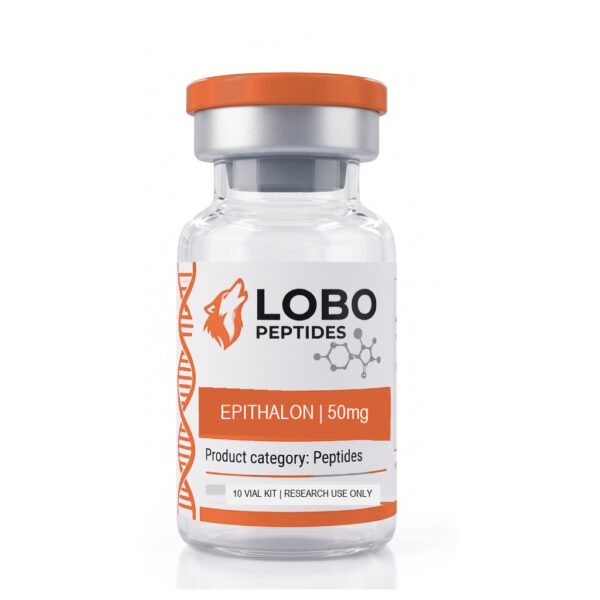
Epithalon 50mg — 10-Vial Kit
Epithalon research pack containing 10 vials at a nominal 50 mg per vial, with a nominal 500 mg total across the pack. Literature also uses the spelling Epitalon for AEDG. For research use only (RUO); not for human or veterinary use.
Out of stock
Epithalon 50mg/vial, 10 vials Product Description
Primary papers use Epithalon and Epitalon as transliterations for the synthetic tetrapeptide Ala-Glu-Asp-Gly, abbreviated AEDG. The catalog name does not itself verify sequence, terminal chemistry, counterion, or lot composition. This listing is a ten-vial pack, not a single 500 mg container. The nominal 50 mg value applies to each vial and yields a nominal 500 mg pack total by arithmetic. Neither amount represents concentration, purity, or independently assayed content.
It provides a related layout reference only; its claims and documentation cannot establish any attribute of Lobo's larger multi-vial pack.
Neutral research contexts include sequence confirmation, chromatographic characterization, transcript measurements, and species-specific experimental models. Reported observations must remain attached to the exact organism, illumination setting, tissue, developmental stage, and test article used. Source papers are summarized only at the level supported by their reported models, and the catalog language avoids translating experimental observations into promises.
The entry is structured for qualified laboratory review. Before publication or experimental comparison, product-specific records should resolve identity, physical form, component definition where applicable, and the relationship between the nominal label amount and any measured result. Until then, uncertainty is retained as part of the product record rather than replaced with assumptions. Each experiment should record the actual lot, reference standard, assay matrix, controls, instrument method, and acceptance criteria needed for reproducible interpretation.
Research Material Profile
Epithalon 50mg/vial, 10 vials Research
Female-rat illumination model
A primary study explicitly identified Epithalon as Ala-Glu-Asp-Gly and examined female rats maintained under standard, natural, or constant illumination conditions. The researchers reported species- and environment-specific observations, with illumination regime functioning as a central experimental variable. This source supports the AEDG identity used in literature and shows why context cannot be removed from a result. It does not justify a broad longevity, prevention, or clinical statement, and it does not verify any property of the Lobo vials. The test article, animal strain, environmental design, observation period, and endpoint definitions all belong to the publication's result. For an RUO catalog, the paper is most useful as identity context and as an example of a controlled animal design. Direct lot characterization would still be required before comparing a new experiment with the published work. Interpretation should remain linked to the reported methods, defined comparators, and confirmed test-article identity rather than the shared catalog name. (PubMed 18856211).
Mouse-brain transcript experiment
Another study described the same tetrapeptide and examined gene-expression measurements in mouse brain. Investigators reported changes in a subset of transcripts and discussed tissue-specific patterns within that experimental system. The evidence supports saying that AEDG has appeared in transcript-focused animal research; it does not establish a universal transcriptional effect or a result for an undocumented commercial lot. Platform technology, tissue collection, normalization, comparator selection, and statistical thresholds all influence interpretation. A laboratory using this pack would need prespecified endpoints, suitable controls, and independent verification of the supplied material before drawing a comparison. The nominal 50 mg per vial and 500 mg pack total are catalog quantities only and have no analytical connection to the paper's characterized material. Interpretation should remain linked to the reported methods, defined comparators, and confirmed test-article identity rather than the shared catalog name. (PubMed 15723138).
Drosophila developmental-exposure model
A Drosophila study used the spelling Epitalon and identified the compound as synthetic Ala-Glu-Asp-Gly. The work involved Canton-S flies and a developmental-exposure design, making species and life-stage context essential to interpretation. Insect observations cannot be generalized to other organisms, and the publication does not establish identity, content, or performance for this ten-vial listing. Its value for the catalog record is narrower: it corroborates the alternate spelling and AEDG sequence in primary literature while illustrating another model in which the tetrapeptide was studied. Experimental conditions, genetic background, environmental controls, and endpoint definitions would need to be reviewed in the paper itself. Nothing in the citation supports a generalized outcome message or any expected result for this RUO material. Interpretation should remain linked to the reported methods, defined comparators, and confirmed test-article identity rather than the shared catalog name. (PubMed 11087911).
Evidence Boundaries
The cited literature supports only the exact molecule or ingredient, model, and endpoint described in each source. It does not verify this Lobo lot, establish equivalence to another seller's material, or convert a nominal catalog amount into measured content. Cell, biochemical, microbial, ex vivo, animal, and controlled human research are not interchangeable evidence categories. Where a blend is involved, single-ingredient papers do not establish the fixed formulation, component ratio, interaction, compatibility, stability, combined performance, or combined safety. Where a fragment, probe, analogue, or related strength is involved, that distinction remains explicit. No unreported identity, sequence, termini, counterion, purity, sterility, endotoxin status, residual-solvent result, or other analytical attribute is inferred. The listing supplies research context only and includes no clinical guidance, procedural directions, or expected outcome.
Epithalon 50mg/vial, 10 vials References
8 curated medical and scientific references used for identity, mechanism, model, and assay context.
- Effect of epitalon on the lifespan increase in Drosophila melanogaster.
Khavinson VK, Izmaylov DM, Obukhova LK, et al. Effect of epitalon on the lifespan increase in Drosophila melanogaster. Mechanisms of ageing and development. 2000;120(1-3):141-9. doi:10.1016/s0047-6374(00)00217-7.
Direct Epitalon identity and insect study · Canton-S Drosophila developmental-exposure model
View research source - Effect of melatonin and tetrapeptide on gene expression in mouse brain.
Anisimov SV, Khavinson VKh, Anisimov VN. Effect of melatonin and tetrapeptide on gene expression in mouse brain. Bulletin of experimental biology and medicine. 2004;138(5):504-9. doi:10.1007/s10517-005-0082-z.
Direct Epithalon/AEDG gene-expression study · CBA mouse brain microarray study
View research source - Effect of Ala-Glu-Asp-Gly peptide on life span and development of spontaneous tumors in female rats exposed to different illumination regimes.
Vinogradova IA, Bukalev AV, Zabezhinski MA, et al. Effect of Ala-Glu-Asp-Gly peptide on life span and development of spontaneous tumors in female rats exposed to different illumination regimes. Bulletin of experimental biology and medicine. 2007;144(6):825-30. doi:10.1007/s10517-007-0441-z.
Direct Epithalon/AEDG rat study · Female rats under standard, natural, and constant illumination regimes
View research source - Epithalon decelerates aging and suppresses development of breast adenocarcinomas in transgenic her-2/neu mice.
Anisimov VN, Khavinson VKh, Alimova IN, et al. Epithalon decelerates aging and suppresses development of breast adenocarcinomas in transgenic her-2/neu mice. Bulletin of experimental biology and medicine. 2002;134(2):187-90. doi:10.1023/a:1021104819170.
Direct Epithalon animal study · HER-2/neu transgenic mouse model
View research source - Synthetic tetrapeptide epitalon restores disturbed neuroendocrine regulation in senescent monkeys.
Khavinson V, Goncharova N, Lapin B. Synthetic tetrapeptide epitalon restores disturbed neuroendocrine regulation in senescent monkeys. Neuro endocrinology letters. 2001;22(4):251-4.
Direct Epitalon nonhuman-primate study · Aged monkeys evaluated with neuroendocrine laboratory measurements
View research source - Epitalon protects against post-ovulatory aging-related damage of mouse oocytes in vitro.
Yue X, Liu SL, Guo JN, et al. Epitalon protects against post-ovulatory aging-related damage of mouse oocytes in vitro. Aging. 2022;14(7):3191-3202. doi:10.18632/aging.204007.
Direct Epitalon cell/oocyte study · Post-ovulatory aged mouse oocytes studied in vitro
View research source - AEDG Peptide (Epitalon) Stimulates Gene Expression and Protein Synthesis during Neurogenesis: Possible Epigenetic Mechanism.
Khavinson V, Diomede F, Mironova E, et al. AEDG Peptide (Epitalon) Stimulates Gene Expression and Protein Synthesis during Neurogenesis: Possible Epigenetic Mechanism. Molecules (Basel, Switzerland). 2020;25(3). doi:10.3390/molecules25030609.
Direct AEDG/Epitalon mechanistic study · Human neuronal differentiation cell model with gene-expression and protein assays
View research source - Peptide promotes overcoming of the division limit in human somatic cell.
Khavinson VKh, Bondarev IE, Butyugov AA, et al. Peptide promotes overcoming of the division limit in human somatic cell. Bulletin of experimental biology and medicine. 2004;137(5):503-6. doi:10.1023/b:bebm.0000038164.49947.8c.
Direct Epitalon cell-culture study · Human somatic-cell cultures assessed for proliferative limit and telomerase-related endpoints
View research source