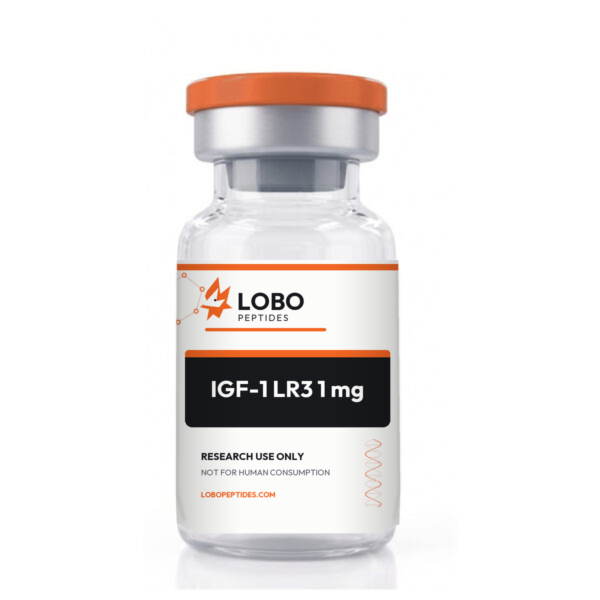
IGF-1 LR3 1mg
IGF-1 LR3 1 mg is the long R3 IGF-I analogue, distinguished from native IGF-I by a residue substitution and an N-terminal extension. For research use only (RUO); not for human or veterinary use.
Out of stock
IGF-1 LR3 Product Description
Long R3 IGF-I is a modified IGF-I analogue rather than native IGF-I. Primary structural work describes an Arg substitution at residue 3 together with a 13-residue N-terminal extension. Those features define the literature identity relevant to this listing. The catalog amount is 1 mg, but the label does not establish folding state, counterion, excipients, physical format, or any analytical result for a specific lot.
The distinction from native IGF-I is experimentally important. Sequence modification can affect folding behavior and interactions with IGF-binding proteins, which in turn can alter assay interpretation. The product name should also not be generalized to other IGF analogues.
The supplied primary literature covers three different levels of investigation: biochemical mapping of disulfide-folding intermediates, comparisons involving IGF-binding-protein affinity in guinea pigs, and receptor-phosphorylation measurements in cultured cells with IGFBP-3 present. Each source addresses a bounded question. Together they establish useful research context for the analogue, but they do not establish commercial-lot identity or a universal biological response.
This entry is framed for qualified laboratory evaluation of structure, binding context, and signaling assays. Any experiment should distinguish the analogue from native IGF-I in controls and documentation. Lot-specific identity, content, purity, sterility, endotoxin status, aggregation, and stability remain unresolved and cannot be inferred from the 1 mg label or from literature on separately prepared research material. The catalog identity and the literature identity are recorded as separate evidence layers so that future documentation can resolve open attributes without rewriting the scientific history or overstating what the current source set demonstrates within defined research boundaries.
Research Material Profile
IGF-1 LR3 Research
Disulfide-folding investigation
A biochemical study compared Long R3 IGF-I with IGF-I by trapping folding intermediates and mapping them with mass spectrometry. The experiment supports the analogue’s structural distinction and reports a folding pathway under the conditions used by the investigators. Because protein folding can depend on preparation and assay environment, the reported intermediates should not be treated as automatic characteristics of every commercial lot. The paper is relevant to identity and method selection: it shows why sequence-modified IGF analogues should be documented separately and why a name or labeled mass does not establish conformational quality. The mass-spectrometric work concerns study material characterized within that publication, not this 1 mg listing. It provides no lot-specific result for identity, purity, aggregation, or activity. For this product page, the defensible statement is limited to biochemical context—Long R3 IGF-I has been compared with native IGF-I in a controlled folding analysis, and the observations remain assay-qualified. (PubMed 10608814).
Binding-protein context in an animal model
In guinea pigs, investigators compared Long R3 IGF-I with native IGFs and reported reduced affinity for IGF-binding proteins in the studied context. That observation helps explain why the LR3 designation cannot be collapsed into native IGF-I, but it remains an animal-model result tied to the preparations and methods used. Binding-protein affinity is not the same measurement as receptor potency, tissue response, or catalog-lot quality. Species-specific binding proteins and experimental conditions further limit broad inference. The paper supports a neutral research question: how does the analogue’s altered structure affect its interactions with IGF-binding proteins in a defined model? It does not establish any characteristic of this Lobo unit and does not justify a human-use interpretation. Researchers using the citation should consult the original methods and preserve the guinea-pig model qualifier in any downstream summary. (PubMed 7561636).
Cultured-cell receptor signaling
A cultured-cell study measured IGF-I receptor phosphorylation while examining modulation by IGFBP-3. This cellular system provides a receptor-proximal signaling context for Long R3 IGF-I and separates that question from whole-organism observations. Receptor phosphorylation is an assay endpoint, not a comprehensive statement about biological outcomes, and results depend on cell type, receptor expression, binding-protein conditions, timing, and analytical method. The source therefore supports discussion of cell-based signaling and IGFBP-3 context only. Read alongside the folding and animal-binding papers, it shows why structural, binding, and signaling evidence should remain distinct layers. None of the studies verifies the identity, folding state, amount, purity, or stability of this 1 mg catalog material. Independent lot documentation would be needed before attributing a measured laboratory result to the expected analogue rather than to material variability. (PubMed 11735239).
Evidence Boundaries
The cited literature supports only the identity and model-qualified research contexts summarized above for IGF-1 LR3. The label statement “1 mg” is preserved as supplied and is not treated as an analytical measurement. Study findings remain bounded by the reported biochemical assay, cell system, animal species, or controlled participant protocol. Lot-specific identity, content, purity, sterility, endotoxin status, stability, and other unreported specifications remain unknown unless separately documented. No procedural, operational, or outcome guidance is provided.
IGF-1 LR3 References
8 curated medical and scientific references used for identity, mechanism, model, and assay context.
- Probing the folding pathways of long R(3) insulin-like growth factor-I (LR(3)IGF-I) and IGF-I via capture and identification of disulfide intermediates by cyanylation methodology and mass spectrometry.
Y Yang, J Wu, J T Watson. The Journal of biological chemistry. 1999.
exact identity · Biochemical folding experiment with disulfide-intermediate trapping and mass spectrometry
View research source - Long R3 insulin-like growth factor-I (IGF-I) infusion stimulates organ growth but reduces plasma IGF-I, IGF-II and IGF binding protein concentrations in the guinea pig.
M A Conlon, F M Tomas, P C Owens et al.. The Journal of endocrinology. 1995.
exact identity · Guinea-pig infusion study
View research source - Effect of IGFBP-3 on IGF- and IGF-analogue-induced insulin-like growth factor-I receptor (IGFIR) signalling.
G R Devi, D L Graham, Y Oh et al.. Growth hormone & IGF research : official journal of the Growth Hormone Research Society and the International IGF Research Society. 2001.
exact identity · Cultured-cell IGF-I receptor phosphorylation assays with IGFBP-3
View research source - Detection of His-tagged Long-R³-IGF-I in a black market product.
Maxie Kohler, Andreas Thomas, Katja Walpurgis et al.. Growth hormone & IGF research : official journal of the Growth Hormone Research Society and the International IGF Research Society. 2010.
method/assay context · Analytical characterization of a His-tagged Long R3 IGF-I product using protein-analysis methods
View research source - Recombinant expression of IGF-1 and LR3 IGF-1 fused with xylanase in Pichia pastoris.
Zequn Lu, Ning Liu, Huoqing Huang et al.. Applied microbiology and biotechnology. 2023.
exact identity · Recombinant-expression study in Pichia pastoris
View research source - Intranasal long R3 insulin-like growth factor-1 treatment promotes amyloid plaque remodeling in cerebral cortex but fails to preserve cognitive function in male 5XFAD mice.
Matthew G Engel, Sushma Narayan, Min-Hui Cui et al.. Journal of Alzheimer's disease : JAD. 2025.
exact identity · Male 5XFAD transgenic mouse model
View research source - IGF-1 LR3 does not promote growth in late-gestation growth-restricted fetal sheep.
Alicia White, Jane Stremming, Stephanie R Wesolowski et al.. American journal of physiology. Endocrinology and metabolism. 2025.
exact identity · Late-gestation growth-restricted fetal sheep model
View research source - Attenuated glucose-stimulated insulin secretion during an acute IGF-1 LR3 infusion into fetal sheep does not persist in isolated islets.
Alicia White, Jane Stremming, Laura D Brown et al.. Journal of developmental origins of health and disease. 2023.
exact identity · Acute fetal-sheep infusion plus isolated-islet follow-up
View research source