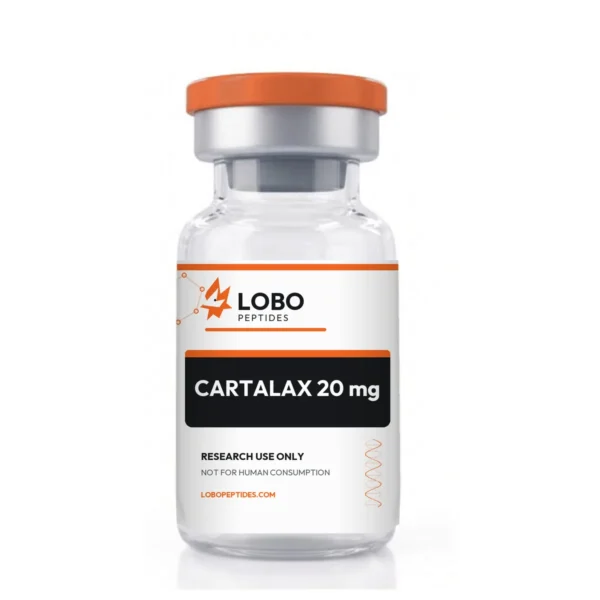
Cartalax 20mg
Cartalax 20mg research material, one vial nominally labeled 20mg. Literature context centers on the short peptide Ala-Glu-Asp (AED), while exact identity and composition require lot-specific documentation. Research use only; not for human or veterinary use.
10 in stock
Cartalax 20mg Product Description
Cartalax 20mg is a research-only catalog entry supplied as one vial with a nominal labeled amount of 20mg. Published papers commonly use Cartalax or T-31 for the short peptide Ala-Glu-Asp (AED). The product name and label alone do not prove that this vial has the same sequence, terminal chemistry, counterion, or composition as an investigator-defined AED reagent; those attributes require lot-specific documentation.
A key identity distinction is the difference between isolated AED and cartilage-derived polypeptide complexes. The latter are heterogeneous mixtures, while AED is described as a three-residue peptide. Results obtained with one material cannot be transferred to the other. AEDG, AEDL, AEDR, and other longer AED-containing sequences are also separate compounds.
The literature summarized below is centered on cultured cells and tissue models. It provides context for assay design, marker selection, and identity review, but it does not establish the identity, content, purity, sterility, or performance of this catalog vial. No lot-specific certificate of analysis is currently published on this page.
For research use only. Not for human or veterinary use. No preparation, dosing, administration, diagnostic, or therapeutic guidance is provided.
Research Material Profile
Cartalax 20mg Research
Chondrocyte proliferation models
Investigators compared AED with a bovine-cartilage polypeptide complex in primary chondrocyte cultures from young and old rats. Reported changes in cell number were measured after defined culture exposure. This is an in-vitro proliferation experiment; it does not demonstrate formation of functional cartilage, joint-level effects, or equivalence between the isolated peptide and the extract. (DOI 10.29296/25877305-2023-10-08).
Replicative-aging and differentiation markers
In replicatively aged human mesenchymal stem-cell cultures, researchers measured SOX9, aggrecan, type II collagen, and COMP after testing AED and a cartilage polypeptide complex as separate materials. These are gene-expression and protein-marker observations in cultured cells, not organism-level structural outcomes. (PubMed 37782646).
Senescence-associated cell readouts
A separate chondrocyte-culture study evaluated a panel that included p16, p21, p53, TNF-alpha, IL-1alpha, and Sirt1. The published abstract provides limited donor and methods detail, so the results should remain attached to that specific culture system rather than generalized to other models. (PubMed 37356100).
Adjacent cellular-aging research
AED has also appeared in passage-aged human mesenchymal stem-cell and fibroblast experiments. These papers examine transcriptional or cell-culture endpoints and can inform mechanistic questions, but they are not direct evidence of cartilage restoration or clinical activity. Studies that tested several peptides do not establish that every reported change was uniquely produced by AED. (PubMed 32399807; PubMed 33231794).
Evidence Boundaries
The directly relevant evidence is primarily in vitro, independent replication is limited, and several reports compare or combine distinct materials. The studies do not establish human safety, pharmacokinetics, bioavailability, clinical outcomes, or an administration regimen. They also do not verify that this 20mg catalog vial is the same material used by the investigators. No identity, purity, content, sterility, endotoxin, or other analytical specification should be inferred without lot-specific evidence.
References
8 curated scientific sources used for identity, mechanism, model, and assay context.
- Peptides of Cartilage Tissue: Regulation of Chondrocyte Proliferation, Geroprotection and Prospects for Use in Osteoarthrosis.
Myakisheva S et al. Vrach (2023). DOI: 10.29296/25877305-2023-10-08.
Direct AED and cartilage-polypeptide-complex comparison in primary rat chondrocyte cultures; the two test articles are not interchangeable.
View research source - The influence of peptides on the chondrogenic differentiation of human mesenchymal stem cells during replicative aging.
Myakisheva SN et al. Adv Gerontol (2023). PMID 37782646.
Replicatively aged human mesenchymal stem-cell cultures with chondrogenic-marker measurements.
View research source - Peptides prevent the forming of secretory phenotype of chondrocytes associated with the aging.
Myakisheva SN et al. Adv Gerontol (2023). PMID 37356100.
Cultured chondrocyte senescence-associated marker study; donor and method details limit generalization.
View research source - Gene expression in human mesenchymal stem cell aging cultures: modulation by short peptides.
Ashapkin V et al. Mol Biol Rep (2020). PMID 32399807. DOI: 10.1007/s11033-020-05506-3.
Passage-aged and stationary human mesenchymal stem-cell cultures; multiple short peptides were tested.
View research source - Comparison of the Effects of KE and AED Peptides on Functional Activity of Human Skin Fibroblasts during Their Replicative Aging.
Fridman NV et al. Bull Exp Biol Med (2020). PMID 33231794. DOI: 10.1007/s10517-020-05022-1.
Adjacent human skin-fibroblast aging model, not cartilage-outcome evidence.
View research source - Peptide Regulation of Skin Fibroblast Functions during Their Aging In Vitro.
Linkova NS et al. Bull Exp Biol Med (2016). PMID 27259496. DOI: 10.1007/s10517-016-3370-x.
Adjacent cultured-fibroblast model; outcomes cannot be transferred to cartilage systems.
View research source - Peptide Regulation of Cells Renewal Processes in Kidney Tissue Cultures from Young and Old Animals.
Chalisova NI et al. Bull Exp Biol Med (2015). PMID 26033601. DOI: 10.1007/s10517-015-2906-9.
Adjacent kidney tissue-culture research involving young and old animal material.
View research source - Peptidergic regulation of thymocyte differentiation, proliferation, and apoptosis during aging of the thymus.
Linkova NS et al. Bull Exp Biol Med (2011). PMID 22238759. DOI: 10.1007/s10517-011-1298-8.
Negative-result boundary: the reported combined thymocyte effects were not attributed to AED/T-31.
View research source