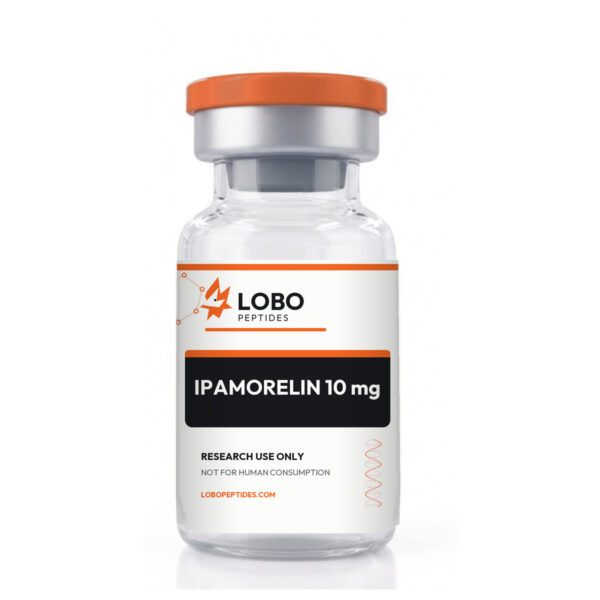
Ipamorelin
Ipamorelin is a synthetic pentapeptide cataloged without a recorded strength or pack format. For research use only (RUO); not for human or veterinary use.
Out of stock
Ipamorelin Product Description
Ipamorelin is reported in primary literature as the synthetic pentapeptide Aib-His-D-2-Nal-D-Phe-Lys-NH2. Its research identity is associated with secretagogue-receptor pharmacology, not with GHRH analogues. The supplied Lobo record does not state an amount, concentration, vial count, or physical format.
Identity discipline matters because peptide secretagogues are not interchangeable. Ipamorelin should remain separate from GHRP-2, GHRP-6, tesamorelin, sermorelin, and CJC-1295 variants. Even when several materials are investigated through endocrine measurements, their sequences and receptor-level behavior differ. Experimental comparisons need molecule-specific controls and assay conditions; broad class labels are not sufficient evidence that results from one compound apply to another.
The cited research spans primary rat pituitary-cell assays, rat experiments, and a controlled dose-escalation study in healthy male volunteers. These models answer different questions. Cell assays can characterize response patterns under defined exposure conditions, animal work can integrate multiple physiological variables, and controlled participant research can model plasma concentrations alongside timed biomarkers. None of those levels establishes the composition or suitability of an unspecified-strength catalog unit.
This RUO entry therefore emphasizes what is known and what is not. The name and literature identity are recorded; the commercial amount and material attributes are not. Research discussion may address receptor pharmacology, assay selectivity, pharmacokinetic modeling, and biomarker timing, but lot identity, content, purity, sterility, endotoxin status, and stability remain pending documentation. The catalog identity and the literature identity are recorded as separate evidence layers so that future documentation can resolve open attributes without rewriting the scientific history or overstating what the current source set demonstrates within defined research boundaries.
Research Material Profile
Ipamorelin Research
Pituitary-cell and rat characterization
Primary research evaluated ipamorelin within a peptide series using isolated rat pituitary-cell assays and rat experiments. Investigators measured growth-hormone release while also examining broader hormonal readouts, allowing them to discuss response selectivity within those particular systems. The cell results are assay-dependent: receptor expression, cell preparation, incubation conditions, and measured endpoints all constrain interpretation. The animal results add integrated physiology but remain specific to rats and to the reported protocol. Neither model establishes the strength, composition, or analytical properties of this Lobo listing. The paper is most useful here as an identity and pharmacology source for the named pentapeptide and as an example of how selectivity was experimentally evaluated. It does not support transferring findings to other secretagogues, to GHRH analogues, or to an unspecified commercial material. This page therefore keeps the conclusion at the level of model-qualified receptor and endocrine research. (PubMed 9849822).
Controlled pharmacokinetic modeling
A dose-escalation study in healthy male volunteers measured plasma ipamorelin concentrations and time-linked growth-hormone values, then used those observations for pharmacokinetic and pharmacodynamic modeling. This controlled human research context demonstrates how concentration data and a downstream biomarker can be related mathematically within a defined protocol. It does not prove that every material sold under the same name has matching identity or behavior. The participant group, analytical methods, sampling schedule, and model assumptions delimit the reported results, and they should be reviewed before using the paper to inform a new study design. The publication does not resolve the absent strength or pack format in this catalog record, nor does it provide a basis for consumer guidance. For this RUO listing, it supports only the neutral statement that ipamorelin has been studied with serial concentration and biomarker measurements in a controlled participant setting. (PubMed 10496658).
Cross-model evidence boundaries
The two cited papers complement one another without becoming evidence for this lot. Rat pituitary-cell assays address direct secretory responses in an isolated preparation; rat experiments add whole-organism context; controlled participant data support model-based analysis of plasma concentration and timed biomarkers. Agreement in a broad endpoint across systems would still not erase species, assay, or protocol differences. A rigorous research plan would treat each model as a separate evidence layer and verify the exact test material independently. The literature also does not establish counterion, excipients, physical presentation, purity, sterility, or stability for this item. The evidence is therefore sufficient for a cautious identity profile and research map, but not for claims about an untested catalog unit or any human or veterinary application. (PubMed 9849822 · PubMed 10496658).
Evidence Boundaries
The cited literature supports only the identity and model-qualified research contexts summarized above for Ipamorelin. The label statement “Strength not recorded” is preserved as supplied and is not treated as an analytical measurement. Study findings remain bounded by the reported biochemical assay, cell system, animal species, or controlled participant protocol. Lot-specific identity, content, purity, sterility, endotoxin status, stability, and other unreported specifications remain unknown unless separately documented. No procedural, operational, or outcome guidance is provided.
Ipamorelin References
8 curated medical and scientific references used for identity, mechanism, model, and assay context.
- Ipamorelin, the first selective growth hormone secretagogue.
K Raun, B S Hansen, N L Johansen et al.. European journal of endocrinology. 1998.
exact identity · Isolated rat pituitary-cell assays and rat endocrine experiments
View research source - Pharmacokinetic-pharmacodynamic modeling of ipamorelin, a growth hormone releasing peptide, in human volunteers.
J V Gobburu, H Agersø, W J Jusko et al.. Pharmaceutical research. 1999.
exact identity · Dose-escalation pharmacokinetic/pharmacodynamic study in healthy male volunteers
View research source - Pharmacokinetic evaluation of ipamorelin and other peptidyl growth hormone secretagogues with emphasis on nasal absorption.
P B Johansen, K T Hansen, J V Andersen et al.. Xenobiotica; the fate of foreign compounds in biological systems. 1998.
exact identity · Pharmacokinetic studies of peptidyl secretagogues in animal models
View research source - Ipamorelin, a new growth-hormone-releasing peptide, induces longitudinal bone growth in rats.
P B Johansen, J Nowak, C Skjaerbaek et al.. Growth hormone & IGF research : official journal of the Growth Hormone Research Society and the International IGF Research Society. 1999.
exact identity · Longitudinal bone-growth study in rats
View research source - Influence of chronic treatment with the growth hormone secretagogue Ipamorelin, in young female rats: somatotroph response in vitro.
L Jiménez-Reina, R Cañete, M J de la Torre et al.. Histology and histopathology. 2002.
exact identity · Young female rat study with ex vivo/in-vitro somatotroph response measurements
View research source - Efficacy of ipamorelin, a novel ghrelin mimetic, in a rodent model of postoperative ileus.
Kalina Venkova, William Mann, Richard Nelson et al.. The Journal of pharmacology and experimental therapeutics. 2009.
exact identity · Rodent postoperative-ileus model
View research source - Efficacy of ipamorelin, a ghrelin mimetic, on gastric dysmotility in a rodent model of postoperative ileus.
Beverley Greenwood-Van Meerveld, Karl Tyler, Ehsan Mohammadi et al.. Journal of experimental pharmacology. 2012.
exact identity · Rodent postoperative-ileus and gastric-dysmotility model
View research source - The growth hormone secretagogue receptor 1a agonists, anamorelin and ipamorelin, inhibit cisplatin-induced weight loss in ferrets: Anamorelin also exhibits anti-emetic effects via a central mechanism.
Zengbing Lu, Man P Ngan, Julia Y H Liu et al.. Physiology & behavior. 2024.
exact identity · Ferret model comparing GHSR1a agonists
View research source