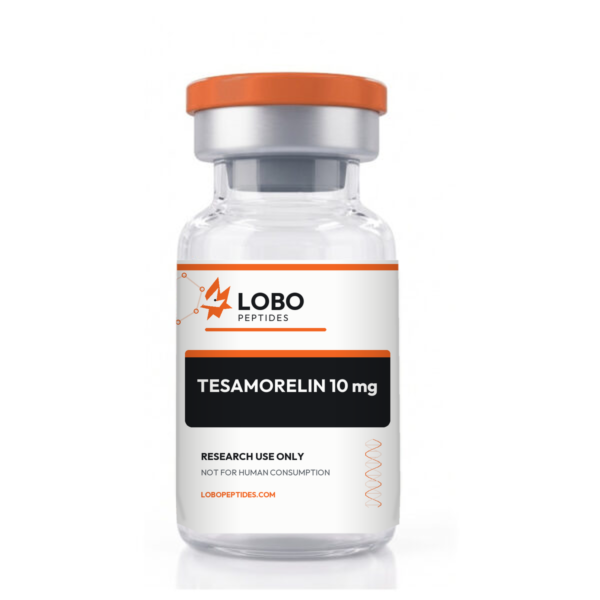
Tesamorelin 10mg
Tesamorelin 10 mg is a stabilized analogue of the 44-residue growth-hormone-releasing hormone sequence, cataloged as a laboratory reference material. The entry preserves the stated amount while leaving lot composition and physical format unresolved. For research use only (RUO); not for human or veterinary use.
Out of stock
Tesamorelin Product Description
Tesamorelin is described in the literature as a synthetic analogue of the full 44-residue growth-hormone-releasing hormone sequence. That identity places it within GHRH-receptor research rather than the separate class of growth-hormone secretagogue receptor agonists. The supplied catalog record states 10 mg, but it does not establish salt form, excipients, physical presentation, or analytical characteristics of a specific lot. Those attributes remain documentation questions rather than facts that can be inferred from the name.
For experimental design, the most important boundary is molecular identity. Tesamorelin should not be collapsed into GHRH(1-29), sermorelin, CJC-1295 with DAC, no-DAC modified GRF, or ipamorelin. Each has a different sequence, modification pattern, or receptor-pharmacology rationale. A study that names one of those adjacent materials cannot automatically substantiate a tesamorelin experiment, and a catalog amount alone does not demonstrate equivalence to material used in a publication.
The cited controlled studies examined tesamorelin in defined adult participant groups using imaging, endocrine biomarkers, and metabolic laboratory measures. They are useful for understanding which variables investigators selected and how observations were bounded by protocol. They do not establish intended use, performance, safety, or composition for this research listing. Any comparison should preserve population, assay timing, analytical method, and study design rather than translating participant-level observations into a catalog promise.
This entry is therefore framed as a research-use-only identity record. Suitable discussion is limited to receptor biology, assay selection, biomarker methodology, and comparison of experimental systems. Lot-specific identity, content, purity, sterility, endotoxin status, and stability cannot be supplied from the cited papers or the label amount and require separate documentation. The catalog identity and the literature identity are recorded as separate evidence layers so that future documentation can resolve open attributes without rewriting the scientific history or overstating what the current source set demonstrates within defined research boundaries.
Research Material Profile
Tesamorelin Research
Controlled study context
Two randomized, placebo-controlled studies in antiretroviral-therapy-exposed adults examined tesamorelin through protocol-defined imaging, endocrine biomarkers, and metabolic laboratory measurements. The reports provide a controlled human research context in which the named molecule, participant criteria, comparators, and observation windows were specified. They are relevant to study-design literacy because they show that imaging outcomes and circulating biomarkers are different measurement domains and should not be treated as interchangeable. Nothing in those publications verifies the source, identity, content, or analytical quality of this 10 mg catalog entry. The participant observations also cannot be generalized beyond the studied populations and protocols. For an RUO page, the defensible takeaway is narrow: tesamorelin has been examined under controlled conditions with multiple laboratory and imaging endpoints. The papers do not provide use instructions for an uncharacterized catalog lot, and this summary intentionally omits protocol amounts and operational details. (PubMed 20554713).
Longer protocol and extension design
A separate 12-month investigation enrolled 404 adults and used a blinded randomized phase followed by an extension. Investigators tracked imaging variables and IGF-I-related laboratory endpoints over the defined protocol. The design is informative because an extension phase answers a different question from an initial randomized comparison: continued observation can reveal time-dependent patterns, while changes in assignment or retention complicate interpretation. Those methodological features should remain visible when the paper is cited. The study concerns tesamorelin used within its own controlled research protocol; it does not establish that this 10 mg item has the same composition, formulation, or analytical profile as the studied material. It also does not justify transferring measured observations to another population, model, or assay. Here the paper supports only molecule-specific literature context and examples of measured variables, with no commercial performance claim. (PubMed 20101189).
Interpretation across models
Taken together, the cited studies place tesamorelin within a defined GHRH-axis research literature, but they do not substitute for biochemical receptor assays or lot documentation. Human biomarker and imaging observations can identify protocol-associated patterns, while receptor binding, signaling, and identity testing would address different experimental questions. A researcher comparing systems should predefine which level is under examination and avoid treating a circulating biomarker as direct proof of receptor behavior. The papers also use studied participant populations rather than unrestricted samples, so their observations remain population- and protocol-qualified. For this listing, the evidence supports a neutral map of research contexts: controlled participant studies, endocrine measurements, and imaging-based endpoints. It does not resolve the material’s salt form, excipients, physical state, container, or lot-specific attributes, and it supplies no basis for human or veterinary use. (PubMed 20554713 · PubMed 20101189).
Evidence Boundaries
The cited literature supports only the identity and model-qualified research contexts summarized above for Tesamorelin. The label statement “10 mg” is preserved as supplied and is not treated as an analytical measurement. Study findings remain bounded by the reported biochemical assay, cell system, animal species, or controlled participant protocol. Lot-specific identity, content, purity, sterility, endotoxin status, stability, and other unreported specifications remain unknown unless separately documented. No procedural, operational, or outcome guidance is provided.
Tesamorelin References
8 curated medical and scientific references used for identity, mechanism, model, and assay context.
- Effects of tesamorelin (TH9507), a growth hormone-releasing factor analog, in human immunodeficiency virus-infected patients with excess abdominal fat: a pooled analysis of two multicenter, double-blind placebo-controlled phase 3 trials with safety extension data.
Julian Falutz, Jean-Claude Mamputu, Diane Potvin et al.. The Journal of clinical endocrinology and metabolism. 2010.
exact identity · Pooled multicenter phase 3 randomized controlled human studies in adults with HIV and excess abdominal fat
View research source - Effects of tesamorelin, a growth hormone-releasing factor, in HIV-infected patients with abdominal fat accumulation: a randomized placebo-controlled trial with a safety extension.
Julian Falutz, Diane Potvin, Jean-Claude Mamputu et al.. Journal of acquired immune deficiency syndromes (1999). 2010.
exact identity · Randomized placebo-controlled human study with safety extension in adults with HIV-associated abdominal fat accumulation
View research source - Metabolic effects of a growth hormone-releasing factor in patients with HIV.
Julian Falutz, Soraya Allas, Koenraad Blot et al.. The New England journal of medicine. 2007.
exact identity · Randomized controlled human study in adults with HIV-associated abdominal fat accumulation
View research source - The effects of tesamorelin on phosphocreatine recovery in obese subjects with reduced GH.
Hideo Makimura, Caitlin A Murphy, Meghan N Feldpausch et al.. The Journal of clinical endocrinology and metabolism. 2014.
exact identity · Controlled human physiology study in obese adults with reduced growth-hormone secretion
View research source - Population pharmacokinetic and pharmacodynamic analysis of tesamorelin in HIV-infected patients and healthy subjects.
Mario González-Sales, Olivier Barrière, Pierre Olivier Tremblay et al.. Journal of pharmacokinetics and pharmacodynamics. 2015.
exact identity · Population pharmacokinetic/pharmacodynamic modeling using healthy-subject and HIV-study data
View research source - Predictors of Treatment Response to Tesamorelin, a Growth Hormone-Releasing Factor Analog, in HIV-Infected Patients with Excess Abdominal Fat.
Alexandra Mangili, Julian Falutz, Jean-Claude Mamputu et al.. PloS one. 2015.
exact identity · Secondary analysis of randomized tesamorelin trials in adults with HIV and excess abdominal fat
View research source - Efficacy and safety of tesamorelin in people with HIV on integrase inhibitors.
Samuel C Russo, Mollie W Ockene, Allison K Arpante et al.. AIDS (London, England). 2024.
exact identity · Human interventional study in people with HIV receiving integrase inhibitors
View research source - Effects of Tesamorelin on Neurocognitive Impairment in Persons With HIV and Abdominal Obesity.
Ronald J Ellis, Florin Vaida, Keren Hu et al.. The Journal of infectious diseases. 2025.
exact identity · Controlled human study in persons with HIV, abdominal obesity, and neurocognitive impairment
View research source