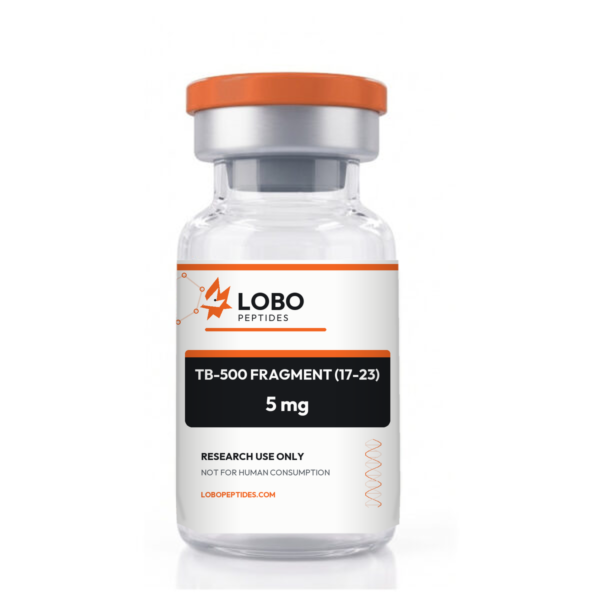
TB-500 Fragment (17-23)
TB-500 Fragment (17–23), shown at a nominal 5 mg per vial, is a short thymosin beta-4-derived sequence designation for analytical and comparative laboratory work. Acetylation and other terminal features are not confirmed. For research use only (RUO); not for human or veterinary use.
Out of stock
TB-500 Fragment (17–23) 5mg Product Description
The product title specifies residues 17 through 23 of thymosin beta-4, not the complete 43-residue parent peptide. A published analysis identified Ac-LKKTETQ in one product labeled TB-500, but that result cannot define every similarly named catalog lot. The nominal amount is 5 mg in one vial, with no pack count stated. The label information provided here does not establish acetylation, exact termini, counterion, sequence confirmation, purity, or independently measured content.
A shared nominal amount does not overcome the identity difference, and its scientific or analytical statements are not used as evidence for this fragment.
Neutral research framing includes chromatographic or mass-spectrometric identification, parent-versus-fragment comparisons, actin-related biochemical assays, and model-specific response studies with clearly defined reference materials. Conclusions must remain specific to the exact molecular form tested. Source papers are summarized only at the level supported by their reported models, and the catalog language avoids translating experimental observations into promises.
The entry is structured for qualified laboratory review. Before publication or experimental comparison, product-specific records should resolve identity, physical form, component definition where applicable, and the relationship between the nominal label amount and any measured result. Until then, uncertainty is retained as part of the product record rather than replaced with assumptions. Each experiment should record the actual lot, reference standard, assay matrix, controls, instrument method, and acceptance criteria needed for reproducible interpretation.
Research Material Profile
TB-500 Fragment (17–23) 5mg Research
Analytical identification of a labeled product
Analytical researchers applied chromatographic and mass-spectrometric methods to a product labeled TB-500 and identified an N-terminally acetylated seven-residue peptide, Ac-LKKTETQ. They also synthesized the assigned compound for comparison. This paper is directly relevant to the identity question surrounding the 17–23 designation, but its result belongs to the specific sample analyzed in that investigation. It does not prove that the Lobo vial is acetylated, that it contains the same counterion or physical form, or that its nominal content has been verified. For catalog purposes, the study supports careful naming and the need to record terminal chemistry rather than silently assuming it. A qualified laboratory could use the publication to design an orthogonal identity workflow, but the resulting data would need to come from the actual lot before any identity statement could be upgraded. Interpretation should remain linked to the reported methods, defined comparators, and confirmed test-article identity rather than the shared catalog name. (PubMed 22962027).
Parent and fragment comparison assays
A separate study described thymosin beta-4 as a 43-amino-acid polypeptide and compared the complete molecule, proteolytic fragments, and synthetic peptides in endothelial migration and chick aortic-arch sprouting assays. The experimental design is important because it treated related sequences as distinct test articles rather than interchangeable names. Observations assigned to the full parent cannot automatically be assigned to residues 17–23, and fragment observations depend on the exact sequence and terminal form used. This paper therefore supports an identity boundary, not a broad functional promise. New work with this Lobo material would require direct lot characterization and fragment-specific controls before researchers could compare assay behavior with published materials. Interpretation should remain linked to the reported methods, defined comparators, and confirmed test-article identity rather than the shared catalog name. (PubMed 14500546).
Separate actin-binding peptide model
Another primary report compared defined thymosin beta-4 with a separate seven-amino-acid actin-binding-domain peptide in db/db and aged mouse experimental systems. The materials were deliberately distinguished, and the animal observations were linked to those stated test articles and protocols. This is adjacent evidence showing that short domain peptides and complete thymosin beta-4 can be investigated as separate molecular entities. It does not identify the current vial, establish acetylation, or demonstrate equivalence between the reported seven-residue peptide and every product called TB-500 Fragment (17–23). Species, model selection, sequence definition, analytical confirmation, and endpoint timing remain essential qualifiers. For an RUO listing, the proper conclusion is that fragment-specific investigation requires exact molecular documentation; parent-peptide literature and a related seller page cannot fill that documentation gap. Interpretation should remain linked to the reported methods, defined comparators, and confirmed test-article identity rather than the shared catalog name. (PubMed 12581423).
Evidence Boundaries
The cited literature supports only the exact molecule or ingredient, model, and endpoint described in each source. It does not verify this Lobo lot, establish equivalence to another seller's material, or convert a nominal catalog amount into measured content. Cell, biochemical, microbial, ex vivo, animal, and controlled human research are not interchangeable evidence categories. Where a blend is involved, single-ingredient papers do not establish the fixed formulation, component ratio, interaction, compatibility, stability, combined performance, or combined safety. Where a fragment, probe, analogue, or related strength is involved, that distinction remains explicit. No unreported identity, sequence, termini, counterion, purity, sterility, endotoxin status, residual-solvent result, or other analytical attribute is inferred. The listing supplies research context only and includes no clinical guidance, procedural directions, or expected outcome.
TB-500 Fragment (17–23) 5mg References
7 curated medical and scientific references used for identity, mechanism, model, and assay context.
- Thymosin beta 4 and a synthetic peptide containing its actin-binding domain promote dermal wound repair in db/db diabetic mice and in aged mice.
Philp D, Badamchian M, Scheremeta B, et al. Thymosin beta 4 and a synthetic peptide containing its actin-binding domain promote dermal wound repair in db/db diabetic mice and in aged mice. Wound repair and regeneration : official publication of the Wound Healing Society [and] the European Tissue Repair Society. 2003;11(1):19-24. doi:10.1046/j.1524-475x.2003.11105.x.
Adjacent fragment-function study · db/db diabetic and aged mouse dermal-wound models; full-length thymosin beta-4 and a separate seven-amino-acid actin-binding peptide
View research source - The actin binding site on thymosin beta4 promotes angiogenesis.
Philp D, Huff T, Gho YS, et al. The actin binding site on thymosin beta4 promotes angiogenesis. FASEB journal : official publication of the Federation of American Societies for Experimental Biology. 2003;17(14):2103-5. doi:10.1096/fj.03-0121fje.
Direct sequence-region/function study · Full-length thymosin beta-4, fragments, and synthetic peptides in HUVEC migration and chick aortic-arch sprouting assays
View research source - Synthesis and characterization of the N-terminal acetylated 17-23 fragment of thymosin beta 4 identified in TB-500, a product suspected to possess doping potential.
Esposito S, Deventer K, Goeman J, et al. Synthesis and characterization of the N-terminal acetylated 17-23 fragment of thymosin beta 4 identified in TB-500, a product suspected to possess doping potential. Drug testing and analysis. 2012;4(9):733-8. doi:10.1002/dta.1402.
Exact analytical identity study · HPLC/high-resolution MS characterization plus synthetic reference comparison
View research source - Biological activities of thymosin beta4 defined by active sites in short peptide sequences.
Sosne G, Qiu P, Goldstein AL, et al. Biological activities of thymosin beta4 defined by active sites in short peptide sequences. FASEB journal : official publication of the Federation of American Societies for Experimental Biology. 2010;24(7):2144-51. doi:10.1096/fj.09-142307.
Short-sequence activity mapping · Review and experimental synthesis of thymosin beta-4 active-site peptide literature
View research source - Thymosin beta4 and thymosin beta4-derived peptides induce mast cell exocytosis.
Wyczółkowska J, Walczak-Drzewiecka A, Wagner W, et al. Thymosin beta4 and thymosin beta4-derived peptides induce mast cell exocytosis. Peptides. 2007;28(4):752-9. doi:10.1016/j.peptides.2007.01.004.
Direct fragment cell-assay study · Murine peritoneal mast cells and human HMC-1 mast cells in vitro
View research source - Doping control analysis of TB-500, a synthetic version of an active region of thymosin β₄, in equine urine and plasma by liquid chromatography-mass spectrometry.
Ho EN, Kwok WH, Lau MY, et al. Doping control analysis of TB-500, a synthetic version of an active region of thymosin β₄, in equine urine and plasma by liquid chromatography-mass spectrometry. Journal of chromatography. A. 2012;1265:57-69. doi:10.1016/j.chroma.2012.09.043.
Exact analytical/doping-control study · LC–MS analysis of N-acetyl-LKKTETQ and metabolites in equine plasma and urine
View research source - Simultaneous quantification of TB-500 and its metabolites in in-vitro experiments and rats by UHPLC-Q-Exactive orbitrap MS/MS and their screening by wound healing activities in-vitro.
Rahaman KA, Muresan AR, Min H, et al. Simultaneous quantification of TB-500 and its metabolites in in-vitro experiments and rats by UHPLC-Q-Exactive orbitrap MS/MS and their screening by wound healing activities in-vitro. Journal of chromatography. B, Analytical technologies in the biomedical and life sciences. 2024;1235:124033. doi:10.1016/j.jchromb.2024.124033.
Exact TB-500 metabolism and assay study · Human serum and enzyme incubations, rat urine, mass spectrometry, and in-vitro wound-healing screens
View research source