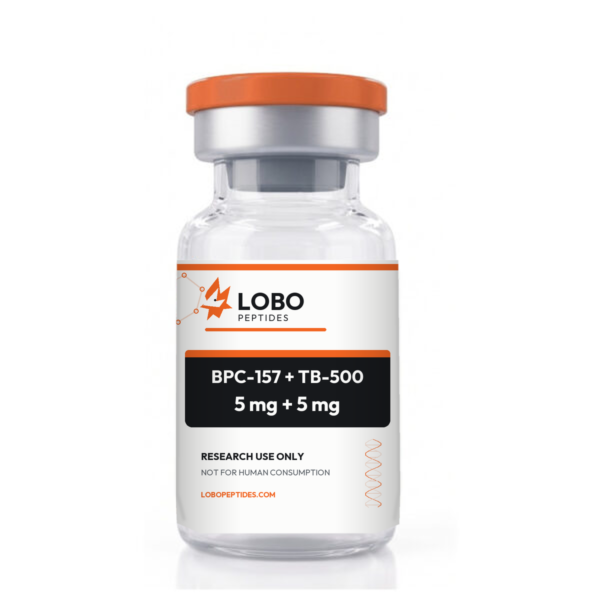
BPC-157 + TB-500 Blend
A BPC-157 and TB-500-designated laboratory blend with a nominal 10 mg total per vial. The component ratio, exact TB-500 identity, and lot composition remain unconfirmed for Lobo pending product-specific records. For research use only (RUO); not for human or veterinary use.
Out of stock
BPC-157 + TB-500 Blend 10mg Product Description
This title identifies two named components but does not analytically define either component. Literature describes BPC-157 as a 15-residue peptide, while TB-500 is a catalog designation that cannot be assumed to mean full-length thymosin beta-4 or a particular fragment. The displayed 10 mg is a nominal total for one vial, not two separate verified quantities.
It does not establish Lobo component amounts, sequences, terminal chemistry, compatibility, stability, purity, or content, and none of those attributes are imported here.
The blend may be framed for laboratory comparison designs that separately evaluate ingredient-associated endpoints and include single-component controls. Ingredient papers are contextual evidence only because none of the cited studies tested this fixed Lobo formulation or its unknown ratio. Source papers are summarized only at the level supported by their reported models, and the catalog language avoids translating experimental observations into promises.
The entry is structured for qualified laboratory review. Before publication or experimental comparison, product-specific records should resolve identity, physical form, component definition where applicable, and the relationship between the nominal label amount and any measured result. Until then, uncertainty is retained as part of the product record rather than replaced with assumptions. Each experiment should record the actual lot, reference standard, assay matrix, controls, instrument method, and acceptance criteria needed for reproducible interpretation.
Research Material Profile
BPC-157 + TB-500 Blend 10mg Research
BPC-157 explant and fibroblast evidence
One primary study described BPC-157 as a 15-amino-acid peptide and examined it in rat Achilles-tendon explants and cultured tendon fibroblasts. Investigators measured explant outgrowth, fibroblast migration, oxidative-stress survival, F-actin organization, and FAK/paxillin-associated signals. Those findings belong to the single characterized BPC-157 material and the stated laboratory systems. They do not establish the behavior of a two-component blend, and they provide no information about an unspecified TB-500-designated ingredient. For blend research, the paper is useful for selecting ingredient-specific endpoints and single-component comparators. It cannot support synergy, compatibility, stability, combined performance, or combined safety. The Lobo vial would require independent identity and composition records before any result could be compared meaningfully with the publication. Interpretation should remain linked to the reported methods, defined comparators, and confirmed test-article identity rather than the shared catalog name. (PubMed 21030672).
BPC-157 endothelial assay context
Another BPC-157 paper combined cultured endothelial assays, a chick chorioallantoic membrane experiment, and a rat hind-limb ischemia model. The investigators reported VEGFR2 expression and internalization observations together with Akt- and eNOS-associated measurements. Each result is bounded by the species, preparation, test article, and assay protocol used in that study. It is not evidence about TB-500, and it is not direct evidence about a precombined 10 mg vial. In a rigorous blend experiment, researchers would need BPC-157 alone, the precisely identified second component alone, the fixed combination, and suitable negative controls. Without those arms, an observed signal could not be assigned to a component or interaction. This publication therefore supplies ingredient-level experimental context only and does not verify any feature of the Lobo lot. Interpretation should remain linked to the reported methods, defined comparators, and confirmed test-article identity rather than the shared catalog name. (PubMed 27847966).
Defined thymosin beta-4 as adjacent evidence
Studies of defined thymosin beta-4 examined cultured human endothelial-cell migration, scratch-wounded monolayers, and Matrigel-associated migration. A separate paper described full-length thymosin beta-4 as a 43-amino-acid polypeptide and compared it with proteolytic fragments and synthetic peptides in endothelial and chick aortic-arch assays. These studies demonstrate why the exact identity of a TB-500-designated component matters: parent peptide and fragments are experimentally distinct materials. They do not prove that this blend contains full-length thymosin beta-4, the 17–23 fragment, or any particular modified form. They also did not test BPC-157 together with the thymosin material. The evidence is therefore adjacent and ingredient-specific, suitable for defining controls and identity questions but not for attributing any combined property to the nominal 10 mg blend. Interpretation should remain linked to the reported methods, defined comparators, and confirmed test-article identity rather than the shared catalog name. (PubMed 9194528 · PubMed 14500546).
Evidence Boundaries
The cited literature supports only the exact molecule or ingredient, model, and endpoint described in each source. It does not verify this Lobo lot, establish equivalence to another seller's material, or convert a nominal catalog amount into measured content. Cell, biochemical, microbial, ex vivo, animal, and controlled human research are not interchangeable evidence categories. Where a blend is involved, single-ingredient papers do not establish the fixed formulation, component ratio, interaction, compatibility, stability, combined performance, or combined safety. Where a fragment, probe, analogue, or related strength is involved, that distinction remains explicit. No unreported identity, sequence, termini, counterion, purity, sterility, endotoxin status, residual-solvent result, or other analytical attribute is inferred. The listing supplies research context only and includes no clinical guidance, procedural directions, or expected outcome.
BPC-157 + TB-500 Blend 10mg References
8 curated medical and scientific references used for identity, mechanism, model, and assay context.
- The actin binding site on thymosin beta4 promotes angiogenesis.
Philp D, Huff T, Gho YS, et al. The actin binding site on thymosin beta4 promotes angiogenesis. FASEB journal : official publication of the Federation of American Societies for Experimental Biology. 2003;17(14):2103-5. doi:10.1096/fj.03-0121fje.
TB-500-side ingredient evidence only; exact fixed blend not studied · Full-length thymosin beta-4, proteolytic fragments, and synthetic peptides in HUVEC migration and chick aortic-arch sprouting assays
View research source - The promoting effect of pentadecapeptide BPC 157 on tendon healing involves tendon outgrowth, cell survival, and cell migration.
Chang CH, Tsai WC, Lin MS, et al. The promoting effect of pentadecapeptide BPC 157 on tendon healing involves tendon outgrowth, cell survival, and cell migration. Journal of applied physiology (Bethesda, Md. : 1985). 2011;110(3):774-80. doi:10.1152/japplphysiol.00945.2010.
BPC-157 ingredient evidence only; exact fixed blend not studied · Rat Achilles-tendon explants and cultured rat tendon fibroblasts
View research source - Therapeutic potential of pro-angiogenic BPC157 is associated with VEGFR2 activation and up-regulation.
Hsieh MJ, Liu HT, Wang CN, et al. Therapeutic potential of pro-angiogenic BPC157 is associated with VEGFR2 activation and up-regulation. Journal of molecular medicine (Berlin, Germany). 2017;95(3):323-333. doi:10.1007/s00109-016-1488-y.
BPC-157 ingredient evidence only; exact fixed blend not studied · Endothelial assays, chick chorioallantoic membrane, and rat hind-limb ischemia model
View research source - Thymosin beta 4 stimulates directional migration of human umbilical vein endothelial cells.
Malinda KM, Goldstein AL, Kleinman HK. Thymosin beta 4 stimulates directional migration of human umbilical vein endothelial cells. FASEB journal : official publication of the Federation of American Societies for Experimental Biology. 1997;11(6):474-81. doi:10.1096/fasebj.11.6.9194528.
Thymosin beta-4 ingredient evidence only; exact fixed blend not studied · Human endothelial-cell migration assays, scratch-wounded monolayers, and subcutaneous Matrigel assay
View research source - Body protective compound-157 enhances alkali-burn wound healing in vivo and promotes proliferation, migration, and angiogenesis in vitro.
Huang T, Zhang K, Sun L, et al. Body protective compound-157 enhances alkali-burn wound healing in vivo and promotes proliferation, migration, and angiogenesis in vitro. Drug design, development and therapy. 2015;9:2485-99. doi:10.2147/DDDT.S82030.
BPC-157 ingredient evidence only; exact fixed blend not studied · Cultured HUVEC assays and rat corneal alkali-burn model
View research source - Pentadecapeptide BPC 157 (PL 14736) improves ligament healing in the rat.
Cerovecki T, Bojanic I, Brcic L, et al. Pentadecapeptide BPC 157 (PL 14736) improves ligament healing in the rat. Journal of orthopaedic research : official publication of the Orthopaedic Research Society. 2010;28(9):1155-61. doi:10.1002/jor.21107.
BPC-157 ingredient evidence only; exact fixed blend not studied · Rat medial collateral-ligament injury model
View research source - Thymosin beta 4 and a synthetic peptide containing its actin-binding domain promote dermal wound repair in db/db diabetic mice and in aged mice.
Philp D, Badamchian M, Scheremeta B, et al. Thymosin beta 4 and a synthetic peptide containing its actin-binding domain promote dermal wound repair in db/db diabetic mice and in aged mice. Wound repair and regeneration : official publication of the Wound Healing Society [and] the European Tissue Repair Society. 2003;11(1):19-24. doi:10.1046/j.1524-475x.2003.11105.x.
Thymosin beta-4/fragment ingredient context only; exact fixed blend not studied · db/db diabetic and aged mouse dermal-wound models, with full-length peptide and a separate actin-binding-domain peptide
View research source - Doping control analysis of TB-500, a synthetic version of an active region of thymosin β₄, in equine urine and plasma by liquid chromatography-mass spectrometry.
Ho EN, Kwok WH, Lau MY, et al. Doping control analysis of TB-500, a synthetic version of an active region of thymosin β₄, in equine urine and plasma by liquid chromatography-mass spectrometry. Journal of chromatography. A. 2012;1265:57-69. doi:10.1016/j.chroma.2012.09.043.
TB-500 ingredient identity/analytical context only; exact fixed blend not studied · Equine plasma and urine LC–MS method development
View research source