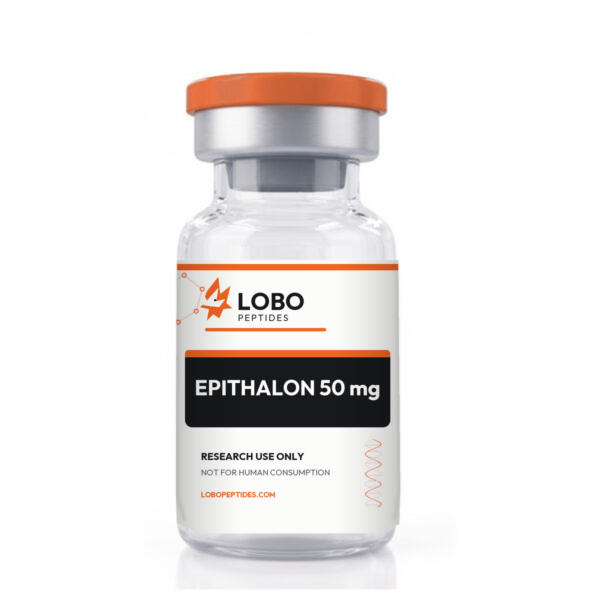
Epithalon
Epithalon 10mg, 50mg is presented as Epithalon/Epitalon, Ala-Glu-Asp-Gly (AEDG), with Separate nominal catalog options: 10 mg and 50 mg. The spelling variants are transliterations for the same literature sequence, not evidence of different compounds; mixtures and other short peptides remain separate. The amount is nominal pending lot-specific documentation. For research use only (RUO); not for human or veterinary use.
Epithalon 10mg, 50mg Product Description
Epithalon 10mg, 50mg is presented as Epithalon/Epitalon, Ala-Glu-Asp-Gly (AEDG). The displayed inventory statement is Separate nominal catalog options: 10 mg and 50 mg. This is a catalog description of intended identity and nominal quantity, not a report of independently measured composition. Exact sequence, terminal chemistry, counterion, physical form, purity, and assayed content are unconfirmed. Until a lot-specific record is available, the listing should be read as an identification framework for qualified laboratory review rather than as an analytical certificate.
The principal boundary for this entry is straightforward: The spelling variants are transliterations for the same literature sequence, not evidence of different compounds; mixtures and other short peptides remain separate. Close names can conceal meaningful differences in sequence, terminal groups, coordination state, labeling, oxidation state, or presentation. Those differences can affect assay design and interpretation, so adjacent compounds are not treated as substitutes. The product title is preserved exactly, and any ambiguity is made visible instead of being resolved through assumptions.
This material is offered for research use only (RUO) and is not for human or veterinary use. The page does not provide directions for preparation, administration, dosing, or consumer use. Appropriate experimental planning requires independent review of the selected model, controls, analytical methods, and the eventual lot documentation. Literature summarized below describes named study reagents under particular conditions; it is not evidence that this catalog unit reproduces those findings.
Its seller-specific statements about form, testing, composition, availability, or performance are not transferred to Lobo. This original text is organized around the Lobo specification, primary literature, and a conservative separation between published evidence and unverified product attributes.
Research Material Profile
Epithalon 10mg, 50mg Research
Female-rat illumination study
A study in female rats examined AEDG under standard, natural, and constant illumination regimes and reported outcomes that varied with the lighting context. The publication explicitly connects the Epithalon name with Ala-Glu-Asp-Gly, making it useful for identity terminology. Its animal observations, however, remain limited to the species, colony conditions, illumination schedules, and study methods. They do not support claims about people, and they do not verify either the 10 mg or 50 mg catalog option. Lifespan and spontaneous-tumor measurements in this design are research endpoints rather than a basis for commercial outcome language. The source is presented with its model boundaries intact. Interpretation therefore requires the source’s exact reagent definition, controls, comparators, reported endpoint, sampling framework, and analytical limitations before drawing narrow, model-bound conclusions from the reported experimental observations. (PubMed 18856211).
Mouse-brain expression profiling
A CBA mouse study used microarray methods to measure gene-expression changes in brain tissue after experimental exposure to melatonin or the tetrapeptide identified as Epithalon/AEDG. Microarray signals report transcript abundance under the selected design; they do not establish a general organism-level function and can depend on tissue sampling, platform, normalization, and statistical thresholds. The paper supports a narrow statement that AEDG has been studied in mouse-brain expression profiling. It offers no analytical information about the Lobo lots and no basis for comparing the nominal 10 mg and 50 mg options. The two spellings remain treated as transliterations of the same intended tetrapeptide. Interpretation therefore requires the source’s exact reagent definition, controls, comparators, reported endpoint, sampling framework, and analytical limitations before drawing narrow, model-bound conclusions from the reported experimental observations. (PubMed 15723138).
Drosophila developmental experiment
A Drosophila melanogaster experiment evaluated developmental exposure to synthetic AEDG and measured lifespan in an insect model. Insect physiology, developmental timing, and study conditions prevent direct translation to humans or other mammals. The publication is useful as direct primary literature for the Epitalon spelling and the Ala-Glu-Asp-Gly identity, but its measured observations remain within Drosophila. They do not substantiate longevity marketing and do not prove the sequence, purity, or content of a catalog vial. This listing therefore records the experiment as model-specific evidence while limiting product claims to intended identity, nominal amounts, and pending documentation. Interpretation therefore requires the source’s exact reagent definition, controls, comparators, reported endpoint, sampling framework, and analytical limitations before drawing narrow, model-bound conclusions from the reported experimental observations. (PubMed 11087911).
Evidence Boundaries
The evidence set describes published experiments with defined study materials; it does not constitute analytical evidence for Epithalon 10mg, 50mg. The product-level uncertainties remain: Exact sequence, terminal chemistry, counterion, physical form, purity, and assayed content are unconfirmed. The listed quantity is nominal, and no unreported identity, purity, content, sterility, endotoxin, residual-solvent, or microbiological result should be inferred. The spelling variants are transliterations for the same literature sequence, not evidence of different compounds; mixtures and other short peptides remain separate. Cell, biochemical, ex-vivo, animal, insect, or precursor studies are labeled as such and cannot be generalized across models. Source titles may describe the authors’ chosen endpoints, but this page does not convert them into commercial promises. No preparation, dosing, administration, or human-use conclusion is supplied.
Epithalon 10mg, 50mg References
8 curated medical and scientific references used for identity, mechanism, model, and assay context.
- Effect of Ala-Glu-Asp-Gly peptide on life span and development of spontaneous tumors in female rats exposed to different illumination regimes.
Vinogradova IA et al. Effect of Ala-Glu-Asp-Gly peptide on life span and development of spontaneous tumors in female rats exposed to different illumination regimes. Bull Exp Biol Med (2007). PMID 18856211. DOI: 10.1007/s10517-007-0441-z.
Direct Epithalon/Epitalon/AEDG literature; the spelling variants refer to Ala-Glu-Asp-Gly in these sources. · Female rats under standard, natural, and constant illumination with lifespan and spontaneous-tumor endpoints.
View research source - Effect of melatonin and tetrapeptide on gene expression in mouse brain.
Anisimov SV et al. Effect of melatonin and tetrapeptide on gene expression in mouse brain. Bull Exp Biol Med (2004). PMID 15723138. DOI: 10.1007/s10517-005-0082-z.
Direct Epithalon/Epitalon/AEDG literature; the spelling variants refer to Ala-Glu-Asp-Gly in these sources. · CBA mouse-brain microarray study.
View research source - Effect of epitalon on the lifespan increase in Drosophila melanogaster.
Khavinson VK et al. Effect of epitalon on the lifespan increase in Drosophila melanogaster. Mech Ageing Dev (2000). PMID 11087911. DOI: 10.1016/s0047-6374(00)00217-7.
Direct Epithalon/Epitalon/AEDG literature; the spelling variants refer to Ala-Glu-Asp-Gly in these sources. · Canton-S Drosophila developmental-exposure and lifespan model.
View research source - Epithalon peptide induces telomerase activity and telomere elongation in human somatic cells.
Khavinson VKh et al. Epithalon peptide induces telomerase activity and telomere elongation in human somatic cells. Bull Exp Biol Med (2003). PMID 12937682. DOI: 10.1023/a:1025493705728.
Direct Epithalon/Epitalon/AEDG literature; the spelling variants refer to Ala-Glu-Asp-Gly in these sources. · Cultured human somatic cells with telomerase-activity and telomere-length measurements.
View research source - Studies of the effects of Vilon and Epithalon on gene expression in mouse heart using DNA-microarray technology.
Anisimov SV et al. Studies of the effects of Vilon and Epithalon on gene expression in mouse heart using DNA-microarray technology. Bull Exp Biol Med (2002). PMID 12360356. DOI: 10.1023/a:1015859322630.
Direct Epithalon/Epitalon/AEDG literature; the spelling variants refer to Ala-Glu-Asp-Gly in these sources. · Mouse-heart DNA-microarray study in which Vilon was also examined.
View research source - Regulatory effect of Epithalon on production of melatonin and cortisol in old monkeys.
Goncharova ND et al. Regulatory effect of Epithalon on production of melatonin and cortisol in old monkeys. Bull Exp Biol Med (2001). PMID 11550036. DOI: 10.1023/a:1017928925177.
Direct Epithalon/Epitalon/AEDG literature; the spelling variants refer to Ala-Glu-Asp-Gly in these sources. · Old monkeys with melatonin and cortisol measurements.
View research source - AEDG Peptide (Epitalon) Stimulates Gene Expression and Protein Synthesis during Neurogenesis: Possible Epigenetic Mechanism.
Khavinson V et al. AEDG Peptide (Epitalon) Stimulates Gene Expression and Protein Synthesis during Neurogenesis: Possible Epigenetic Mechanism. Molecules (2020). PMID 32019204. DOI: 10.3390/molecules25030609.
Direct Epithalon/Epitalon/AEDG literature; the spelling variants refer to Ala-Glu-Asp-Gly in these sources. · Neurogenesis cell/tissue models with gene-expression and protein-synthesis readouts.
View research source - Effect of Peptide AEDG on Telomere Length and Mitotic Index of PHA-Stimulated Human Blood Lymphocytes.
Khavinson VK et al. Effect of Peptide AEDG on Telomere Length and Mitotic Index of PHA-Stimulated Human Blood Lymphocytes. Bull Exp Biol Med (2019). PMID 31761987. DOI: 10.1007/s10517-019-04664-0.
Direct Epithalon/Epitalon/AEDG literature; the spelling variants refer to Ala-Glu-Asp-Gly in these sources. · PHA-stimulated human blood lymphocytes in vitro with telomere-length and mitotic-index endpoints.
View research source