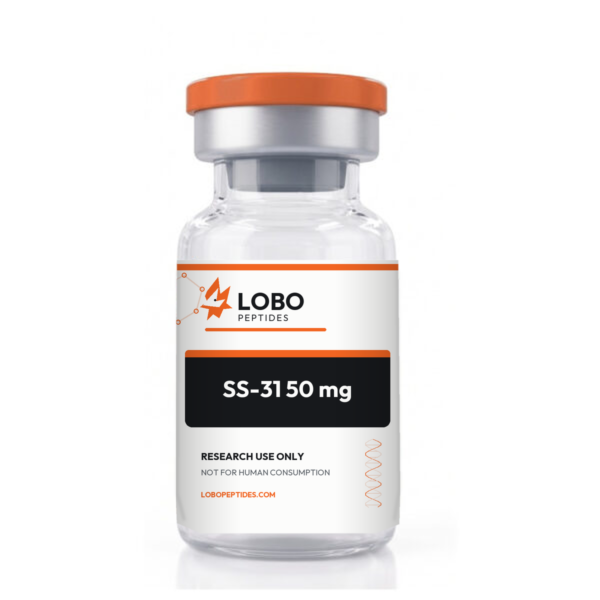
SS-31
SS-31 5mg, 10mg, 50mg is presented as Canonical SS-31, with Separate nominal catalog options: 5 mg, 10 mg, and 50 mg. Distinct from fluorescent SS-31 probes, dimethyltyrosine-free comparator analogs, other Szeto–Schiller peptides, and unrelated mitochondrial-targeting compounds. The amount is nominal pending lot-specific documentation. For research use only (RUO); not for human or veterinary use.
SS-31 5mg, 10mg, 50mg Product Description
SS-31 5mg, 10mg, 50mg is presented as Canonical SS-31. The displayed inventory statement is Separate nominal catalog options: 5 mg, 10 mg, and 50 mg. This is a catalog description of intended identity and nominal quantity, not a report of independently measured composition. Exact sequence, terminal chemistry, counterion, physical form, purity, and assayed content are unconfirmed. Until a lot-specific record is available, the listing should be read as an identification framework for qualified laboratory review rather than as an analytical certificate.
The principal boundary for this entry is straightforward: Distinct from fluorescent SS-31 probes, dimethyltyrosine-free comparator analogs, other Szeto–Schiller peptides, and unrelated mitochondrial-targeting compounds. Close names can conceal meaningful differences in sequence, terminal groups, coordination state, labeling, oxidation state, or presentation. Those differences can affect assay design and interpretation, so adjacent compounds are not treated as substitutes. The product title is preserved exactly, and any ambiguity is made visible instead of being resolved through assumptions.
This material is offered for research use only (RUO) and is not for human or veterinary use. The page does not provide directions for preparation, administration, dosing, or consumer use. Appropriate experimental planning requires independent review of the selected model, controls, analytical methods, and the eventual lot documentation. Literature summarized below describes named study reagents under particular conditions; it is not evidence that this catalog unit reproduces those findings.
Its seller-specific statements about form, testing, composition, availability, or performance are not transferred to Lobo. This original text is organized around the Lobo specification, primary literature, and a conservative separation between published evidence and unverified product attributes.
Research Material Profile
SS-31 5mg, 10mg, 50mg Research
Cell, mitochondria, and ex-vivo models
One study examined SS-31 in N2A cells, isolated mitochondria, and an ex-vivo ischemic-heart preparation, with measurements that included mitochondrial swelling and oxidative-cell endpoints. Comparator analogs were also part of the experimental design. The results support model-specific research context for the characterized SS-31 reagent but do not verify any of the three catalog options. Cell permeability or behavior observed in those systems cannot be generalized into a product promise. The comparator structure also matters: observations for another Szeto–Schiller peptide do not automatically belong to canonical SS-31. This listing keeps all strengths under one intended identity while treating each displayed amount as nominal and separately selectable. Interpretation therefore requires the source’s exact reagent definition, controls, comparators, reported endpoint, sampling framework, and analytical limitations before drawing narrow, model-bound conclusions from the reported experimental observations. (PubMed 15178689).
Cardiolipin-interaction experiments
Biochemical assays and a rat renal-ischemia model were used to examine SS-31 interaction with cardiolipin. The research program also employed a polarity-sensitive fluorescent SS-31 analog to visualize aspects of the interaction. A fluorescently labeled probe is analytically and functionally distinct from an unlabeled catalog material, so probe observations cannot establish equivalence to this SKU. The source supports the existence of a cardiolipin-focused experimental framework involving defined SS-31 and related tools. It does not establish sequence, counterion, purity, or amount for the 5 mg, 10 mg, or 50 mg options, and it does not warrant organism-level claims outside the stated rat model. Interpretation therefore requires the source’s exact reagent definition, controls, comparators, reported endpoint, sampling framework, and analytical limitations before drawing narrow, model-bound conclusions from the reported experimental observations. (PubMed 23813215).
Rat mitochondrial energetics study
A separate rat renal ischemia-reperfusion study measured mitochondrial energetics, ATP-related variables, and tissue endpoints after experimental exposure to the study peptide. These are animal-model findings bound to species, protocol, timing, and analytical methods. They neither confirm the identity of a commercial vial nor establish a general effect across models. The paper is included as primary evidence that canonical SS-31 has been examined in mitochondrial-energy research. It remains distinct from fluorescent derivatives and comparator analogs. No inference is made that a larger nominal catalog option has different biological properties; the listed amounts are inventory choices, not experimental performance tiers. Interpretation therefore requires the source’s exact reagent definition, controls, comparators, reported endpoint, sampling framework, and analytical limitations before drawing narrow, model-bound conclusions from the reported experimental observations. (PubMed 21546574).
Evidence Boundaries
The evidence set describes published experiments with defined study materials; it does not constitute analytical evidence for SS-31 5mg, 10mg, 50mg. The product-level uncertainties remain: Exact sequence, terminal chemistry, counterion, physical form, purity, and assayed content are unconfirmed. The listed quantity is nominal, and no unreported identity, purity, content, sterility, endotoxin, residual-solvent, or microbiological result should be inferred. Distinct from fluorescent SS-31 probes, dimethyltyrosine-free comparator analogs, other Szeto–Schiller peptides, and unrelated mitochondrial-targeting compounds. Cell, biochemical, ex-vivo, animal, insect, or precursor studies are labeled as such and cannot be generalized across models. Source titles may describe the authors’ chosen endpoints, but this page does not convert them into commercial promises. No preparation, dosing, administration, or human-use conclusion is supplied.
SS-31 5mg, 10mg, 50mg References
8 curated medical and scientific references used for identity, mechanism, model, and assay context.
- Cell-permeable peptide antioxidants targeted to inner mitochondrial membrane inhibit mitochondrial swelling, oxidative cell death, and reperfusion injury.
Zhao K et al. Cell-permeable peptide antioxidants targeted to inner mitochondrial membrane inhibit mitochondrial swelling, oxidative cell death, and reperfusion injury. J Biol Chem (2004). PMID 15178689. DOI: 10.1074/jbc.M402999200.
Canonical SS-31/elamipretide literature; fluorescent probes, prodrugs, and comparator analogs remain distinct. · N2A cells, isolated mitochondria, and an ex-vivo ischemic-heart model with comparator analogs.
View research source - The mitochondrial-targeted compound SS-31 re-energizes ischemic mitochondria by interacting with cardiolipin.
Birk AV et al. The mitochondrial-targeted compound SS-31 re-energizes ischemic mitochondria by interacting with cardiolipin. J Am Soc Nephrol (2013). PMID 23813215. DOI: 10.1681/ASN.2012121216.
Canonical SS-31/elamipretide literature; fluorescent probes, prodrugs, and comparator analogs remain distinct. · Biochemical assays, a fluorescent SS-31 analog, and rat renal-ischemia experiments.
View research source - Mitochondria-targeted peptide accelerates ATP recovery and reduces ischemic kidney injury.
Szeto HH et al. Mitochondria-targeted peptide accelerates ATP recovery and reduces ischemic kidney injury. J Am Soc Nephrol (2011). PMID 21546574. DOI: 10.1681/ASN.2010080808.
Canonical SS-31/elamipretide literature; fluorescent probes, prodrugs, and comparator analogs remain distinct. · Rat renal ischemia-reperfusion model with mitochondrial and ATP-recovery endpoints.
View research source - The effects of a mitochondrial targeted peptide (elamipretide/SS31) on BAX recruitment and activation during apoptosis.
Grosser JA et al. The effects of a mitochondrial targeted peptide (elamipretide/SS31) on BAX recruitment and activation during apoptosis. BMC Res Notes (2021). PMID 34022923. DOI: 10.1186/s13104-021-05613-9.
Canonical SS-31/elamipretide literature; fluorescent probes, prodrugs, and comparator analogs remain distinct. · Cellular and mitochondrial assays of BAX recruitment and activation.
View research source - Differential Effects of the Mitochondria-Active Tetrapeptide SS-31 (D-Arg-dimethylTyr-Lys-Phe-NH2) and Its Peptidase-Targeted Prodrugs in Experimental Acute Kidney Injury.
Wyss JC et al. Differential Effects of the Mitochondria-Active Tetrapeptide SS-31 (D-Arg-dimethylTyr-Lys-Phe-NH2) and Its Peptidase-Targeted Prodrugs in Experimental Acute Kidney Injury. Front Pharmacol (2019). PMID 31780923. DOI: 10.3389/fphar.2019.01209.
Canonical SS-31/elamipretide literature; fluorescent probes, prodrugs, and comparator analogs remain distinct. · Experimental acute-kidney-injury models comparing canonical amidated SS-31 with peptidase-targeted prodrugs.
View research source - Mitochondrial targeting with antioxidant peptide SS-31 prevents mitochondrial depolarization, reduces islet cell apoptosis, increases islet cell yield, and improves posttransplantation function.
Thomas DA et al. Mitochondrial targeting with antioxidant peptide SS-31 prevents mitochondrial depolarization, reduces islet cell apoptosis, increases islet cell yield, and improves posttransplantation function. J Am Soc Nephrol (2007). PMID 17151329. DOI: 10.1681/ASN.2006080825.
Canonical SS-31/elamipretide literature; fluorescent probes, prodrugs, and comparator analogs remain distinct. · Isolated islet cells and an islet-transplantation model.
View research source - Protective Effect of Bendavia (SS-31) Against Oxygen/Glucose-Deprivation Stress-Induced Mitochondrial Damage in Human Brain Microvascular Endothelial Cells.
Imai T et al. Protective Effect of Bendavia (SS-31) Against Oxygen/Glucose-Deprivation Stress-Induced Mitochondrial Damage in Human Brain Microvascular Endothelial Cells. Curr Neurovasc Res (2017). PMID 27855593. DOI: 10.2174/1567202614666161117110609.
Canonical SS-31/elamipretide literature; fluorescent probes, prodrugs, and comparator analogs remain distinct. · Human brain microvascular endothelial cells under oxygen/glucose deprivation.
View research source - Elamipretide (SS-31) improves mitochondrial dysfunction, synaptic and memory impairment induced by lipopolysaccharide in mice.
Zhao W et al. Elamipretide (SS-31) improves mitochondrial dysfunction, synaptic and memory impairment induced by lipopolysaccharide in mice. J Neuroinflammation (2019). PMID 31747905. DOI: 10.1186/s12974-019-1627-9.
Canonical SS-31/elamipretide literature; fluorescent probes, prodrugs, and comparator analogs remain distinct. · Lipopolysaccharide-challenged mice with mitochondrial, synaptic, and memory endpoints.
View research source