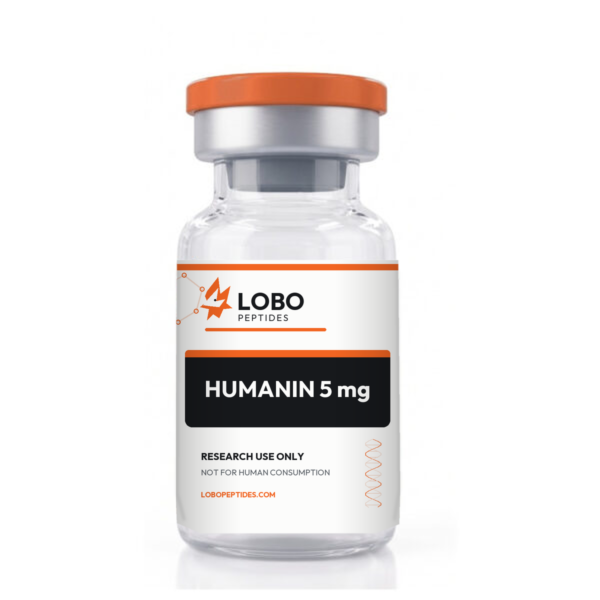
Humanin
Humanin 5mg is presented as Canonical Humanin, with 5 mg nominal catalog strength. Excludes S14G-Humanin/HNG, colivelin, N-formylated Humanin, fusion constructs, labeled probes, and other modified analogs. The amount is nominal pending lot-specific documentation. For research use only (RUO); not for human or veterinary use.
Out of stock
Humanin 5mg Product Description
Humanin 5mg is presented as Canonical Humanin. The displayed inventory statement is 5 mg nominal catalog strength. This is a catalog description of intended identity and nominal quantity, not a report of independently measured composition. Exact sequence, terminal chemistry, counterion, physical form, purity, and assayed content are unconfirmed. Until a lot-specific record is available, the listing should be read as an identification framework for qualified laboratory review rather than as an analytical certificate.
The principal boundary for this entry is straightforward: Excludes S14G-Humanin/HNG, colivelin, N-formylated Humanin, fusion constructs, labeled probes, and other modified analogs. Close names can conceal meaningful differences in sequence, terminal groups, coordination state, labeling, oxidation state, or presentation. Those differences can affect assay design and interpretation, so adjacent compounds are not treated as substitutes. The product title is preserved exactly, and any ambiguity is made visible instead of being resolved through assumptions.
This material is offered for research use only (RUO) and is not for human or veterinary use. The page does not provide directions for preparation, administration, dosing, or consumer use. Appropriate experimental planning requires independent review of the selected model, controls, analytical methods, and the eventual lot documentation. Literature summarized below describes named study reagents under particular conditions; it is not evidence that this catalog unit reproduces those findings.
Its seller-specific statements about form, testing, composition, availability, or performance are not transferred to Lobo. This original text is organized around the Lobo specification, primary literature, and a conservative separation between published evidence and unverified product attributes.
Research Material Profile
Humanin 5mg Research
Cultured neuronal-cell discovery work
Humanin was reported through a functional-expression screening approach in cultured neuronal cells, with investigators measuring cell-survival endpoints under defined experimental challenges. This publication establishes historical identity and discovery context for characterized Humanin. It does not verify the sequence or form of the Lobo lot, and the cell-culture observations do not establish outcomes beyond that system. The present listing is expressly limited to canonical Humanin, so results involving S14G-Humanin or composite analogs are not silently imported. Culture conditions, expression constructs, challenge agents, and endpoint definitions all matter when reading the study. The paper supports research background, not a product-level functional guarantee. Interpretation therefore requires the source’s exact reagent definition, controls, comparators, reported endpoint, sampling framework, and analytical limitations before drawing narrow, model-bound conclusions from the reported experimental observations. (PubMed 11371646).
Bax activation experiments
A later investigation used cell assays, isolated mitochondria, and biochemical methods to examine interactions between Humanin and Bax activation. Combining several experimental levels can clarify a proposed mechanism, but each level remains a controlled model using characterized reagents. The reported molecular observations do not establish the composition or performance of this 5 mg catalog material. They also do not justify treating HNG, colivelin, N-formylated Humanin, or other sequence variants as equivalent to canonical Humanin. This source is cited to document a specific biochemical question in the primary literature while maintaining strict separation between published reagent identity and pending lot analytics. Interpretation therefore requires the source’s exact reagent definition, controls, comparators, reported endpoint, sampling framework, and analytical limitations before drawing narrow, model-bound conclusions from the reported experimental observations. (PubMed 12732850).
Cytokine-receptor-complex studies
Neuronal-cell loss-of-function and overexpression experiments, together with reconstituted binding assays, were used to investigate a receptor complex involving CNTF receptor alpha, WSX-1, and gp130. These methods support discussion of a receptor-oriented research hypothesis for the characterized peptide. Reconstituted binding does not by itself establish organism-level behavior, and cultured neuronal models do not establish a use case for people or animals. The publication provides no confirmation that this vial is canonical Humanin or that its nominal 5 mg value is analytically measured. Identity, terminal chemistry, and lot content therefore remain separate documentation questions. Interpretation therefore requires the source’s exact reagent definition, controls, comparators, reported endpoint, sampling framework, and analytical limitations before drawing narrow, model-bound conclusions from the reported experimental observations. (PubMed 19386761).
Evidence Boundaries
The evidence set describes published experiments with defined study materials; it does not constitute analytical evidence for Humanin 5mg. The product-level uncertainties remain: Exact sequence, terminal chemistry, counterion, physical form, purity, and assayed content are unconfirmed. The listed quantity is nominal, and no unreported identity, purity, content, sterility, endotoxin, residual-solvent, or microbiological result should be inferred. Excludes S14G-Humanin/HNG, colivelin, N-formylated Humanin, fusion constructs, labeled probes, and other modified analogs. Cell, biochemical, ex-vivo, animal, insect, or precursor studies are labeled as such and cannot be generalized across models. Source titles may describe the authors’ chosen endpoints, but this page does not convert them into commercial promises. No preparation, dosing, administration, or human-use conclusion is supplied.
Humanin 5mg References
8 curated medical and scientific references used for identity, mechanism, model, and assay context.
- A rescue factor abolishing neuronal cell death by a wide spectrum of familial Alzheimer's disease genes and Abeta.
Hashimoto Y et al. A rescue factor abolishing neuronal cell death by a wide spectrum of familial Alzheimer's disease genes and Abeta. Proc Natl Acad Sci U S A (2001). PMID 11371646. DOI: 10.1073/pnas.101133498.
Canonical Humanin literature; sequence-modified HNG/S14G-Humanin and fusion constructs are excluded. · Cultured neuronal-cell functional-expression screen involving familial Alzheimer genes and amyloid-beta toxicity.
View research source - Humanin peptide suppresses apoptosis by interfering with Bax activation.
Guo B et al. Humanin peptide suppresses apoptosis by interfering with Bax activation. Nature (2003). PMID 12732850. DOI: 10.1038/nature01627.
Canonical Humanin literature; sequence-modified HNG/S14G-Humanin and fusion constructs are excluded. · Cell assays, isolated mitochondria, and Bax-interaction biochemistry.
View research source - Humanin inhibits neuronal cell death by interacting with a cytokine receptor complex or complexes involving CNTF receptor alpha/WSX-1/gp130.
Hashimoto Y et al. Humanin inhibits neuronal cell death by interacting with a cytokine receptor complex or complexes involving CNTF receptor alpha/WSX-1/gp130. Mol Biol Cell (2009). PMID 19386761. DOI: 10.1091/mbc.e09-02-0168.
Canonical Humanin literature; sequence-modified HNG/S14G-Humanin and fusion constructs are excluded. · Neuronal-cell knockdown/overexpression and reconstituted cytokine-receptor-complex binding assays.
View research source - Humanin is an endogenous activator of chaperone-mediated autophagy.
Gong Z et al. Humanin is an endogenous activator of chaperone-mediated autophagy. J Cell Biol (2018). PMID 29187525. DOI: 10.1083/jcb.201606095.
Canonical Humanin literature; sequence-modified HNG/S14G-Humanin and fusion constructs are excluded. · Cellular and biochemical chaperone-mediated-autophagy assays.
View research source - Humanin prevents high glucose-induced monocyte adhesion to endothelial cells by targeting KLF2.
Wang X et al. Humanin prevents high glucose-induced monocyte adhesion to endothelial cells by targeting KLF2. Mol Immunol (2018). PMID 30029058. DOI: 10.1016/j.molimm.2018.07.008.
Canonical Humanin literature; sequence-modified HNG/S14G-Humanin and fusion constructs are excluded. · High-glucose monocyte–endothelial adhesion model with KLF2-related measurements.
View research source - Humanin Specifically Interacts with Amyloid-β Oligomers and Counteracts Their in vivo Toxicity.
Romeo M et al. Humanin Specifically Interacts with Amyloid-β Oligomers and Counteracts Their in vivo Toxicity. J Alzheimers Dis (2017). PMID 28282805. DOI: 10.3233/JAD-160951.
Canonical Humanin literature; sequence-modified HNG/S14G-Humanin and fusion constructs are excluded. · Biochemical Humanin–amyloid-beta interaction assays plus an in-vivo toxicity model.
View research source - Mitochondrial humanin peptide acts as a cytoprotective factor in granulosa cell survival.
Marvaldi C et al. Mitochondrial humanin peptide acts as a cytoprotective factor in granulosa cell survival. Reproduction (2021). PMID 33764899. DOI: 10.1530/REP-20-0197.
Canonical Humanin literature; sequence-modified HNG/S14G-Humanin and fusion constructs are excluded. · Granulosa-cell survival models with mitochondrial/cell-death readouts.
View research source - HUMANIN produced by human efferocytic macrophages promotes the resolution of inflammation.
Maraux M et al. HUMANIN produced by human efferocytic macrophages promotes the resolution of inflammation. Cell Death Dis (2025). PMID 40877234. DOI: 10.1038/s41419-025-07909-1.
Canonical Humanin literature; sequence-modified HNG/S14G-Humanin and fusion constructs are excluded. · Human efferocytic macrophage systems with inflammation-resolution measurements.
View research source