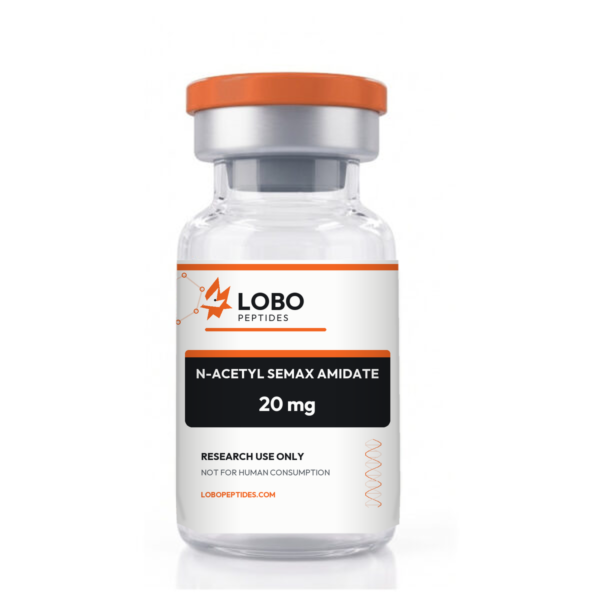
N-Acetyl Semax Amidate 20mg
N-Acetyl Semax Amidate 20mg is presented as N-Acetyl Semax Amidate, provisionally Ac-Met-Glu-His-Phe-Pro-Gly-Pro-NH2, with 20 mg nominal catalog strength. Both N-acetylation and C-terminal amidation distinguish the intended material from unmodified Semax and singly modified N-acetyl Semax. The amount is nominal pending lot-specific documentation. For research use only (RUO); not for human or veterinary use.
Out of stock
N-Acetyl Semax Amidate 20mg Product Description
N-Acetyl Semax Amidate 20mg is presented as N-Acetyl Semax Amidate, provisionally Ac-Met-Glu-His-Phe-Pro-Gly-Pro-NH2. The displayed inventory statement is 20 mg nominal catalog strength. This is a catalog description of intended identity and nominal quantity, not a report of independently measured composition. Exact sequence, both terminal modifications, counterion, purity, and assayed content require lot-specific confirmation. Until a lot-specific record is available, the listing should be read as an identification framework for qualified laboratory review rather than as an analytical certificate.
The principal boundary for this entry is straightforward: Both N-acetylation and C-terminal amidation distinguish the intended material from unmodified Semax and singly modified N-acetyl Semax. Close names can conceal meaningful differences in sequence, terminal groups, coordination state, labeling, oxidation state, or presentation. Those differences can affect assay design and interpretation, so adjacent compounds are not treated as substitutes. The product title is preserved exactly, and any ambiguity is made visible instead of being resolved through assumptions.
This material is offered for research use only (RUO) and is not for human or veterinary use. The page does not provide directions for preparation, administration, dosing, or consumer use. Appropriate experimental planning requires independent review of the selected model, controls, analytical methods, and the eventual lot documentation. Literature summarized below describes named study reagents under particular conditions; it is not evidence that this catalog unit reproduces those findings.
Its seller-specific statements about form, testing, composition, availability, or performance are not transferred to Lobo. This original text is organized around the Lobo specification, primary literature, and a conservative separation between published evidence and unverified product attributes.
Research Material Profile
N-Acetyl Semax Amidate 20mg Research
Adjacent acetylated-Semax stability study
A publication on an acetylated Semax derivative examined proteolytic stability in biological media. It is the closest modification-related source in this record, but the citation does not by itself establish that the studied derivative carried the same C-terminal amide as the target SKU. Its observations must therefore remain adjacent evidence. They cannot be assigned directly to N-Acetyl Semax Amidate, and they do not verify the commercial lot. The source is useful for illustrating why terminal chemistry belongs in the identity field: acetylation at one end does not prove amidation at the other, and stability measured for one derivative is not automatically transferable to a doubly modified analog. Interpretation therefore requires the source’s exact reagent definition, controls, comparators, reported endpoint, sampling framework, and analytical limitations before drawing narrow, model-bound conclusions from the reported experimental observations. (DOI research).
Parent-peptide rat transcriptomics
A rat study investigated unmodified ACTH(4–7)PGP, commonly called Semax, in a cerebral ischemia-reperfusion model and reported transcriptome-level measurements. This is parent-peptide context, not evidence for the N-acetylated, C-amidated analog. Sequence-related materials may differ in stability, distribution, assay exposure, and molecular interactions, so the reported transcriptional patterns cannot be inherited by this listing. The animal and model qualifiers also remain essential. The source is included to map the literature neighborhood around Semax while making the non-equivalence explicit. No functional, clinical, or product-performance statement about the 20 mg SKU is drawn from it. Interpretation therefore requires the source’s exact reagent definition, controls, comparators, reported endpoint, sampling framework, and analytical limitations before drawing narrow, model-bound conclusions from the reported experimental observations. (PubMed 32580520).
Parent-peptide artificial-membrane work
Another study used unmodified Semax in biochemical and artificial-membrane experiments involving copper-associated amyloid aggregation. Artificial membranes are controlled model systems, and the cited material was the parent peptide rather than the catalog’s proposed doubly terminally modified analog. The paper can support only a description of an adjacent assay question. It cannot establish binding, aggregation behavior, stability, or activity for N-Acetyl Semax Amidate. This distinction is especially important where a familiar root name might encourage overgeneralization. Until direct exact-identity literature and lot analytics are available, this product page keeps parent-peptide results segregated from the target SKU. Interpretation therefore requires the source’s exact reagent definition, controls, comparators, reported endpoint, sampling framework, and analytical limitations before drawing narrow, model-bound conclusions from the reported experimental observations. (PubMed 35080861).
Evidence Boundaries
The evidence set describes published experiments with defined study materials; it does not constitute analytical evidence for N-Acetyl Semax Amidate 20mg. The product-level uncertainties remain: Exact sequence, both terminal modifications, counterion, purity, and assayed content require lot-specific confirmation. The listed quantity is nominal, and no unreported identity, purity, content, sterility, endotoxin, residual-solvent, or microbiological result should be inferred. Both N-acetylation and C-terminal amidation distinguish the intended material from unmodified Semax and singly modified N-acetyl Semax. Cell, biochemical, ex-vivo, animal, insect, or precursor studies are labeled as such and cannot be generalized across models. Source titles may describe the authors’ chosen endpoints, but this page does not convert them into commercial promises. No preparation, dosing, administration, or human-use conclusion is supplied.
N-Acetyl Semax Amidate 20mg References
6 curated medical and scientific references used for identity, mechanism, model, and assay context.
- Influence of the N-terminus acetylation of Semax, a synthetic analog of ACTH(4-10), on copper(II) and zinc(II) coordination and biological properties.
Magrì A et al. Influence of the N-terminus acetylation of Semax, a synthetic analog of ACTH(4-10), on copper(II) and zinc(II) coordination and biological properties. J Inorg Biochem (2016). PMID 27586814. DOI: 10.1016/j.jinorgbio.2016.08.013.
Adjacent singly N-acetylated Semax evidence; C-terminal amidation was not established. · N-terminally acetylated Semax in metal-coordination and associated biological-property assays.
View research source - Stability of Semax acetyl to proteolysis in various biological media.
Shevchenko KV et al. Stability of Semax acetyl to proteolysis in various biological media. Dokl Biol Sci (2013). PMID 23652441. DOI: 10.1134/S0012496613020166.
Adjacent singly N-acetylated Semax evidence; C-terminal amidation was not established. · Singly acetylated Semax tested for proteolytic stability in multiple biological media.
View research source - Novel Insights into the Protective Properties of ACTH(4-7)PGP (Semax) Peptide at the Transcriptome Level Following Cerebral Ischaemia-Reperfusion in Rats.
Filippenkov IB et al. Novel Insights into the Protective Properties of ACTH(4-7)PGP (Semax) Peptide at the Transcriptome Level Following Cerebral Ischaemia-Reperfusion in Rats. Genes (Basel) (2020). PMID 32580520. DOI: 10.3390/genes11060681.
Adjacent unmodified parent-Semax evidence; neither N-acetylation nor C-terminal amidation was studied. · Unmodified Semax in a rat cerebral ischemia-reperfusion transcriptomics study.
View research source - Semax, a Synthetic Regulatory Peptide, Affects Copper-Induced Abeta Aggregation and Amyloid Formation in Artificial Membrane Models.
Sciacca MFM et al. Semax, a Synthetic Regulatory Peptide, Affects Copper-Induced Abeta Aggregation and Amyloid Formation in Artificial Membrane Models. ACS Chem Neurosci (2022). PMID 35080861. DOI: 10.1021/acschemneuro.1c00707.
Adjacent unmodified parent-Semax evidence; neither N-acetylation nor C-terminal amidation was studied. · Unmodified Semax in copper-induced amyloid-beta aggregation and artificial-membrane models.
View research source - Semax, an analogue of adrenocorticotropin (4-10), binds specifically and increases levels of brain-derived neurotrophic factor protein in rat basal forebrain.
Dolotov OV et al. Semax, an analogue of adrenocorticotropin (4-10), binds specifically and increases levels of brain-derived neurotrophic factor protein in rat basal forebrain. J Neurochem (2006). PMID 16635254. DOI: 10.1111/j.1471-4159.2006.03658.x.
Adjacent unmodified parent-Semax evidence; neither N-acetylation nor C-terminal amidation was studied. · Unmodified Semax in rat basal-forebrain binding and BDNF-protein experiments.
View research source - The peptide semax affects the expression of genes related to the immune and vascular systems in rat brain focal ischemia: genome-wide transcriptional analysis.
Medvedeva EV et al. The peptide semax affects the expression of genes related to the immune and vascular systems in rat brain focal ischemia: genome-wide transcriptional analysis. BMC Genomics (2014). PMID 24661604. DOI: 10.1186/1471-2164-15-228.
Adjacent unmodified parent-Semax evidence; neither N-acetylation nor C-terminal amidation was studied. · Unmodified Semax in a rat focal-cerebral-ischemia genome-wide expression study.
View research source