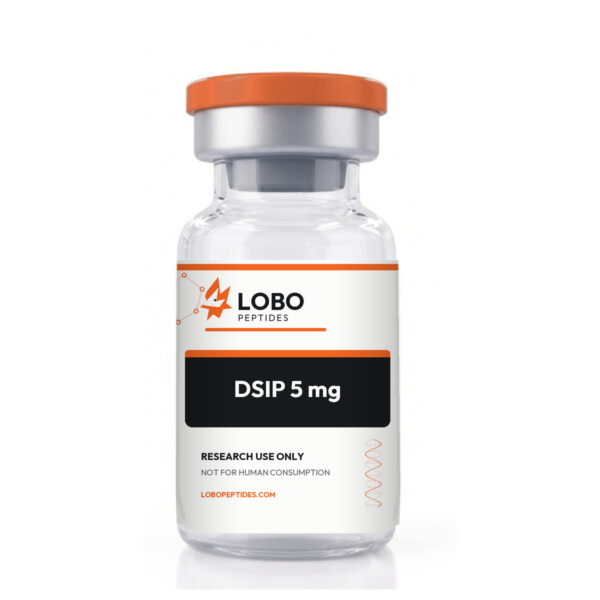
DSIP 5mg
DSIP 5mg is presented as DSIP, Trp-Ala-Gly-Gly-Asp-Ala-Ser-Gly-Glu, with 5 mg nominal catalog strength. Distinct from phosphorylated forms, sequence analogs, labeled probes, and other peptides described with similar terminology. The amount is nominal pending lot-specific documentation. For research use only (RUO); not for human or veterinary use.
Out of stock
DSIP 5mg Product Description
DSIP 5mg is presented as DSIP, Trp-Ala-Gly-Gly-Asp-Ala-Ser-Gly-Glu. The displayed inventory statement is 5 mg nominal catalog strength. This is a catalog description of intended identity and nominal quantity, not a report of independently measured composition. Terminal chemistry, counterion, physical form, purity, and assayed content remain unconfirmed. Until a lot-specific record is available, the listing should be read as an identification framework for qualified laboratory review rather than as an analytical certificate.
The principal boundary for this entry is straightforward: Distinct from phosphorylated forms, sequence analogs, labeled probes, and other peptides described with similar terminology. Close names can conceal meaningful differences in sequence, terminal groups, coordination state, labeling, oxidation state, or presentation. Those differences can affect assay design and interpretation, so adjacent compounds are not treated as substitutes. The product title is preserved exactly, and any ambiguity is made visible instead of being resolved through assumptions.
This material is offered for research use only (RUO) and is not for human or veterinary use. The page does not provide directions for preparation, administration, dosing, or consumer use. Appropriate experimental planning requires independent review of the selected model, controls, analytical methods, and the eventual lot documentation. Literature summarized below describes named study reagents under particular conditions; it is not evidence that this catalog unit reproduces those findings.
Its seller-specific statements about form, testing, composition, availability, or performance are not transferred to Lobo. This original text is organized around the Lobo specification, primary literature, and a conservative separation between published evidence and unverified product attributes.
Research Material Profile
DSIP 5mg Research
Rat antibody-intervention study
A male-rat sleep-deprivation experiment used anti-DSIP serum and measured slow-wave sleep together with endocrine-related endpoints. The design investigated the possible role of endogenous DSIP-related immunoreactivity rather than testing a commercial DSIP SKU. Antibody intervention, species, deprivation protocol, and measurement method are essential qualifiers. This paper supports historical research context for the named nonapeptide but does not establish a predictable effect of exogenous catalog material. It also does not verify sequence, terminal state, or content for this 5 mg listing. The page therefore reports the experimental question neutrally and avoids turning the DSIP name into consumer-facing sleep positioning. Interpretation therefore requires the source’s exact reagent definition, controls, comparators, reported endpoint, sampling framework, and analytical limitations before drawing narrow, model-bound conclusions from the reported experimental observations. (PubMed 3368469).
Barrier-model permeability
An in-vitro investigation characterized DSIP permeability using a primary brain-microvessel endothelial-cell barrier model. Such systems allow controlled measurements across cultured endothelial layers, but they simplify the biological environment and depend heavily on model integrity and assay conditions. The reported permeability behavior applies to the study material and setup. It cannot establish organism-level distribution, and it cannot confirm this lot’s identity or composition. The source is appropriate for a research page because it identifies a transport question studied with defined DSIP. It offers no basis for handling, administration, or human-use guidance, all of which are outside the scope of an RUO listing. Interpretation therefore requires the source’s exact reagent definition, controls, comparators, reported endpoint, sampling framework, and analytical limitations before drawing narrow, model-bound conclusions from the reported experimental observations. (PubMed 2576448).
Rat neuronal and synaptosome assays
Researchers examined DSIP-related responses involving glutamate and GABA receptor systems in rat-derived neurons and synaptosome preparations from several brain regions. These were isolated biological preparations, not intact-human observations, and the reported responses belong to the stated experimental conditions. The work supports a narrow statement that DSIP has been used in receptor-oriented neurochemical assays. It does not demonstrate a catalog-level function, nor does it resolve whether a product labeled DSIP has the exact sequence and terminal chemistry used by the investigators. Any comparison with phosphorylated or otherwise modified DSIP materials would require separate evidence. Interpretation therefore requires the source’s exact reagent definition, controls, comparators, reported endpoint, sampling framework, and analytical limitations before drawing narrow, model-bound conclusions from the reported experimental observations. (PubMed 17369935).
Evidence Boundaries
The evidence set describes published experiments with defined study materials; it does not constitute analytical evidence for DSIP 5mg. The product-level uncertainties remain: Terminal chemistry, counterion, physical form, purity, and assayed content remain unconfirmed. The listed quantity is nominal, and no unreported identity, purity, content, sterility, endotoxin, residual-solvent, or microbiological result should be inferred. Distinct from phosphorylated forms, sequence analogs, labeled probes, and other peptides described with similar terminology. Cell, biochemical, ex-vivo, animal, insect, or precursor studies are labeled as such and cannot be generalized across models. Source titles may describe the authors’ chosen endpoints, but this page does not convert them into commercial promises. No preparation, dosing, administration, or human-use conclusion is supplied.
DSIP 5mg References
8 curated medical and scientific references used for identity, mechanism, model, and assay context.
- Evidence for a role of delta sleep-inducing peptide in slow-wave sleep and sleep-related growth hormone release in the rat.
Iyer KS et al. Evidence for a role of delta sleep-inducing peptide in slow-wave sleep and sleep-related growth hormone release in the rat. Proc Natl Acad Sci U S A (1988). PMID 3368469. DOI: 10.1073/pnas.85.10.3653.
Direct canonical DSIP literature; analog and phosphorylated-form findings are not interchangeable. · Male-rat anti-DSIP-serum sleep-deprivation experiment with slow-wave-sleep and growth-hormone endpoints.
View research source - In-vitro characterization of blood-brain barrier permeability to delta sleep-inducing peptide.
Raeissi S et al. In-vitro characterization of blood-brain barrier permeability to delta sleep-inducing peptide. J Pharm Pharmacol (1989). PMID 2576448. DOI: 10.1111/j.2042-7158.1989.tb06385.x.
Direct canonical DSIP literature; analog and phosphorylated-form findings are not interchangeable. · Primary brain-microvessel endothelial-cell blood-brain-barrier model.
View research source - Effects of delta sleep-inducing peptide on pre- and postsynaptic glutamate and postsynaptic GABA receptors in neurons of the cortex, hippocampus, and cerebellum in rats.
Grigor'ev VV et al. Effects of delta sleep-inducing peptide on pre- and postsynaptic glutamate and postsynaptic GABA receptors in neurons of the cortex, hippocampus, and cerebellum in rats. Bull Exp Biol Med (2006). PMID 17369935. DOI: 10.1007/s10517-006-0323-9.
Direct canonical DSIP literature; analog and phosphorylated-form findings are not interchangeable. · Rat-derived cortical, hippocampal, and cerebellar neuronal/synaptosome assays.
View research source - The delta EEG (sleep)-inducing peptide (DSIP). XI. Amino-acid analysis, sequence, synthesis and activity of the nonapeptide.
Schoenenberger GA et al. The delta EEG (sleep)-inducing peptide (DSIP). XI. Amino-acid analysis, sequence, synthesis and activity of the nonapeptide. Pflugers Arch (1978). PMID 568769. DOI: 10.1007/BF00581575.
Direct canonical DSIP literature; analog and phosphorylated-form findings are not interchangeable. · Amino-acid analysis, chemical synthesis, and activity testing of the DSIP nonapeptide.
View research source - Delta sleep-inducing peptide crosses the blood-brain-barrier in dogs: some correlations with protein binding.
Banks WA et al. Delta sleep-inducing peptide crosses the blood-brain-barrier in dogs: some correlations with protein binding. Pharmacol Biochem Behav (1982). PMID 6897451. DOI: 10.1016/0091-3057(82)90486-5.
Direct canonical DSIP literature; analog and phosphorylated-form findings are not interchangeable. · Dog blood-brain-barrier and protein-binding experiment.
View research source - Degradation and aggregation of delta sleep-inducing peptide (DSIP) and two analogs in plasma and serum.
Graf MV et al. Degradation and aggregation of delta sleep-inducing peptide (DSIP) and two analogs in plasma and serum. Peptides (1987). PMID 3628078. DOI: 10.1016/0196-9781(87)90031-3.
Direct canonical DSIP literature; analog and phosphorylated-form findings are not interchangeable. · DSIP and two analogs incubated in plasma and serum for degradation/aggregation analysis.
View research source - Delta-sleep-inducing peptide (DSIP) inhibited CRF-induced ACTH secretion from rat anterior pituitary gland in vitro.
Okajima T et al. Delta-sleep-inducing peptide (DSIP) inhibited CRF-induced ACTH secretion from rat anterior pituitary gland in vitro. Horm Metab Res (1986). PMID 3017833. DOI: 10.1055/s-2007-1012357.
Direct canonical DSIP literature; analog and phosphorylated-form findings are not interchangeable. · Rat anterior-pituitary tissue in vitro with CRF-induced ACTH secretion.
View research source - Effects of delta-sleep-inducing peptide on 24-hour sleep-wake behaviour in severe chronic insomnia.
Schneider-Helmert D et al. Effects of delta-sleep-inducing peptide on 24-hour sleep-wake behaviour in severe chronic insomnia. Eur Neurol (1987). PMID 3622582. DOI: 10.1159/000116143.
Direct canonical DSIP literature; analog and phosphorylated-form findings are not interchangeable. · Participants with severe chronic insomnia monitored over 24-hour sleep-wake cycles.
View research source