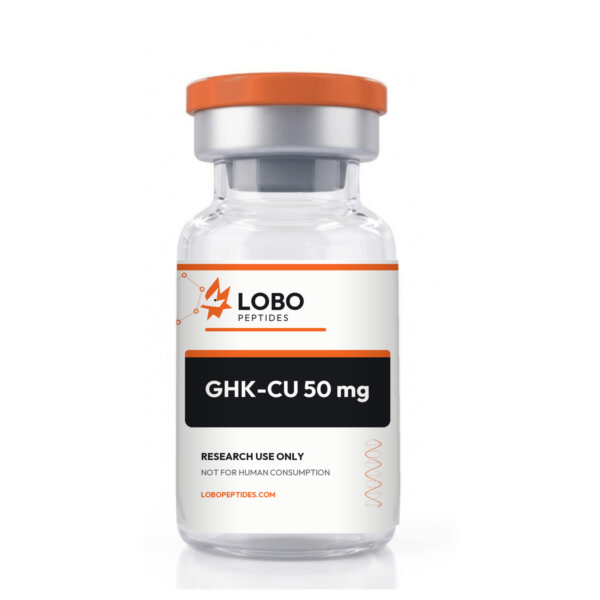
GHK-Cu
GHK-Cu 50mg is presented as GHK-Cu, copper(II)-coordinated glycyl-L-histidyl-L-lysine, with 50 mg nominal catalog strength. Distinct from uncomplexed GHK, free copper salts, palmitoylated copper peptides, and multi-ingredient formulations. The amount is nominal pending lot-specific documentation. For research use only (RUO); not for human or veterinary use.
Out of stock
GHK-Cu 50mg Product Description
GHK-Cu 50mg is presented as GHK-Cu, copper(II)-coordinated glycyl-L-histidyl-L-lysine. The displayed inventory statement is 50 mg nominal catalog strength. This is a catalog description of intended identity and nominal quantity, not a report of independently measured composition. Copper occupancy, counterion, physical form, purity, and assayed content remain undocumented. Until a lot-specific record is available, the listing should be read as an identification framework for qualified laboratory review rather than as an analytical certificate.
The principal boundary for this entry is straightforward: Distinct from uncomplexed GHK, free copper salts, palmitoylated copper peptides, and multi-ingredient formulations. Close names can conceal meaningful differences in sequence, terminal groups, coordination state, labeling, oxidation state, or presentation. Those differences can affect assay design and interpretation, so adjacent compounds are not treated as substitutes. The product title is preserved exactly, and any ambiguity is made visible instead of being resolved through assumptions.
This material is offered for research use only (RUO) and is not for human or veterinary use. The page does not provide directions for preparation, administration, dosing, or consumer use. Appropriate experimental planning requires independent review of the selected model, controls, analytical methods, and the eventual lot documentation. Literature summarized below describes named study reagents under particular conditions; it is not evidence that this catalog unit reproduces those findings.
Its seller-specific statements about form, testing, composition, availability, or performance are not transferred to Lobo. This original text is organized around the Lobo specification, primary literature, and a conservative separation between published evidence and unverified product attributes.
Research Material Profile
GHK-Cu 50mg Research
Fibroblast collagen assay
A cultured-fibroblast investigation examined collagen-synthesis responses to a characterized glycyl-L-histidyl-L-lysine copper complex. The experimental system was an in-vitro cell culture, not a product trial, and the cited material was chemically defined within that research setting. This paper supports discussion of GHK-Cu as a coordination complex used to probe extracellular-matrix biology. It does not establish copper occupancy, purity, or activity for the Lobo lot. The result should therefore be read as an assay-specific observation whose interpretation depends on cell source, culture conditions, exposure design, and analytical method. It is not evidence for uncomplexed GHK or for copper salts considered separately. Interpretation therefore requires the source’s exact reagent definition, controls, comparators, reported endpoint, sampling framework, and analytical limitations before drawing narrow, model-bound conclusions from the reported experimental observations. (PubMed 3169264).
Rat chamber matrix measurements
A separate study placed experimental chambers in rats and measured connective-tissue and extracellular-matrix accumulation after exposure to the defined tripeptide-copper complex. The work offers an animal-model counterpart to cell-culture observations, but its scope remains the chamber system, the study reagent, and the reported measurements. It does not establish a general outcome for an RUO catalog unit and does not provide analytical confirmation for this 50 mg listing. Species, local experimental environment, sampling time, and endpoint definitions constrain interpretation. The source is retained because it directly names the coordinated GHK-Cu material and documents a specific matrix-biology research context. Interpretation therefore requires the source’s exact reagent definition, controls, comparators, reported endpoint, sampling framework, and analytical limitations before drawing narrow, model-bound conclusions from the reported experimental observations. (PubMed 8227353).
MMP-2 expression in culture
Investigators also evaluated matrix metalloproteinase-2 expression in cultured dermal fibroblasts exposed to the tripeptide-copper complex, alongside related molecular readouts. This supports a neutral description of GHK-Cu as an experimental probe for cell-based matrix-regulation questions. Expression measurements are not equivalent to organism-level outcomes, and a response in cultured cells cannot be assigned to an untested commercial lot. The citation also does not collapse GHK-Cu into GHK alone: copper coordination is part of the studied identity. Lot documentation would still be required to determine whether the catalog material has the intended complex composition and stated amount. Interpretation therefore requires the source’s exact reagent definition, controls, comparators, reported endpoint, sampling framework, and analytical limitations before drawing narrow, model-bound conclusions from the reported experimental observations. (PubMed 11045606).
Evidence Boundaries
The evidence set describes published experiments with defined study materials; it does not constitute analytical evidence for GHK-Cu 50mg. The product-level uncertainties remain: Copper occupancy, counterion, physical form, purity, and assayed content remain undocumented. The listed quantity is nominal, and no unreported identity, purity, content, sterility, endotoxin, residual-solvent, or microbiological result should be inferred. Distinct from uncomplexed GHK, free copper salts, palmitoylated copper peptides, and multi-ingredient formulations. Cell, biochemical, ex-vivo, animal, insect, or precursor studies are labeled as such and cannot be generalized across models. Source titles may describe the authors’ chosen endpoints, but this page does not convert them into commercial promises. No preparation, dosing, administration, or human-use conclusion is supplied.
GHK-Cu 50mg References
8 curated medical and scientific references used for identity, mechanism, model, and assay context.
- Stimulation of collagen synthesis in fibroblast cultures by the tripeptide-copper complex glycyl-L-histidyl-L-lysine-Cu2+.
Maquart FX et al. Stimulation of collagen synthesis in fibroblast cultures by the tripeptide-copper complex glycyl-L-histidyl-L-lysine-Cu2+. FEBS Lett (1988). PMID 3169264. DOI: 10.1016/0014-5793(88)80509-x.
Direct GHK-Cu literature; copper-complex evidence must not be assigned to uncomplexed GHK. · Cultured fibroblasts with collagen-synthesis measurements.
View research source - In vivo stimulation of connective tissue accumulation by the tripeptide-copper complex glycyl-L-histidyl-L-lysine-Cu2+ in rat experimental wounds.
Maquart FX et al. In vivo stimulation of connective tissue accumulation by the tripeptide-copper complex glycyl-L-histidyl-L-lysine-Cu2+ in rat experimental wounds. J Clin Invest (1993). PMID 8227353. DOI: 10.1172/JCI116842.
Direct GHK-Cu literature; copper-complex evidence must not be assigned to uncomplexed GHK. · Rat experimental-wound chambers with connective-tissue endpoints.
View research source - The tripeptide-copper complex glycyl-L-histidyl-L-lysine-Cu2+ stimulates matrix metalloproteinase-2 expression by fibroblast cultures.
Siméon A et al. The tripeptide-copper complex glycyl-L-histidyl-L-lysine-Cu2+ stimulates matrix metalloproteinase-2 expression by fibroblast cultures. Life Sci (2000). PMID 11045606. DOI: 10.1016/s0024-3205(00)00803-1.
Direct GHK-Cu literature; copper-complex evidence must not be assigned to uncomplexed GHK. · Cultured fibroblasts with MMP-2/TIMP-related measurements.
View research source - Effect of GLY-HIS-LYS and its copper complex on TGF-β secretion in normal human dermal fibroblasts.
Gruchlik A et al. Effect of GLY-HIS-LYS and its copper complex on TGF-β secretion in normal human dermal fibroblasts. Acta Pol Pharm (2014). PMID 25745767.
Direct GHK-Cu literature; copper-complex evidence must not be assigned to uncomplexed GHK. · Normal human dermal fibroblasts comparing GHK with its copper complex through TGF-beta secretion.
View research source - Effects of copper tripeptide on the growth and expression of growth factors by normal and irradiated fibroblasts.
Pollard JD et al. Effects of copper tripeptide on the growth and expression of growth factors by normal and irradiated fibroblasts. Arch Facial Plast Surg (2005). PMID 15655171. DOI: 10.1001/archfaci.7.1.27.
Direct GHK-Cu literature; copper-complex evidence must not be assigned to uncomplexed GHK. · Normal and irradiated fibroblast cultures with growth and growth-factor-expression endpoints.
View research source - Glycyl-L-histidyl-L-lysine-Cu2+ attenuates cigarette smoke-induced pulmonary emphysema and inflammation by reducing oxidative stress pathway.
Zhang Q et al. Glycyl-L-histidyl-L-lysine-Cu2+ attenuates cigarette smoke-induced pulmonary emphysema and inflammation by reducing oxidative stress pathway. Front Mol Biosci (2022). PMID 35936787. DOI: 10.3389/fmolb.2022.925700.
Direct GHK-Cu literature; copper-complex evidence must not be assigned to uncomplexed GHK. · Cigarette-smoke-related pulmonary emphysema/inflammation models spanning cellular and animal assays.
View research source - Protective effects of GHK-Cu in bleomycin-induced pulmonary fibrosis via anti-oxidative stress and anti-inflammation pathways.
Ma WH et al. Protective effects of GHK-Cu in bleomycin-induced pulmonary fibrosis via anti-oxidative stress and anti-inflammation pathways. Life Sci (2020). PMID 31809714. DOI: 10.1016/j.lfs.2019.117139.
Direct GHK-Cu literature; copper-complex evidence must not be assigned to uncomplexed GHK. · Bleomycin-induced pulmonary-fibrosis animal model and associated molecular assays.
View research source - GHK-Cu-liposomes accelerate scald wound healing in mice by promoting cell proliferation and angiogenesis.
Wang X et al. GHK-Cu-liposomes accelerate scald wound healing in mice by promoting cell proliferation and angiogenesis. Wound Repair Regen (2017). PMID 28370978. DOI: 10.1111/wrr.12520.
Direct GHK-Cu literature; copper-complex evidence must not be assigned to uncomplexed GHK. · Mouse scald-wound model using a GHK-Cu liposomal formulation.
View research source