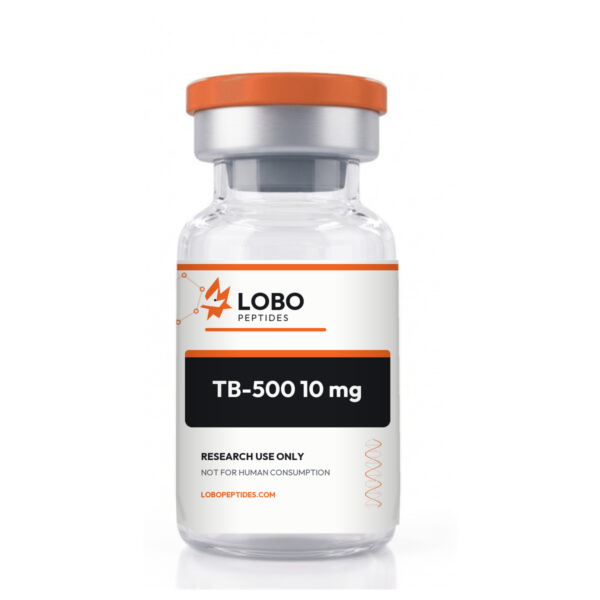
TB-500
TB-500 10mg is presented as TB-500 catalog designation, with 10 mg nominal catalog strength. The name alone does not establish full-length thymosin beta-4, a fragment, an analog, or defined terminal chemistry. The amount is nominal pending lot-specific documentation. For research use only (RUO); not for human or veterinary use.
Out of stock
TB-500 10mg Product Description
TB-500 10mg is presented as TB-500 catalog designation. The displayed inventory statement is 10 mg nominal catalog strength. This is a catalog description of intended identity and nominal quantity, not a report of independently measured composition. Sequence, terminal chemistry, counterion, physical form, and assayed content are unconfirmed. Until a lot-specific record is available, the listing should be read as an identification framework for qualified laboratory review rather than as an analytical certificate.
The principal boundary for this entry is straightforward: The name alone does not establish full-length thymosin beta-4, a fragment, an analog, or defined terminal chemistry. Close names can conceal meaningful differences in sequence, terminal groups, coordination state, labeling, oxidation state, or presentation. Those differences can affect assay design and interpretation, so adjacent compounds are not treated as substitutes. The product title is preserved exactly, and any ambiguity is made visible instead of being resolved through assumptions.
This material is offered for research use only (RUO) and is not for human or veterinary use. The page does not provide directions for preparation, administration, dosing, or consumer use. Appropriate experimental planning requires independent review of the selected model, controls, analytical methods, and the eventual lot documentation. Literature summarized below describes named study reagents under particular conditions; it is not evidence that this catalog unit reproduces those findings.
Its seller-specific statements about form, testing, composition, availability, or performance are not transferred to Lobo. This original text is organized around the Lobo specification, primary literature, and a conservative separation between published evidence and unverified product attributes.
Research Material Profile
TB-500 10mg Research
Defined-material migration assays
The 1997 endothelial study used characterized thymosin beta-4 in cultured human umbilical-vein endothelial cells. Investigators measured directional migration in Boyden-chamber and scratch-monolayer formats and also used a subcutaneous Matrigel setting. These endpoints describe the behavior of the defined study reagent in specific systems. They do not identify an undocumented TB-500 vial, and they do not establish that a catalog designation corresponds to the same full-length molecule. For this listing, the paper is useful because it shows the experimental precision needed when discussing an actin-associated peptide: material identity, cell type, assay geometry, and measured endpoint all matter. It therefore supplies adjacent research context only, while the target SKU remains described by its supplied name and nominal mass. Interpretation therefore requires the source’s exact reagent definition, controls, comparators, reported endpoint, sampling framework, and analytical limitations before drawing narrow, model-bound conclusions from the reported experimental observations. (PubMed 9194528).
Full molecule versus fragments
The 2003 FASEB Journal paper described thymosin beta-4 as a 43-amino-acid polypeptide and compared the intact molecule with proteolytic fragments and synthetic peptides in endothelial migration and chick aortic-arch sprouting assays. That comparison is directly relevant to catalog discipline because it demonstrates that related sequences can be investigated as separate materials rather than assumed to be interchangeable. The publication supports terminology for its own characterized reagents, but it cannot resolve what the label TB-500 means for this lot. Until analytical documentation reports sequence and terminal features, neither the intact protein nor any fragment should be assigned to this product. The paper is included to define the ambiguity, not to bridge it. Interpretation therefore requires the source’s exact reagent definition, controls, comparators, reported endpoint, sampling framework, and analytical limitations before drawing narrow, model-bound conclusions from the reported experimental observations. (PubMed 14500546).
Animal-model comparison
A mouse study compared defined thymosin beta-4 with a separate seven-amino-acid peptide derived from an actin-binding region. The authors used db/db diabetic and aged mouse models and reported model-specific tissue observations. For the present page, the important point is experimental separation: full-length material and a short synthetic peptide were distinct arms of the study. Those animal observations remain attached to the named study reagents, species, and protocol. They are not translated into a catalog performance statement and do not support any human or veterinary implication. The source helps explain why the TB-500 designation must remain unresolved until lot-specific identity evidence is available. Interpretation therefore requires the source’s exact reagent definition, controls, comparators, reported endpoint, sampling framework, and analytical limitations before drawing narrow, model-bound conclusions from the reported experimental observations. (PubMed 12581423).
Evidence Boundaries
The evidence set describes published experiments with defined study materials; it does not constitute analytical evidence for TB-500 10mg. The product-level uncertainties remain: Sequence, terminal chemistry, counterion, physical form, and assayed content are unconfirmed. The listed quantity is nominal, and no unreported identity, purity, content, sterility, endotoxin, residual-solvent, or microbiological result should be inferred. The name alone does not establish full-length thymosin beta-4, a fragment, an analog, or defined terminal chemistry. Cell, biochemical, ex-vivo, animal, insect, or precursor studies are labeled as such and cannot be generalized across models. Source titles may describe the authors’ chosen endpoints, but this page does not convert them into commercial promises. No preparation, dosing, administration, or human-use conclusion is supplied.
TB-500 10mg References
8 curated medical and scientific references used for identity, mechanism, model, and assay context.
- Thymosin beta 4 stimulates directional migration of human umbilical vein endothelial cells.
Malinda KM et al. Thymosin beta 4 stimulates directional migration of human umbilical vein endothelial cells. FASEB J (1997). PMID 9194528. DOI: 10.1096/fasebj.11.6.9194528.
Adjacent evidence on analytically defined thymosin beta-4; TB-500 remains an unresolved catalog designation. · Cultured human umbilical-vein endothelial cells, scratch-wounded monolayers, and a subcutaneous Matrigel migration assay.
View research source - The actin binding site on thymosin beta4 promotes angiogenesis.
Philp D et al. The actin binding site on thymosin beta4 promotes angiogenesis. FASEB J (2003). PMID 14500546. DOI: 10.1096/fj.03-0121fje.
Adjacent evidence on analytically defined thymosin beta-4; TB-500 remains an unresolved catalog designation. · Endothelial migration and chick aortic-arch sprouting assays comparing full-length thymosin beta-4, fragments, and synthetic peptides.
View research source - Thymosin beta 4 and a synthetic peptide containing its actin-binding domain promote dermal wound repair in db/db diabetic mice and in aged mice.
Philp D et al. Thymosin beta 4 and a synthetic peptide containing its actin-binding domain promote dermal wound repair in db/db diabetic mice and in aged mice. Wound Repair Regen (2003). PMID 12581423. DOI: 10.1046/j.1524-475x.2003.11105.x.
Adjacent evidence on analytically defined thymosin beta-4; TB-500 remains an unresolved catalog designation. · db/db diabetic and aged mouse wound models comparing thymosin beta-4 with a seven-residue actin-binding-domain peptide.
View research source - Thymosin beta 4 promotes corneal wound healing and modulates inflammatory mediators in vivo.
Sosne G et al. Thymosin beta 4 promotes corneal wound healing and modulates inflammatory mediators in vivo. Exp Eye Res (2001). PMID 11311052. DOI: 10.1006/exer.2000.0985.
Adjacent evidence on analytically defined thymosin beta-4; TB-500 remains an unresolved catalog designation. · In-vivo corneal wound model with inflammatory-mediator measurements.
View research source - Thymosin beta(4) reduces lethality and down-regulates inflammatory mediators in endotoxin-induced septic shock.
Badamchian M et al. Thymosin beta(4) reduces lethality and down-regulates inflammatory mediators in endotoxin-induced septic shock. Int Immunopharmacol (2003). PMID 12860178. DOI: 10.1016/S1567-5769(03)00024-9.
Adjacent evidence on analytically defined thymosin beta-4; TB-500 remains an unresolved catalog designation. · Endotoxin-induced septic-shock animal model with survival and inflammatory-mediator endpoints.
View research source - Thymosin beta 4 attenuates PrP(106-126)-induced human brain endothelial cells dysfunction.
Song K et al. Thymosin beta 4 attenuates PrP(106-126)-induced human brain endothelial cells dysfunction. Eur J Pharmacol (2020). PMID 31877278. DOI: 10.1016/j.ejphar.2019.172891.
Adjacent evidence on analytically defined thymosin beta-4; TB-500 remains an unresolved catalog designation. · Human brain endothelial cells challenged with prion-protein fragment 106-126.
View research source - Thymosin beta 4 prevents systemic lipopolysaccharide-induced plaque load in middle-age APP/PS1 mice.
Othman O et al. Thymosin beta 4 prevents systemic lipopolysaccharide-induced plaque load in middle-age APP/PS1 mice. Int Immunopharmacol (2023). PMID 36878045. DOI: 10.1016/j.intimp.2023.109951.
Adjacent evidence on analytically defined thymosin beta-4; TB-500 remains an unresolved catalog designation. · Middle-aged APP/PS1 mice exposed to systemic lipopolysaccharide.
View research source - Thymosin beta 4 as an Alzheimer disease intervention target identified using human brain organoids.
Zeng PM et al. Thymosin beta 4 as an Alzheimer disease intervention target identified using human brain organoids. Stem Cell Reports (2025). PMID 40816274. DOI: 10.1016/j.stemcr.2025.102601.
Adjacent evidence on analytically defined thymosin beta-4; TB-500 remains an unresolved catalog designation. · Human brain organoids and associated cell/mechanistic assays.
View research source