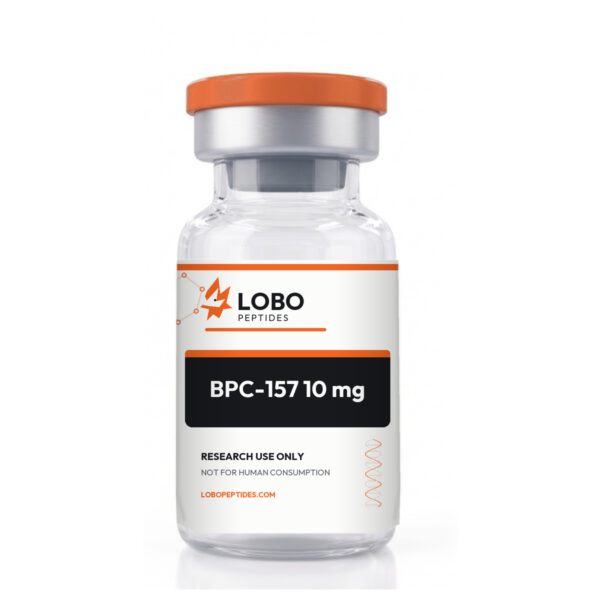
BPC-157
BPC-157 in 5mg, 10mg, and 40mg display strengths. For research use only (RUO); not for human or veterinary use.
BPC-157 5mg, 10mg, 40mg Product Description
BPC-157 is offered in three selectable display strengths: 5mg, 10mg, and 40mg. Primary publications describe the study peptide as a 15-amino-acid pentadecapeptide. That literature description does not by itself verify the sequence, salt or counterion, physical form, measured content, or identity of any catalog selection.
No physical unit or pack count has been supplied, so the strengths are retained as display options without assuming one vial or a multipack. Its specifications and testing cannot be extended to any Lobo selection, and the absent 40mg match remains explicit.
A compliant listing can describe BPC-157 as a research peptide investigated in cell, explant, and animal models while keeping every observation model-qualified. Neutral contexts include analytical identity confirmation and controlled in-vitro assay planning after documentation review. The page should not imply tissue repair, treatment, recovery, or human performance. Each strength requires its own lot records, because evidence or documentation for one selection does not automatically cover another. No certificate values are available in this draft, and no statement about purity, sterility, endotoxin, stability, or analytical performance is implied. The item is for research use only and is not for human or veterinary use. Qualified laboratories should base protocol decisions on their own requirements, the verified identity of the received material, and lot-specific records rather than on a retail family name. Catalog inclusion does not establish fitness for a particular method. Receiving records, chain of custody, reference standards, and acceptance criteria should be defined by the laboratory and documented independently for every lot and presentation.
Research Material Profile
BPC-157 5mg, 10mg, 40mg Research
Tendon explant and fibroblast models
PMID 21030672 describes BPC-157 as a 15-amino-acid peptide and reports experiments using rat Achilles-tendon explants and cultured tendon fibroblasts. Investigators measured cell outgrowth, migration, oxidative-stress survival, F-actin formation, and FAK/paxillin signaling under the study conditions. These are explant and cell-culture observations, not evidence of a clinical outcome and not proof that a commercial item has the same identity or activity. The paper does not evaluate 5mg, 10mg, or 40mg catalog selections as packaged products. It can support the literature identity and the specific laboratory endpoints studied. Product copy should avoid converting those endpoints into repair or recovery claims. Sequence confirmation, content assessment, and lot traceability remain necessary before linking this material to the defined peptide used by the investigators. Across interpretations, the publication supports only its reported material and measurements; it does not supply lot-level identity, composition, or quality evidence for this catalog presentation. (PubMed 21030672).
Endothelial-cell and rat model
PMID 25995620 reports work in cultured human endothelial cells and a rat alkali-burn model. The researchers measured proliferation, migration, tube formation, tissue histology, and selected signaling markers. Those findings are limited to the reported cell system, animal model, protocol, and study reagent. They do not establish efficacy, safety, or expected behavior in people, and they do not authenticate any strength offered here. The citation may inform selection of model-specific endpoints for qualified researchers, but it cannot replace analytical documentation. This catalog summary therefore reports the experimental context without turning it into a product promise. Across interpretations, the publication supports only its reported material and measurements; it does not supply lot-level identity, composition, or quality evidence for this catalog presentation. (PubMed 25995620).
VEGFR2-related model evidence
PMID 27847966 examines VEGFR2-related signaling using endothelial assays, a chick chorioallantoic-membrane model, and a rat hind-limb ischemia model. The combination of in-vitro and animal systems provides pathway-focused research context, but every result remains tied to those systems and the defined study material. The paper does not verify the sequence, chemical form, content, purity, or stability of the 5mg, 10mg, or 40mg catalog items. It also does not support human-use directions or generalized repair claims. When citing the study in a research product page, the appropriate conclusion is that BPC-157 has been examined through specified signaling and model endpoints. Whether a supplied lot corresponds analytically to that literature entity is a separate question answered only by product-specific documentation. Across interpretations, the publication supports only its reported material and measurements; it does not supply lot-level identity, composition, or quality evidence for this catalog presentation. (PubMed 27847966).
Evidence Boundaries
The cited publications describe defined study materials in particular biochemical, cell, animal, or controlled human research settings. They do not authenticate this catalog item, transfer analytical specifications to it, or establish that a nominally similar retail product is equivalent. Model observations must remain attached to the reported species, preparation, protocol, and endpoints. Where the title leaves sequence, chemical form, processing state, physical unit, formulation, or pack details unresolved, this draft leaves them unresolved as well. No purity percentage, sterility status, endotoxin result, stability period, or content assay is inferred. Any stronger conclusion requires lot-specific documentation and, where relevant, direct testing of the exact formulation.
BPC-157 5mg, 10mg, 40mg References
8 curated medical and scientific references used for identity, mechanism, model, and assay context.
- The promoting effect of pentadecapeptide BPC 157 on tendon healing involves tendon outgrowth, cell survival, and cell migration.
Chang CH, Tsai WC, Lin MS, Hsu YH, Pang JH The promoting effect of pentadecapeptide BPC 157 on tendon healing involves tendon outgrowth, cell survival, and cell migration. J Appl Physiol (1985). 2011;110(3):774-780. doi:10.1152/japplphysiol.00945.2010. PMID:21030672.
BPC 157 and tendon-cell/explant endpoints · Rat Achilles-tendon explants and cultured tendon fibroblasts.
View research source - Body protective compound-157 enhances alkali-burn wound healing in vivo and promotes proliferation, migration, and angiogenesis in vitro.
Huang T, Zhang K, Sun L, Xue X, Zhang C, Shu Z, Mu N, Gu J, Zhang W, Wang Y, Zhang Y, Zhang W Body protective compound-157 enhances alkali-burn wound healing in vivo and promotes proliferation, migration, and angiogenesis in vitro. Drug Des Devel Ther. 2015;9:2485-2499. doi:10.2147/dddt.s82030. PMID:25995620.
BPC 157 in endothelial assays and corneal injury model · Cultured HUVEC proliferation, migration, and tube-formation assays plus a rat alkali-burn model.
View research source - Therapeutic potential of pro-angiogenic BPC157 is associated with VEGFR2 activation and up-regulation.
Hsieh MJ, Liu HT, Wang CN, Huang HY, Lin Y, Ko YS, Wang JS, Chang VH, Pang JS Therapeutic potential of pro-angiogenic BPC157 is associated with VEGFR2 activation and up-regulation. J Mol Med (Berl). 2017;95(3):323-333. doi:10.1007/s00109-016-1488-y. PMID:27847966.
BPC 157 and VEGFR2-related signaling · Endothelial-cell assays, chick chorioallantoic membrane, and rat hind-limb ischemia model.
View research source - Pentadecapeptide BPC 157 enhances the growth hormone receptor expression in tendon fibroblasts.
Chang CH, Tsai WC, Hsu YH, Pang JH Pentadecapeptide BPC 157 enhances the growth hormone receptor expression in tendon fibroblasts. Molecules. 2014;19(11):19066-19077. doi:10.3390/molecules191119066. PMID:25415472.
BPC 157 and growth-hormone-receptor expression · Cultured rat tendon fibroblast assays.
View research source - Pentadecapeptide BPC 157 (PL 14736) improves ligament healing in the rat.
Cerovecki T, Bojanic I, Brcic L, Radic B, Vukoja I, Seiwerth S, Sikiric P Pentadecapeptide BPC 157 (PL 14736) improves ligament healing in the rat. J Orthop Res. 2010;28(9):1155-1161. doi:10.1002/jor.21107. PMID:20225319.
BPC 157 in ligament healing · Rat ligament-injury model with biomechanical and histological measurements.
View research source - Stable gastric pentadecapeptide BPC 157: novel therapy in gastrointestinal tract.
Sikiric P, Seiwerth S, Rucman R, Turkovic B, Rokotov DS, Brcic L, Sever M, Klicek R, Radic B, Drmic D, Ilic S, Kolenc D, Vrcic H, Sebecic B Stable gastric pentadecapeptide BPC 157: novel therapy in gastrointestinal tract. Curr Pharm Des. 2011;17(16):1612-1632. doi:10.2174/138161211796196954. PMID:21548867.
BPC 157 gastrointestinal research overview · Peer-reviewed review of preclinical gastrointestinal and related experimental literature.
View research source - Clopidogrel-Induced Gastric Injury in Rats is Attenuated by Stable Gastric Pentadecapeptide BPC 157.
Wu H, Wei M, Li N, Lu Q, Shrestha SM, Tan J, Zhang Z, Wu G, Shi R Clopidogrel-Induced Gastric Injury in Rats is Attenuated by Stable Gastric Pentadecapeptide BPC 157. Drug Des Devel Ther. 2020;14:5599-5610. doi:10.2147/dddt.s284163. PMID:33376304.
BPC 157 in a clopidogrel gastric-injury model · Rat gastric-injury experiments with histological and laboratory endpoints.
View research source - Stable gastric pentadecapeptide BPC 157 in the treatment of colitis and ischemia and reperfusion in rats: New insights.
Duzel A, Vlainic J, Antunovic M, Malekinusic D, Vrdoljak B, Samara M, Gojkovic S, Krezic I, Vidovic T, Bilic Z, Knezevic M, Sever M, Lojo N, Kokot A, Kolovrat M, Drmic D, Vukojevic J, Kralj T, Kasnik K, Siroglavic M, Seiwerth S, Sikiric P Stable gastric pentadecapeptide BPC 157 in the treatment of colitis and ischemia and reperfusion in rats: New insights. World J Gastroenterol. 2017;23(48):8465-8488. doi:10.3748/wjg.v23.i48.8465. PMID:29358856.
BPC 157 in colitis and ischemia-reperfusion models · Multiple rat gastrointestinal disease and ischemia-reperfusion experiments.
View research source